RAMP Programme
Relevance: GS2 - Government policies and interventions for development in various sectors and issues arising out of their design and implementation
(Source: PIB, 12/22/2023)
Click here for Daily Current Affairs
Why in the news?
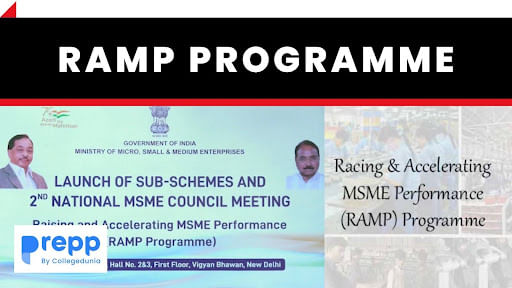
Recently, the Union Minister for MSME launched three sub-schemes under the aegis of the RAMP programme - the MSME Green Investment and Financing for Transformation Scheme (MSE GIFT Scheme), MSE Scheme for Promotion and Investment in Circular Economy (MSE SPICE Scheme), and MSE Scheme on Online Dispute Resolution for Delayed Payments.
Table of Contents
What is the RAMP programme?
- The Raising and Accelerating MSME Performance (RAMP) programme is a World Bank-assisted Central Sector Scheme that aims to support various COVID-19 Resilience and Recovery Interventions of the Ministry of Micro, Small and Medium Enterprises (MoMSME).
- Objectives:
- Improve access to market and credit
- Strengthen governance and institutions at central and state levels
- Improve center-state linkages
- Address delayed payments to MSMEs
- Promote greening of MSMEs
Key components
- Strategic Investment Plans: It will include an outreach plan for the identification and mobilization of MSMEs under RAMP.
- Key constraints and gaps will be identified.
- Set milestones and project budgets for investment in priority sectors - renewable energy, rural & non-farm business, wholesale and retail trade, village and cottage industries, women enterprises, etc.
- National level monitoring: An apex National MSME Council will conduct the overall monitoring and policy overview of RAMP.
- The council will be headed by the Minister for MSME with members representing various ministries.
- The Council will be supported in its functioning by a secretariat.
National MSME Council
|
What are the new sub-schemes launched under the RAMP programme?
MSME Green Investment and Financing for Transformation Scheme (MSME GIFT Scheme):
- Aim: It was launched to assist MSMEs in adopting green technology through interest subvention and credit guarantee support.
- Implementing agency: It will be implemented by SIDBI.
- Features:
- Encourage eco-friendly practices in MSMEs.
- Financially incentivize the adoption of green technology.
MSE Scheme for Promotion and Investment in Circular Economy (MSE SPICE Scheme):
- It is the first programme by the government to support circular economy projects through credit subsidies.
- Aim: It aims to ensure that the MSME sector attains the target of zero emissions by 2070.
- Implementing agency: SIDBI is the implementing agency.
- Features:
- Promote sustainable and eco-friendly business models.
- Support long-term environmental goals.
MSE Scheme on Online Dispute Resolution for Delayed Payments:
- Aim: It aims to synergize legal support with modern IT tools and AI to tackle the issue of delayed payments faced by most MSMEs.
- Implementing agency: The National Informatics Centre Services Inc. (NICSI) is the implementing agency.
- Features:
- Ensure the use of innovative technology for dispute resolution
- Streamline payment processes and reduce conflicts in MSMEs.
SIDBI
To know more, click the link. National Informatics Centre Services Inc. (NICSI)
|

Other initiatives under existing schemes
The Union Minister for MSME launched two new initiatives to support MSMEs.
- Support for Commercialisation of IP Programme (MSME – SCIP Programme): Enable commercialization of Intellectual Property Rights (IPR) by innovators in the MSME sector.
- Zero Effect and Zero Defect Scheme (ZED Scheme): The government guarantees 100% financial support for the certification cost.
- The ZED Scheme of the Ministry has been made completely free for women-led MSMEs.
MSME sector in India
- The MSME sector is considered to be the backbone of the country's economy.
- Classification of MSMEs: MSMEs are classified based on Investment in Plant & Machinery and Annual Turnover
- Micro: Investment in equipment of not more than ₹1 crore and annual turnover of not more than ₹5 crores
- Small: Investment in equipment of not more than ₹10 crore and annual Turnover of not more than ₹50 crore
- Medium: Investment in equipment of not more than ₹50 crore and annual turnover of not more than ₹250 crore
- It accounts for 30% of India's GDP, 40% of exports, and one-third of India's manufacturing output.
- According to the 2021-22 Annual Report of the Department of MSMEs, there are 633.88 lakh unincorporated non-agriculture MSMEs in the country engaged in different economic activities.
- These MSMEs employ more than 11 crore people.
- The Union government has set a target of increasing the sector's GDP contribution to 50% by 2025 in line with India’s goal of becoming a $5 trillion economy.
Challenges faced by the MSME Sector
- Financial Constraint: Only 16% of SMEs have been able to obtain timely finance, thus small and medium firms have had to rely on their resources.
- This has made it difficult for such smaller firms to grow which in turn, negatively impacts the economy.
- Innovation: The Indian MSME sector has been affected by a lack of innovation and entrepreneurial spirit.
- As a result of the continued use of outdated technology, Indian MSMEs have lower productivity in comparison to larger firms.
- This makes it difficult for such firms to compete with larger firms.
- Lack of awareness: The MSME sector struggles to access government assistance such as emergency lines of credit, equity participation, etc due to limited awareness and communication gaps.
- Informal nature of the sector: An estimated 86% of the MSMEs in the manufacturing sector are unregistered.
- A similar situation has been observed in other sectors involving MSMEs.
- The lack of formal registration increases the credit gap and impacts their ability to access credit.
- Economic: Economic uncertainties like fluctuations in raw material prices and market demand are other factors that impact the stability of MSMEs.
- Women-specific issues: Although the number of women-led MSMEs in India has increased from 2.15 lakh to 1.23 crore, they face a financial gap of $158 billion.
- About 90% of women-owned SMEs in India are still reliant on informal credit.
- Social attitudes and socio-economic constraints are other problems faced by women-led MSMEs.
Way forward
- Authorities must take necessary steps to encourage cash flow-based lending by financial institutions, ease credit and repayment options, and help resolve disputes over payments.
- Cluster development can help overcome infrastructure bottlenecks by helping MSMEs collaborate and share resources.
- MSMEs must be assisted in entering into B2B and B2C e-commerce marketplaces and encouraged to adopt modern technology to improve their productivity.
- Fostering women’s education and supporting funding institutions in providing loans to women entrepreneurs will help tackle issues faced by a large number of MSMEs while also encouraging women to become entrepreneurs.
Conclusion
The RAMP programme and its new sub-schemes are a reflection of the Indian government's commitment to fortifying the MSME sector and realizing its potential. The growth of the sector will however require steps to promote financial inclusion, innovation, and empowerment of entrepreneurs.
To know more click the link.
(*Click this link to read prelims specific weekly current affairs articles)
FAQs
Question: What are MSMEs?
Answer:
MSMEs are businesses that fall within a certain range of criteria related to their size, investment, and annual turnover. These three categories are Micro Enterprises, Small Enterprises, and Medium Enterprises.
Question: What are intellectual property rights?
Answer:
Intellectual property rights are the rights given to persons over the creations of their minds. They generally give the creator an exclusive right over the use of the creation for a certain period.
UPSC Mains Practice Question:
|
MCQs
Question: Consider the following statements with reference to India:
- According to the ‘Micro, Small and Medium Enterprises Development (MSMED) Act, 2006, the ‘medium enterprises’ are those with investments in plant and machinery between `15 crore and `25 crore.
- All bank loans to the Micro, Small and Medium Enterprises qualify under the priority sector.
Which of the statements given above is/are correct? (UPSC 2023)
(a) 1 only
(b) 2 only
(c) Both 1 and 2
(d) Neither 1 nor 2
Answer: (d) See the Explanation
- On May 13, 2020, 14 years after the MSME Development Act was enacted, a modification in the MSME definition was announced in the Atmanirbhar Bharat package.
- According to this notification, the definition of micro manufacturing and services units has been expanded to Rs. 1 crore in investment and Rs. 5 crore in turnover.
- The small unit limit has been raised to Rs. 10 crore of investment and Rs. 50 crore of turnover.
- Similarly, the medium unit ceiling was raised to Rs. 20 crore in investment and Rs. 100 crore in turnover.
- On June 1, 2020, the Government of India agreed to revise the MSME Definition further upward. It is now Rs. 50 crore for medium enterprises and Rs. 250 crore for large enterprises. Hence, statement 1 is incorrect.
- All bank loans to Micro, Small, and Medium Enterprises are not eligible for priority sector status. Bank loans to Micro, Small, and Medium Enterprises in both the manufacturing and service sectors are eligible for priority sector classification under the following rules:
- Manufacturing Enterprises - Micro, Small, and Medium Enterprises engaged in the manufacture or production of items for any industry included in the first schedule to the Industries (Development and Regulation) Act of 1951, as amended from time to time by the Government. Manufacturing businesses are distinguished by their investment in equipment and machinery.
- Service Enterprises - Under the MSMED Act of 2006, banks can lend up to Rs 5 crore per unit to Micro and Small Enterprises and Rs 10 crore to Medium Enterprises engaged in providing or performing services and defined in terms of investment in equipment. Hence, statement 2 is incorrect.
Therefore, option (d) is the correct answer.
Question: Priority Sector Lending by banks in India constitutes the lending to (UPSC 2013)
(a) agriculture
(b) micro and small enterprises
(c) weaker sections
(d) All of the above
Answer: (d) See the Explanation
Priority sector lending constitutes lending to agriculture, micro and small enterprises, micro-credit, education, housing, and weaker sections.
Therefore, option (d) is the correct answer.
Download the PREPP App and attempt FREE IAS Exam Mock Tests and get complete study material!

Full Test - 04: UPSC CSE Prelims CSAT (Paper-II)
Full Test - 03: UPSC CSE Prelims CSAT (Paper-II)
UPSC CSE Prelims 2026 GS Paper 1 Question Paper (24-May-2026)
UPSC CSE Prelims 2026 CSAT Paper 2 Question Paper (24-May-2026)

17 February 2025 | The Hindu Must Read Articles | Current Affairs

16 February 2026 | The Hindu Must Read Articles | Current Affairs

13 February 2026 | The Hindu Must Read Articles | Current Affairs









Comments