Quantum Computing – Science & Technology Notes
Quantum computing is a new technology that uses the laws of quantum mechanics to solve problems that are too complex for traditional computers. Qubits are used by quantum computers to run and solve multidimensional quantum algorithms. In this article, we will discuss regarding Quantum Computing which will be helpful for UPSC exam preparation.
Table of Contents
- Quantum Computing – Background
- Quantum Computing
- Need for Quantum Computers
- Quantum Supremacy
- Principles of Quantum Computing
- Quantum Computing vs Classical Computing
- Applications of Quantum Computing
- Benefits of Quantum Computing
- Limitations of Quantum Computing
- Quantum Computing in India
- Quantum Computer Simulator (QSim) Toolkit
- Conclusion
- FAQs
- MCQs
Quantum Computing – Background
- In the 1980s, the field of quantum computing emerged. Certain computational problems were discovered to be more efficiently solved by quantum algorithms than by their classical counterparts.
- Quantum computing has the ability to sift through vast amounts of data to find potential solutions to complex problems and challenges.
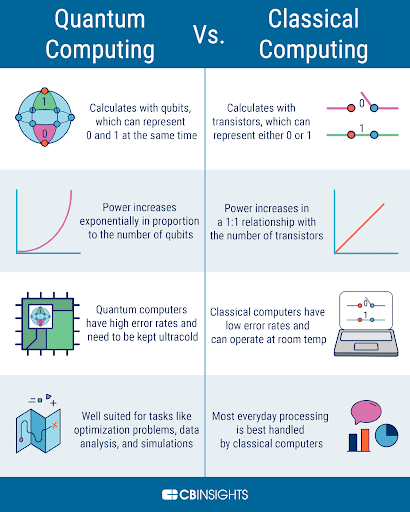
- Whereas traditional computers use bits with either 0s or 1s to store information, quantum computers use qubits.
- Qubits carry information in a quantum state that interacts with 0 and 1 in multiple dimensions.
- Some of the most prominent companies have expressed interest in the massive computing potential and projected market size for its use.
| Other Relevant Links | |
|---|---|
| Digital India | Project brainwave |
| Sagar Vani System | Locky Ransomware, Petya, WannaCry |
| Hindi word for computer i.e., “SANGANAK” | India’s first technology and innovation support centre (TISC) |
| Net neutrality | National cyber coordination centre |
| Hortnet | Digital Transaction Methodologies |
| Bitcoins | Cyber Swachhta Kendra |
| Bharat Net Project | Wi-Fi Technology |
| Digital Terrestrial Television Transmission System | Internet of Things |
What is Quantum Computing?
- Quantum computing is a multidisciplinary field that combines aspects of computer science, physics, and mathematics to solve complex problems faster than traditional computers.
- Quantum computing encompasses both hardware research and application development.
- By utilising quantum mechanical effects such as superposition and quantum interference, quantum computers can solve certain types of problems faster than classical computers.
- Machine learning (ML), optimisation, and simulation of physical systems are some applications where quantum computers can provide such a speed boost.
What is a Qubit?
|
Need for Quantum Computers
- Supercomputers aren't all that great for some problems.
- Supercomputers are used by scientists and engineers to solve difficult problems.
- These are massive traditional computers, often with thousands of traditional CPU and GPU cores.
- However, even supercomputers have difficulty solving certain types of problems.
- If a supercomputer is stumped, it is most likely because the large classical machine was asked to solve a problem of high complexity. When traditional computers fail, it is frequently due to complexity.
- Complex problems have many variables that interact in complicated ways.
- Because of all the different electrons interacting with one another, modelling the behaviour of individual atoms in a molecule is a difficult problem.
What is Quantum Supremacy?
- Quantum supremacy, also known as quantum advantage, refers to quantum computers' ability to solve problems that classical computers cannot.
- It is the point at which the superior potential of quantum computing is realised in practise, effectively superseding existing forms of computing.
- Google recently announced that they had achieved 'quantum supremacy,' which means that a computer harnessing the properties of subatomic particles solved a problem far better than the world's most powerful supercomputer.
- According to reports, Google's Sycamore supercomputer solved a problem in 200 seconds that would have taken today's fastest supercomputer 10,000 years to solve.
Principles of Quantum Computing
Superposition
- Superposition states that, similar to waves in classical physics, you can combine two or more quantum states to produce another valid quantum state.
- Every quantum state can also be represented as a sum of two or more other distinct states.
- This qubit superposition gives quantum computers their inherent parallelism, allowing them to process millions of operations at the same time.
Entanglement
- Quantum entanglement occurs when two systems are so closely linked that knowledge of one provides immediate knowledge of the other, regardless of how far apart they are.
- Quantum processors can infer information about one particle by measuring another. They can, for example, determine that if one qubit spins up, the other will always spin down, and vice versa.
- Because of quantum entanglement, quantum computers can solve complex problems more quickly.
- When you measure a quantum state, the wavefunction collapses and you get either a zero or a one.
- The qubit functions as a classical bit in this known or deterministic state.
- Entanglement refers to qubits' ability to correlate their states with those of other qubits.
Decoherence
- Decoherence is the loss of a qubit's quantum state.
- Environmental factors, such as radiation, can cause the qubits' quantum states to collapse.
- Designing the various features that attempt to delay state decoherence, such as building speciality structures that shield the qubits from external fields, is a significant engineering challenge in the construction of a quantum computer.
Quantum Computing vs Classical Computing
Applications of Quantum Computing
Aerospace Industry
- Quantum computing has enormous potential for addressing computational challenges in aircraft modelling, simulation, and other areas.
- It could also assist in determining the optimal amount of fuel and speed to operate a commercial aircraft, potentially assisting the industry in improving its sustainability performance.
Artificial Intelligence & Big Data
- Quantum computers could improve machine learning by allowing AI programmes to search through massive datasets pertaining to medical research, consumer behaviour, financial markets, and so on.
- Quantum computing aids in the integration of data as well as the rapid analysis and understanding of patterns.
Space
- Quantum computing's scalability will aid in the detection of gravitational waves.
- Can be used to search for habitable planets in the universe.
- Can aid in the modelling and design of spacecraft and space suits.
Medicine
- Discover tumours early and develop better targeting drugs, leading to greater pharmacological advances.
- It has the potential to provide faster and more accurate diagnostics.
- Allow therapists to run more simulations in less time, aiding in the reduction of radiation damage to healthy tissue.
- Clinicians could quickly identify changes and anomalies by reviewing CT scans over time.
- Precision medicine can be accelerated.
- Medical practitioners can quickly identify targeted chemotherapy protocols and customise them thanks to quantum computing's enhanced data processing capabilities.
Computational Chemistry
- There are numerous challenges in identifying the best catalyst or process for developing a new or more efficient existing material.
- The quantum mechanical processes that occur can be simulated using a quantum computer. Potential applications include:
- developing new materials capable of achieving a room temperature superconductor;
- developing a catalyst capable of improving the efficiency of carbon sequestration; and
- developing a new battery chemistry capable of significantly outperforming today's lithium-ion batteries.
Agriculture
- Assist in the detection of weeds using an invasive weed optimisation algorithm.
- Farmers can thus create effective fertilisers.
- Can aid in determining the appropriate amount of inputs.
- It can be used to create precise long-term large-scale production plans, which aids in increasing yield and efficiency.
Cybersecurity
- Quantum computing, in conjunction with machine learning, can aid in the development of various techniques for combating cybersecurity threats.
- Furthermore, quantum computing can aid in the development of encryption methods, also known as quantum cryptography.
Weather Forecasting & Climate Change
- The ability of quantum computers to crunch vast amounts of data in a short period of time could lead to improved weather system modelling, allowing scientists to predict changing weather patterns in real time and with high accuracy — something that is critical in this time of climate change.
- Meteorologists will be able to generate and analyse more detailed climate models with quantum computers, providing greater insight into climate change and ways to mitigate it.
Financial Services
- Quantum computers can be used in the financial industry for complex financial modelling and risk management by discovering new ways to model financial data and isolating key global risk factors.
- It can also be used for algorithmic trading, which involves using complex algorithms to automatically trigger share trades based on a wide range of market variables.
- Can be used to detect problems in stock markets.
Logistics Optimization
Improved data analysis and robust modelling will allow a variety of industries to optimise their logistics and scheduling workflows related to supply-chain management.
Gaming
- Quantum computing has the potential to take game development to a whole new level.
- In the future, it can be used in interesting ways in game development, such as procedural generation, random content generation, and so on.
Benefits of Quantum Computing
- Speed - When compared to traditional computers, quantum computers are extremely fast.
- Capability to solve complex problems - Quantum computers are built to perform multiple complex calculations at the same time. This is especially useful for factorizations, which could aid in the development of decryption technologies.
- Complex simulations can be run on quantum computers. They are fast enough to simulate more complex systems than traditional computers.
- Optimization - The ability of quantum computing to process massive amounts of complex data has the potential to transform artificial intelligence and machine learning.
Limitations of Quantum Computing
Interference
- A quantum computation can collapse due to the slightest disturbance in a quantum system, a process known as decoherence.
- During the computation phase, a quantum computer must be completely isolated from all external interference.
Error Correction
Qubits are not digital data bits and cannot use traditional error correction. In quantum computing, where even a single error in a calculation can cause the validity of the entire computation to collapse, error correction is critical.
Output Observance
- When you retrieve output data after a quantum calculation is finished, you risk corrupting the data.
- Database search algorithms that rely on the unique wave shape of the probability curve in quantum computers can avoid this problem.
- This ensures that after all calculations have been completed, the act of measurement results in the quantum state decohering the correct answer.
Expensive Refrigeration
- Because heat causes error or noise in qubits, most quantum computers cannot function unless they are super-cooled to a few degrees above absolute zero.
- Today's quantum computers are highly unstable and must be stored in expensive refrigerators cooled to near-zero temperatures.
- The expansion of quantum computing will have a negative impact on the environment.
Others
- Finding qualified candidates with doctorates in quantum physics, engineering, and statistics is another significant challenge.
- The majority of the components/hardware used in quantum computing cannot be manufactured in India. It is yet another strategic sector in which India is reliant on imports.
Quantum Computing in India
National Mission on Quantum Technologies and Applications (NM-QTA)
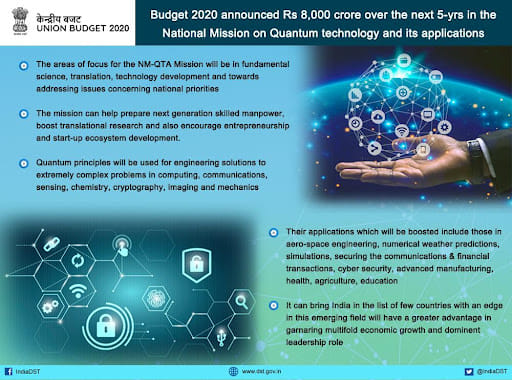
- The government allocated INR 8000 Crore in its 2021 budget for the National Mission on Quantum Technologies and Applications, which aims to accelerate developments in quantum computing, cryptography, communications, and material science.
- It is a government of India programme aimed at creating over 25,000 jobs in India over the next 5-7 years.
- This mission will support next-generation transformative technologies such as quantum computers and computing, quantum communication, quantum key distribution, encryption, quantum devices, quantum sensing, and so on.
- The Mission's areas of focus will be fundamental science, translation, technology development, human and infrastructural resource generation, innovation, and start-ups to address national priorities.
National Mission on Quantum Technologies and Applications
Quantum Computing Laboratory
The Indian Army will establish a quantum computing laboratory and an AI centre at a military engineering institute in Mhow, Madhya Pradesh.
Quantum Communication Lab
The Centre for Development of Telematics (C-DOT) will open a quantum communication lab. It can accommodate more than 100 kilometres of standard optical fibre.
QuEST
The Department of Science and Technology launched the Quantum-Enabled Science and Technology (QuEST) initiative, in which INR 80 crores will be invested to build infrastructure and facilitate research.
Collaborations
The Defence Institute of Advanced Technology (DIAT) and the Centre for Development of Advanced Computing (C-DAC) have agreed to work together on the development of quantum computers.
I-HUB Quantum Technology Foundation
The Department of Science and Technology, along with about 13 research groups from IISER Pune, established the I-HUB Quantum Technology Foundation (I-HUB QTF) to advance quantum technology development.
Quantum Computer Simulator (QSim) Toolkit
It offers India's academics, industry professionals, students, and scientific community the country's first quantum development environment.
Startups
A number of start-ups have emerged, including Qunu Labs in Bangalore and BosonQ in Bhilai, and as a result, they are making inroads in this area.
Conclusion
Quantum computing is a new technology that uses the laws of quantum mechanics to solve problems that are too complex for traditional computers. It is an exciting new technology that will shape our world in the future by giving us an advantage and a plethora of possibilities. When compared to today's traditional computing systems, it is a fundamentally different way of processing information.
| Other Relevant Links | |
|---|---|
| Science & Technology Policy in India | Scientific Policy Resolution 1958 |
| Science & Technology Policy of 1983 | Science & Technology Policy of 2003 |
| Science, Technology and Innovation Policy 2013 | New Initiatives Aligned with the National Agenda |
| India and World collaboration in science projects | Technology Vision Document 2035 |
FAQs
Question: What is Quantum Computing?
Answer: Quantum computing is a type of computing that uses quantum-mechanical phenomena, such as superposition and entanglement, to perform operations on data. Unlike classical computers, which use bits to represent data as either 0 or 1, quantum computers use quantum bits (qubits) that can represent and store information in both 0 and 1 simultaneously. This ability allows quantum computers to process and solve complex problems much faster than classical computers.
Question: How does quantum computing differ from classical computing?
Answer: Quantum computing differs from classical computing in how data is processed. Classical computers use bits as the basic unit of data, which can either be 0 or 1. Quantum computers, however, use qubits that can exist in multiple states at once due to the principles of superposition and entanglement. This enables quantum computers to perform many calculations simultaneously, making them potentially much faster for certain types of computations, such as factoring large numbers or simulating quantum systems.
Question: What are the key principles of quantum computing?
Answer: The key principles of quantum computing include:
- Superposition: A qubit can represent both 0 and 1 simultaneously, allowing quantum computers to process a vast number of possibilities at once.
- Entanglement: Two or more qubits can be entangled, meaning their states are interdependent, even when separated by large distances. This property is crucial for parallel processing in quantum systems.
- Quantum interference: Quantum states can interfere with each other, which can amplify the correct answers and cancel out wrong ones in a quantum algorithm.
Question: What are the potential applications of quantum computing?
Answer: Quantum computing has a wide range of potential applications, including:
- Cryptography: Quantum computers can break traditional encryption methods but also enable the development of quantum-safe cryptography.
- Drug discovery: Quantum computing can simulate molecular interactions at an atomic level, helping to discover new drugs.
- Optimization problems: Quantum algorithms can be used to solve complex optimization problems in logistics, finance, and machine learning.
- Artificial intelligence: Quantum computing could revolutionize AI by processing vast amounts of data and learning patterns more efficiently.
Question: What are the challenges in developing quantum computers?
Answer: The development of quantum computers faces several challenges, including:
- Decoherence: Quantum states are very fragile and can easily be disturbed by the surrounding environment, causing errors in computations.
- Scalability: Building large-scale quantum computers with many qubits that can be reliably controlled and entangled is a major hurdle.
- Error correction: Quantum computers require advanced error correction techniques to handle the inherent errors in quantum calculations.
MCQs
1. What does a qubit represent in quantum computing?
A) A bit of data that can only be 0
B) A bit of data that can only be 1
C) A bit of data that can be both 0 and 1 simultaneously
D) A bit of data used to store images
Answer: (C) See the Explanation
Explanation: A qubit can represent both 0 and 1 simultaneously, thanks to the principle of superposition in quantum mechanics. This is a fundamental property that distinguishes quantum computing from classical computing.
2. What is the principle of entanglement in quantum computing?
A) Qubits are independent of each other
B) Qubits can be linked so that their states are interdependent
C) Qubits cannot exist in superposition
D) Qubits are not used in quantum algorithms
Answer: (B) See the Explanation
Explanation: Entanglement refers to a phenomenon where qubits become linked, meaning their states are interdependent, even if they are physically separated. This allows quantum computers to perform computations in parallel, greatly enhancing computational power.
3. Which of the following is a potential application of quantum computing?
A) Quantum-safe encryption
B) Quantum music production
C) Classical optimization problems
D) Classical artificial intelligence
Answer: (A) See the Explanation
Explanation: Quantum computing has significant applications in cryptography, particularly in the development of quantum-safe encryption methods, which can withstand attacks from future quantum computers.
4. Which principle of quantum mechanics allows quantum computers to perform many calculations simultaneously?
A) Superposition
B) Classical mechanics
C) Special relativity
D) General relativity
Answer: (A) See the Explanation
Explanation: Superposition allows quantum computers to exist in multiple states at once, enabling them to perform many calculations simultaneously, which significantly enhances their processing power for certain tasks.
5. What is the primary challenge in scaling up quantum computers?
A) Quantum interference
B) Decoherence and error correction
C) The speed of light
D) The cost of hardware
Answer: (B) See the Explanation
Explanation: Decoherence and error correction are the primary challenges in scaling up quantum computers. Quantum states are very fragile and can easily be disturbed, leading to errors in computations. Ensuring error-free calculations and maintaining coherence across multiple qubits is a significant hurdle in the development of large-scale quantum computers.
GS Mains Questions and Model Answers
Q1: Explain the potential impact of quantum computing on the field of cryptography.
Answer: Quantum computing has the potential to revolutionize cryptography by both breaking current encryption methods and enabling new forms of secure communication. Quantum computers could easily break widely used encryption algorithms, such as RSA, which depend on the difficulty of factoring large numbers. However, quantum computing also provides an opportunity to develop new encryption techniques, such as quantum key distribution (QKD) and quantum-safe encryption algorithms, which are secure against attacks from both classical and quantum computers. These advances in cryptography could lead to more secure communications in the future.
Q2: Discuss the challenges faced in the development of large-scale quantum computers and their potential solutions.
Answer: The development of large-scale quantum computers faces several key challenges:
- Decoherence: Quantum states are very fragile and can be easily disturbed by their environment, leading to loss of information. Developing systems that can maintain coherence for longer periods is essential.
- Error correction: Quantum computers are prone to errors due to the fragile nature of qubits. Error correction methods, such as quantum error correction codes, are crucial to improving the reliability of quantum computers.
- Scalability: Scaling up quantum computers to a large number of qubits while maintaining control and coherence is a major technical hurdle. Innovations in hardware design and qubit control are needed to address this challenge.
Q3: How can quantum computing contribute to the advancement of artificial intelligence?
Answer: Quantum computing can significantly enhance artificial intelligence (AI) by enabling faster processing and more efficient learning algorithms. Quantum computers can process vast amounts of data and perform complex calculations more quickly than classical computers. Quantum machine learning, for example, has the potential to revolutionize AI by improving the speed and accuracy of training models, leading to breakthroughs in fields like pattern recognition, natural language processing, and optimization. Quantum computing could enable AI systems to tackle more complex problems that are currently intractable for classical computers.
Previous Year Questions on Quantum Computing
1. UPSC CSE Prelims 2020:
Question: What is the main advantage of quantum computing over classical computing?
A) Quantum computers are faster for all tasks
B) Quantum computers can solve specific types of complex problems more efficiently
C) Quantum computers use classical bits
D) Quantum computers require less energy
Answer: (B)
Explanation: Quantum computers can solve specific complex problems more efficiently than classical computers, particularly in tasks like optimization, cryptography, and simulating quantum systems.
2. UPSC CSE Mains 2021 (GS Paper 3):
Question: Discuss the potential impact of quantum computing on global technological advancement and its implications for cybersecurity.
Answer: Quantum computing will have a significant impact on global technological advancement, particularly in fields like cryptography, drug discovery, and material science. However, its ability to break current encryption methods poses a threat to cybersecurity, prompting the development of quantum-safe encryption methods. The rapid development of quantum technologies could lead to both positive advancements in various sectors and challenges in securing sensitive data against quantum attacks.
Download the PREPP App and attempt FREE IAS Exam Mock Tests and get complete study material!

Full Test - 04: UPSC CSE Prelims CSAT (Paper-II)
Full Test - 03: UPSC CSE Prelims CSAT (Paper-II)
UPSC CSE Prelims 2026 GS Paper 1 Question Paper (24-May-2026)
UPSC CSE Prelims 2026 CSAT Paper 2 Question Paper (24-May-2026)

17 February 2025 | The Hindu Must Read Articles | Current Affairs

16 February 2026 | The Hindu Must Read Articles | Current Affairs

13 February 2026 | The Hindu Must Read Articles | Current Affairs









Comments