Products From Uttarakhand Bag GI Tags
Relevance: Prelims - Current Events of National Importance
(Source: The Hindu. 11/10/2023)
Click here for Daily Current Affairs
Why in the news?
- Recently, more than 15 products from Uttarakhand were given the Geographical Indicator (GI) tag.
- The list included local crops, traditional fibers, and arts and crafts of the state.
Table of Contents
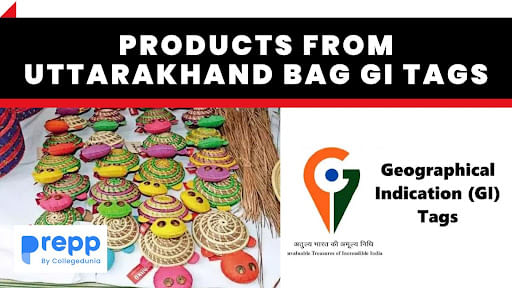
What products from Uttarakhand have been given GI tags recently?
- Berinag tea: It is a sought-after blend of tea made from the leaves of a plant that grows in the wild in the Himalayas.
- The leaves are compressed into a solid mass and sold.
- Bichuu buti fabrics: They are made from Himalayan nettle fibers which are hollow.
- This allows them to create a natural insulation by accumulating air inside.
- Therefore, it is an ideal clothing material for both winter and summer.
- Uttarakhand mandua: It is a finger millet that is grown in the Garhwal and Kumaon regions.
- It is a part of the staple diet for many areas in Uttarakhand.
- Jhangora: It is a homegrown millet commonly cultivated in the rain-fed areas of the Himalayas in Uttarakhand.
- Gahat: An important pulse that grows in the dry regions of the State.
- It has been used by practitioners of Ayurveda and traditional medicine due to its medicinal properties.
- Uttarakhand lal chawal: It is a type of red rice that is cultivated organically in the Purola region.
- Uttarakhand kala bhat: It is a black soybean that is grown at an altitude of 1000-1700m AMSL.
- It is organic, distinctively aromatic, and a source of dietary fiber, protein & iron.
- Malta fruit: Also known as the Himalayan Sweet Orange, it is grown in the Himalayan valleys.
- It has numerous health benefits and a high nutritional value.
- Chaulai (Ramdana): It is a grain consumed when fasting due to its nutritional value.
- It is also known as Rajgira and Amaranth.
- Buransh juice: It is obtained from the red flowers of the Buransh tree (Rhododendron arboreum).
- It is consumed as squash or juice.
- Pahari toor dal: It is a variety of toor dal (pigeon pea) that is grown in the high-altitude valleys of Uttarakhand and Himachal Pradesh.
- Likhai: It is an ancient wood carving tradition of the Kumaon region of Uttarakhand.
- It is mainly found in the form of religious, folk, and tantric motifs on doors and windows.
- Nainital mombatti: These are handmade decorative wax candles from Nainital in Uttarakhand.
- They were extremely popular across India, making Nainital the candle capital of India.
- Rangwali pichhoda: It is a traditional outfit worn by. women during religious and cultural. Ceremonies in Kumaon.
- It is made of a yellow fabric with large red circular motifs printed on it and a 'Swastik' in the center.
- Ramnagar Nainital litchis and Ramgarh Nainital peaches: They are distinctly flavored fruits grown in the Nainital district in Uttarakhand.
- Chamoli wooden Ramman masks: Mask making or Mukhota is a traditional craft of carving masks out of wood.
- These masks portray characters from mythological tales and are used in ritual theatre performances, especially during Ramman religious festivals and in other religious ceremonies performed by villagers.
- Almora Lakhori mirchis: It is an indigenous chili variant that was first grown in a village called Lakhora in Uttarakhand.
- It has a distinctive wrinkle and yellow color and is considered to be quite hot.

Key facts related to GI tags
- A geographical indication or GI is a sign used on products that have a specific geographical origin and possess qualities or a reputation that are due to that origin.
- It is a form of Intellectual Property Rights (IPR).
- It must possess a good reputation and distinct qualities of the place of origin and are generally registered on products produced by rural, marginal, and indigenous communities over generations.
- Only registered users have the right to use the product name of a GI-tagged product.
- However, it does not entitle the holder to prevent someone from making a product using the same techniques used in the standards for that indication.
- GI tags are issued by the Geographical Indication Registry under the Department of Industry Promotion and Internal Trade, Ministry of Commerce and Industry.
- The registration of a GI tag is valid only for a period of 10 years although it can be renewed from time to time for a further period of 10 years each.
- Type of Products: GI tags are used on the following types of products.
- Handicrafts
- Food items
- Wine & Drinks
- Industrial Products
- Agricultural Products
- Laws and treaties related to GI tags:
| WIPO | WTO | Indian laws |
|---|---|---|
|
|
|
(*Click this link to read prelims specific weekly current affairs articles)
FAQs
Question: What are Intellectual Property Rights?
Answer:
Intellectual property Rights or IPR are the rights given to persons over the creations of their minds.
Question: What is the Ramman festival?
Answer:
Ramman is a religious festival held in the Garhwal region of Uttarakhand in honor of the tutelary god, Bhumiyal Devta in late April. It consists of a series of intricate ceremonies, including the reciting of a rendition of Rama's epic and different stories, as well as the performance of songs and masked dances.
UPSC Mains Practice Question:
|
MCQs
Question: India enacted The Geographical Indications of Goods (Registration and Protection) Act, 1999 in order to comply with the obligations to (UPSC 2018)
(a) ILO
(b) IMF
(c) UNCTAD
(d) WTO
Answer: (d) See the Explanation
- The TRIPS Agreement is a part of the WTO agreements and as a member of the WTO, India is obligated to provide protection to geographical indications in accordance with the TRIPS Agreement.
- India enacted the Geographical Indications of Goods (Registration and Protection) Act, 1999 in order to comply with its obligations under the WTO.
Therefore, option (d) is the correct answer.
Question: Which of the following has/have been accorded 'Geographical Indication' status? (UPSC 2015)
- Banaras Brocades and Sarees
- Rajasthani Daal-Bati-Churma
- Tirupathi Laddu
Select the correct answer using the code given below.
(a) 1 only
(b) 2 and 3 only
(c) 1 only 3 only
(d) 1, 2 and 3
Answer: (c) See the Explanation
- Banaras Brocades and Sarees and Tirupathi Laddu have been accorded 'Geographical Indication' status. Hence statements 1 and 3 are correct.
- Rajasthani Daal-Bati-Churma has not been accorded a GI tag as yet. Hence statement 2 is incorrect.
Therefore, option (c) is the correct answer.
Question: The FAO accords the status of ‘Globally Important Agricultural Heritage System (GIAHS)’ to traditional agricultural systems. What is the overall goal of this initiative? (UPSC 2016)
- To provide modern technology, training in modern farming methods, and financial support to local communities of identified GIAHS so as to greatly enhance their agricultural productivity
- To identify and safeguard eco-friendly traditional farm practices and their associated landscapers, agricultural biodiversity, and knowledge systems of the local communities.
- To provide Geographical Indication status to all the varieties of agricultural produce in such identified GIAHS
Select the correct answer using the code given below.
(a) 1 and 3 only
(b) 2 only
(c) 2 and 3 only
(d) 1, 2 and 3
Answer: (b) See the Explanation
- GIAHS aims to protect traditional agricultural systems. It will not provide any modern technology and training. Hence statement 1 is incorrect.
- GIAHS aims to identify and safeguard eco-friendly traditional farm practices and their associated landscapes, agricultural biodiversity, and knowledge systems of the local communities. Hence statement 2 is correct.
- There is no provision regarding providing GI tags to all the varieties of agricultural produce in such identified GIAHS. Hence statement 3 is incorrect.
Therefore, option (b) is the correct answer.
Download the PREPP App and attempt FREE IAS Exam Mock Tests and get complete study material!

Full Test - 04: UPSC CSE Prelims CSAT (Paper-II)
Full Test - 03: UPSC CSE Prelims CSAT (Paper-II)
UPSC CSE Prelims 2026 GS Paper 1 Question Paper (24-May-2026)
UPSC CSE Prelims 2026 CSAT Paper 2 Question Paper (24-May-2026)

17 February 2025 | The Hindu Must Read Articles | Current Affairs

16 February 2026 | The Hindu Must Read Articles | Current Affairs

13 February 2026 | The Hindu Must Read Articles | Current Affairs









Comments