Periyar Diversion Scheme - Geography Notes
The Periyar River is the longest and has the greatest discharge potential in the Indian state of Kerala. Mullaperiyar Dam is one of the region's few perennial rivers, providing drinking water to several major towns. John Pennycuick built it between 1887 and 1895 and also reached an agreement to divert water eastward to the Madras Presidency area (present-day Tamil Nadu). This article will explain to you the Periyar Diversion Scheme which will be helpful in Geography preparation for the UPSC Civil service exam.
|
Table of Contents |
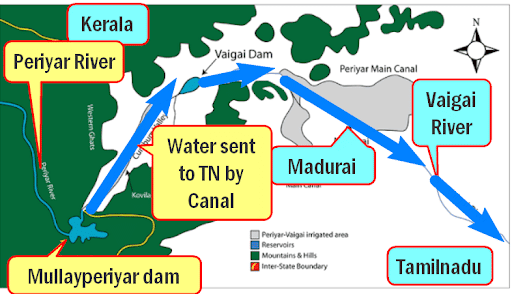
Periyar Diversion
Mullaperiyar Dam - Periyar Diversion Scheme
- The Mullaperiyar Dam is located in Kerala on the River Periyar and its tributary, the Mullayar, hence the name Mulla-Periyar.
- It is located 881 meters (2,890 feet) above sea level on the Cardamom Hills of the Western Ghats in Thekkady, Kerala's Idukki district.
- John Pennycuick built it between 1887 and 1895 when the British government decided to divert the water eastward to serve the farmers in the Madras presidency (present-day Tamil Nadu).
- Pennycuick intended for the river interlinking to bring barren and rain-deprived areas back into cultivation.
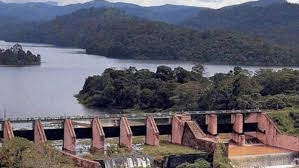
Mullaperiyar dam
|
|
|
|---|---|
| Indira Gandhi Canal Project | Kurnool- Cuddapah Canal |
| Ganga- Cauvery Link Canal | Beas- Satluj Link Canal |
Periyar Diversion Scheme - Objectives
- The Mullaperiyar dam and the diverted Periyar waters provide a lifeline for the districts of Theni, Madurai, Sivaganga, Dindigul, and Ramnad in Tamil Nadu, providing water for irrigation and drinking as well as power generation at the Lower Periyar Power Station.
- Tamil Nadu operates and maintains it to meet the drinking water and irrigation needs of five of its southern districts.
- The operational rights were transferred to Tamil Nadu under a 999-year lease agreement signed during British rule.
- The dam's purpose is to redirect the waters of the west-flowing river Periyar to the arid rain shadow regions of Tamil Nadu.
Periyar Diversion Scheme - Mullaperiyar Dam Issue
- Kerala has criticized the 1886 lease agreement and has challenged its legality. However, the threat posed by the 126-year-old dam to the safety of Kerala residents in the event of a dam failure has been the subject of debate since 2009.
- Tamil Nadu has challenged Kerala's proposal to decommission the dam and build a new one.
- Tamil Nadu has blamed Kerala for the delay in finalizing the dam's rule curve.
- The fluctuating storage levels in a reservoir are determined by the rule curve in a dam. A dam's gate opening schedule is determined by the rule curve. It is part of a dam's "core safety" mechanism.
- The rule curve level is fixed to avoid emergency dam shutter opening in the event of a flood-like situation. It aids in controlling the dam's water level during the monsoon season.
- Kerala has made consistent efforts to prevent Tamil Nadu from operating the dam because Tamil Nadu cannot access data in Kerala's terrain. There is no road, and the power supply has not been restored, despite the fact that Tamil Nadu has paid for it.
- Tamil Nadu has been accused by Kerala of using an "obsolete" gate operation schedule dating back to 1939.
Mullaperiyar Dam Issue - Current Situation
- After the floods in Kerala in 2018 and the destruction of the Rishiganga hydroelectric project and Tapovan dam in Uttarakhand due to a glacier burst that killed nearly 200 people, public concern about the dam's safety resurfaced in 2021.
- According to a UN report on the threats posed by aging dams around the world, the Mullaperiyar dam, located in a seismically active area, has major structural flaws and 5 million people are at risk if the 100+ year old dam fails.
- Two petitions were filed in the Supreme Court alleging that the supervisory committee established by Supreme Court order in 2014 had not been functioning properly for the previous six years, to which the Supreme Court responded by ordering the Chief Secretary of Tamil Nadu to come out with the rule curve immediately or face action.
Conclusion
On the Periyar river in the state of Kerala, there is a substantial masonry dam called Mullaperiyar Dam. Technical and legal options for resolving the conflict have been exhausted, and now a political solution is one of the most likely paths forward because many lives are also on the line in the event of a catastrophe. Government initiatives like the Dam Rehabilitation and Improvement Program (DRIP) and dam safety regulations may pave the way for a peaceful resolution.
|
|
|
|---|---|
| Geography Notes | Physical Geography |
| Water Resources in India | River Basins in India |
| India's Physiographic Divisions | Major Lakes in India |
| River Systems in Peninsular India | River Systems of Himalayan Drainage |
| Smaller Rivers of India flowing towards West | Smaller Rivers of India flowing towards East |
| Indian Drainage Systems | River Interlinking Project in India |
| Climatology | Geomorphology |
FAQs
Question: What is the Periyar Diversion Scheme?
Answer: The Periyar Diversion Scheme is an inter-state water transfer project in India aimed at diverting water from the Periyar River in Kerala to the Vaigai basin in Tamil Nadu. It was designed to address water scarcity and improve irrigation in the arid regions of Tamil Nadu.
Question: Why was the Periyar Diversion Scheme implemented?
Answer: The scheme was implemented to provide a reliable water supply for agricultural and domestic use in Tamil Nadu, especially in the dry regions that face frequent water shortages. By redirecting water from the Periyar River, the scheme supports irrigation, drinking water needs, and hydroelectric power generation.
Question: When was the Periyar Diversion Scheme completed?
Answer: The Periyar Diversion Scheme was completed in 1895 during British rule. It involved the construction of the Mullaperiyar Dam, which played a crucial role in diverting water to the Vaigai basin in Tamil Nadu.
Question: What are the key components of the Periyar Diversion Scheme?
Answer: The key components of the Periyar Diversion Scheme include the Mullaperiyar Dam, a network of canals, and tunnels that facilitate the transfer of water from the Periyar River to the Vaigai River basin. This infrastructure is essential for maintaining water flow and supporting regional irrigation systems.
Question: How has the Periyar Diversion Scheme impacted Tamil Nadu?
Answer: The Periyar Diversion Scheme has significantly benefited Tamil Nadu by providing a consistent water source for irrigation, boosting agricultural productivity, and supporting the livelihoods of farmers. Additionally, it has contributed to hydroelectric power generation, aiding the state's energy needs.
MCQs
1. What was the primary purpose of the Periyar Diversion Scheme?
A) To create a wildlife sanctuary
B) To facilitate water supply to Tamil Nadu
C) To enhance fisheries in Kerala
D) To promote tourism in the region
Answer: (B) See the Explanation
Explanation: The primary purpose of the Periyar Diversion Scheme was to divert water from the Periyar River to the arid regions of Tamil Nadu to improve water supply for agriculture and domestic use.
2. When was the Periyar Diversion Scheme completed?
A) 1875
B) 1885
C) 1895
D) 1905
Answer: (C) See the Explanation
Explanation: The Periyar Diversion Scheme was completed in 1895, during the British era, with the construction of the Mullaperiyar Dam facilitating water diversion to Tamil Nadu.
3. Which dam is associated with the Periyar Diversion Scheme?
A) Bhakra Nangal Dam
B) Mullaperiyar Dam
C) Sardar Sarovar Dam
D) Hirakud Dam
Answer: (B) See the Explanation
Explanation: The Mullaperiyar Dam is the primary structure associated with the Periyar Diversion Scheme, diverting water from the Periyar River to the Vaigai basin in Tamil Nadu.
4. What is one of the main benefits of the Periyar Diversion Scheme for Tamil Nadu?
A) Increased rainfall
B) Enhanced irrigation
C) Improved fisheries
D) Promotion of tourism
Answer: (B) See the Explanation
Explanation: One of the main benefits of the Periyar Diversion Scheme is enhanced irrigation, which has greatly improved agricultural productivity in the drought-prone regions of Tamil Nadu.
5. Which river's water is diverted under the Periyar Diversion Scheme?
A) Kaveri River
B) Vaigai River
C) Periyar River
D) Godavari River
Answer: (C) See the Explanation
Explanation: The Periyar Diversion Scheme diverts water from the Periyar River in Kerala to the Vaigai basin in Tamil Nadu.
GS Mains Questions and Model Answers
Q1: Analyze the significance of the Periyar Diversion Scheme in the context of inter-state water sharing in India.
Answer: The Periyar Diversion Scheme is significant as an example of inter-state water sharing and cooperation in India. Completed in 1895, it was designed to divert water from the Periyar River in Kerala to Tamil Nadu's Vaigai basin to address water scarcity. The scheme illustrates the challenges and opportunities of managing water resources across state boundaries, highlighting the need for collaboration. While it has provided substantial benefits to Tamil Nadu, such as improved irrigation and agriculture, it has also led to disputes over water rights between Kerala and Tamil Nadu. Effective water-sharing agreements and a balance between resource use and ecological preservation are essential for sustainable management and maintaining harmonious relations between states. The scheme underscores the importance of equitable and transparent policies to address water demands while considering environmental impacts.
Q2: Discuss the impact of the Periyar Diversion Scheme on the agriculture and economy of Tamil Nadu.
Answer: The Periyar Diversion Scheme has had a transformative impact on the agriculture and economy of Tamil Nadu. By channeling water from the Periyar River to the Vaigai basin, it has provided a consistent water source for irrigation in arid regions. This has significantly boosted agricultural productivity, supporting crops such as paddy, sugarcane, and bananas. The increased agricultural output has enhanced the livelihoods of farmers and contributed to the overall economic development of the region. Additionally, the scheme has facilitated hydroelectric power generation, contributing to the state’s energy needs. However, it has also raised concerns regarding water-sharing rights with Kerala. Addressing these concerns and maintaining sustainable water management practices are crucial for balancing economic benefits with ecological and inter-state considerations.
Q3: Evaluate the challenges associated with maintaining and managing the Periyar Diversion Scheme.
Answer: The Periyar Diversion Scheme, while beneficial, presents several challenges in terms of maintenance and management. One of the primary challenges is the aging infrastructure of the Mullaperiyar Dam, which raises concerns about safety and potential risks to downstream areas. Regular inspections and reinforcement measures are needed to ensure its structural integrity. Another challenge is the inter-state water-sharing dispute between Kerala and Tamil Nadu, which has led to legal and political tensions. Sustainable management practices, clear regulatory frameworks, and cooperative agreements are essential to mitigate these issues. Climate change poses an additional challenge, impacting rainfall patterns and water availability. Implementing adaptive strategies, enhancing dam safety, and fostering inter-state cooperation are key to addressing these challenges and ensuring the long-term benefits of the scheme.
Previous Year Questions on Periyar Diversion Scheme
1. UPSC CSE Prelims 2021:
Question: The Mullaperiyar Dam, associated with the Periyar Diversion Scheme, is located in:
A) Tamil Nadu
B) Kerala
C) Karnataka
D) Andhra Pradesh
Answer: (B)
Explanation: The Mullaperiyar Dam, an integral part of the Periyar Diversion Scheme, is located in Kerala, although its waters are diverted to Tamil Nadu for irrigation and other uses.
2. UPSC CSE Mains 2019 (GS Paper 3):
Question: "Examine the importance of inter-state water-sharing mechanisms with reference to the Periyar Diversion Scheme. How can such mechanisms be improved for better cooperation among states?"
Answer: Inter-state water-sharing mechanisms like the Periyar Diversion Scheme play a critical role in addressing regional water scarcity and supporting agricultural and economic development. The scheme, which diverts water from Kerala to Tamil Nadu, highlights both the benefits and challenges of shared water resources. While it has enabled agricultural growth in Tamil Nadu, it has also led to disputes over water rights. To improve such mechanisms, transparent policies, regular dialogue between states, and adherence to legal frameworks are essential. Establishing joint water management boards and implementing technology-driven monitoring can enhance cooperation and address conflicts. Ensuring sustainable water usage and considering ecological impacts are also vital for maintaining balanced and fair water-sharing agreements.
Download the PREPP App and attempt FREE IAS Exam Mock Tests and get complete study material!

Live Test : UPSC CSE Prelims CSAT (Paper-II) (Oct 20 - 23)
Full Test - 04: UPSC CSE Prelims CSAT (Paper-II)
Full Test - 03: UPSC CSE Prelims CSAT (Paper-II)
UPSC CSE Prelims 2026 GS Paper 1 Question Paper (24-May-2026)
UPSC CSE Prelims 2026 CSAT Paper 2 Question Paper (24-May-2026)

17 February 2025 | The Hindu Must Read Articles | Current Affairs

16 February 2026 | The Hindu Must Read Articles | Current Affairs

13 February 2026 | The Hindu Must Read Articles | Current Affairs









Comments