Obituary: Saleemul Huq, Climate Voice Of The Global South
Relevance: Prelims - Current Events of International Importance GS3 - Conservation, environmental pollution and degradation, environmental impact assessment.
(Source: Down To Earth, 11/01/2023)
Click here for Daily Current Affairs
Why in the news?
Recently, Saleemul Huq, a pioneering climate scientist from Bangladesh who advocated for the world to pay for, and adapt to worsening warming impacts on poorer nations passed away.
Table of Contents
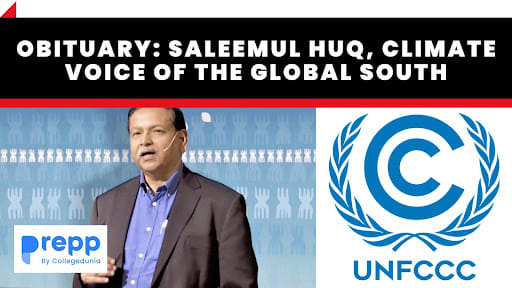
Who was Saleemul Haq?
- Saleemul Huq was a British climate scientist, activist, and advisor to least-developed countries.
- Roles: He served as a professor at Independent University, Bangladesh and as part of the Advisory Committee of the COP28 President.
- Honors:
- He was appointed as an Officer of the Order of the British Empire in 2022
- He was awarded the National Environment Award in 2020 from the Government of Bangladesh for his work towards combating climate change.
- He was recognized as one of the Top 10 Global Scientists list 2022 by Nature Journal.
- Contributions:
- He has been a contributor to IPCC and other UN reports.
- He played a significant role in the establishment of the Climate Hub in UN climate conferences, which is a non-state platform for relevant stakeholders to share information and inputs.
- He was the founding director of the International Centre for Climate Change & Development (ICCCAD), a climate change and development research and capacity-building organization in Bangladesh.
What has Saleemul Haq said about climate change?
- Climate action: According to the latest IPCC report, there has been an increase in the frequency of disasters around the world due to climate change.
- Therefore, actions should be taken to mitigate the effects of climate change rather than just organize discussions on it.
- Support for LDCs from developed countries: He recommended that industrialized countries should commit support for climate action in the least developed and developing countries to help them cope with the worst effects of climate change.
- Loss and damages: He highlighted key areas of concern for COP 28 such as adaptation and loss and damage in South Asian countries.
- Loss and Damage refer to impacts of climate change that cannot be avoided either by mitigation or adaptation.
- It covers economic damage to property, loss of livelihoods, and the destruction of sites of cultural and biodiversity importance.
- This is particularly important for areas like the Sundarbans which are increasingly at risk of being impacted by climate change.
- Local-level and youth-led action: He pushed for locally-led adaptation in countries across the world and the need for the youth to play a leading role in global climate negotiations.
- He emphasized the need to recognize that the younger generations were more affected by climate change and associated risks.
- Political action: He stressed the importance of political action towards countering climate change.
- He described climate change as a global and existential issue that is evident on the ground.
- It posed a severe threat to the lives and property of people, which should be prioritized by local politicians and parties.
- This was particularly relevant in at-risk nations like India, Pakistan, Bangladesh, etc. cyclones in India and Bangladesh, cyclones and floods in Pakistan and Nigeria.
- Renewable energy transition: Countries must assess how quickly they can transition to a clean economy that is dependent on renewables rather than fossil fuels.
- He recommended that countries transition as quickly as possible
- Adaptation vs Mitigation: He was the leading advocate of adaptation to climate change as opposed to mitigation even before the initiation of the COP process.
- Adaptation is the process of adjusting to the current and future effects of climate change while mitigation refers to reducing the severity of climate change by preventing or reducing the emission of greenhouse gases.
What is the Conference of Parties (COP)?
- The Conference of Parties is the apex decision-making body of the United Nations Climate Change Framework Convention (UNFCCC).
- It has been held on an annual basis since the first COP in Berlin in 1995.
- All States that are Parties to the Convention are represented at the COP, which reviews the implementation of the Convention and any other legal instruments adopted by the COP.
- Objectives:
- Review the national communications and emission inventories submitted by Parties.
- Assess the effects of the measures taken by Parties and the progress made in achieving the objective of the Convention
- Take necessary institutional and administrative decisions for the effective implementation of the Convention.
COP 28
AgendaAccording to the President of the COP28, the key areas that need to be addressed are:
|
(*Click this link to read prelims specific weekly current affairs articles)
FAQs
Question: What is climate change?
Answer:
Climate change refers to a long-term shift in temperature and weather patterns through natural or anthropogenic activities. Human activities, primarily the burning of fossil fuels is the main driver of climate change.
Question: What is the UNFCCC?
Answer:
The United Nations Framework Convention on Climate Change (UNFCCC) was signed in 1992 at the United Nations Conference on Environment and Development i.e. the Rio Summit. It entered into force on March 21, 1994, and has near universal membership (197 Parties). It is the parent treaty of the 2015 Paris Agreement with its secretariat in Bonn, Germany.
UPSC Mains Practice Question:
|
MCQs
Question: The United Nations Framework Convention on Climate Change (UNFCCC) is an international treaty drawn at (UPSC 2010)
(a) United Nations Conference on the Human Environment, Stockholm, 1972
(b) UN ‘Conference on Environment and Development, Rio de Janeiro, 1992
(c) World Summit on Sustainable Development, Johannesburg, 2002
(d) UN Climate Change Conference, Copenhagen, 2009
Answer: (b) See the Explanation
- The United Nations Framework Convention on Climate Change is an international treaty that was developed at the UN Conference on Environment and Development, Rio de Janeiro, 1992
Therefore, option (b) is the correct answer.
Question: With reference to the Agreement at the UNFCCC Meeting in Paris in 2015, which of the following statements is/are correct? (UPSC 2016)
- The Agreement was signed by all the member countries of the UN and it will go into effect in 2017.
- The Agreement aims to limit greenhouse gas emissions so that the rise in average global temperature by the end of this century does not exceed 2 °C or even 1.5 °C above pre-industrial levels.
- Developed countries acknowledged their historical responsibility in global warming and committed to donate $ 1000 billion a year from 2020 to help developing countries to cope with climate change.
Select the correct answer using the code given below.
(a) 1 and 3 only
(b) 2 only
(c) 2 and 3 only
(d) 1, 2 and 3
Answer: (b) See the Explanation
- Only 195 nations agreed to the Agreement at the Paris Conference.
- The agreement will enter into force only after 55 countries that account for at least 55% of global emissions have deposited their instruments of ratification. Hence statement 1 is incorrect.
- It aims to urgently address the significant gap between the aggregate effect of Parties’ mitigation pledges in terms of global annual emissions of greenhouse gases by 2020 and aggregate emission pathways consistent with holding the increase in the global average temperature to well below 2°C above preindustrial levels and pursuing efforts to limit the temperature increase to 1.5°C above preindustrial levels. Hence statement 2 is correct.
- Developed countries have committed to give $100 billion by 2020 but have not mentioned giving $1,000 billion dollars. Hence statement 3 is incorrect.
Therefore, option (b) is the correct answer.
Question: Consider the following statements: (UPSC CSE 2023)
Statement-I: Carbon markets are likely to be one of the most widespread tools in the fight against climate change
Statement-II: Carbon markets transfer resources from the private sector to the State.
Which one of the following is correct in respect of the above statements?
(a) Both Statement-I and Statement-II are correct and Statement-II is the correct explanation for Statement-I
(b) Both Statement-I and Statement-II are correct and Statement-II is not the correct explanation for Statement-I
(c) Statement-I is correct but Statement-II is incorrect
(d) Statement-I is incorrect but Statement-II is correct
Answer: (b) See the Explanation
- Carbon markets are mechanisms that put a price on carbon emissions and create economic incentives to reduce emissions by allowing entities to buy and sell carbon credits. Hence statement 1 is correct.
- Carbon markets create a market for buying and selling carbon credits, which represent the right to emit a certain amount of greenhouse gases.
- Companies or entities that emit fewer greenhouse gases than their allotted limit can sell their excess credits to those who exceed their limit.
- While carbon markets involve financial transactions and can transfer resources from the private sector to the state, they also facilitate the exchange of emission allowances between entities, including both private and public entities. Hence statement 2 is correct and is the correct explanation of statement 1.
Therefore, option (b) is the correct answer.
Download the PREPP App and attempt FREE IAS Exam Mock Tests and get complete study material!

Full Test - 04: UPSC CSE Prelims CSAT (Paper-II)
Full Test - 03: UPSC CSE Prelims CSAT (Paper-II)
UPSC CSE Prelims 2026 GS Paper 1 Question Paper (24-May-2026)
UPSC CSE Prelims 2026 CSAT Paper 2 Question Paper (24-May-2026)

17 February 2025 | The Hindu Must Read Articles | Current Affairs

16 February 2026 | The Hindu Must Read Articles | Current Affairs

13 February 2026 | The Hindu Must Read Articles | Current Affairs









Comments