Now, Delhi Plans November Rain To Breathe Easy
Primary Source: The Hindu
Click here for Daily Current Affairs
Why in the news?
- Delhi is grappling with severe air pollution and is considering artificial rain through cloud seeding as a potential solution.
- The Delhi government will present a detailed proposal to the Supreme Court for approval.
Table of Contents
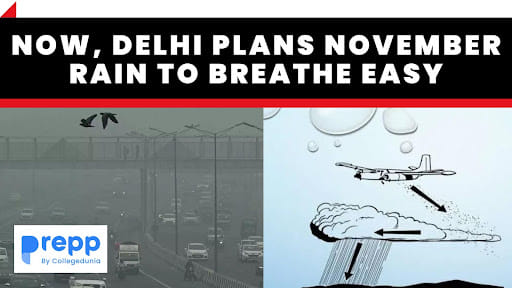
What is Cloud Seeding?
- The cloud seeding initiative refers to the deliberate intervention in the atmospheric processes to induce or enhance precipitation—in this case, rain.
- This technique is often considered as a potential way to reduce air pollution by causing precipitation that can remove pollutants from the air.
- Cloud seeding involves the introduction of substances into the clouds that act as ice nuclei or condensation nuclei, which encourage the formation of ice or water droplets that can grow and eventually fall as precipitation.
- Commonly used substances for cloud seeding include silver iodide, potassium iodide, and liquid propane, which can be dispersed by aircraft or by ground-based generators.
- Cloud seeding has been tried in various parts of the world with mixed results. Its effectiveness depends on the atmospheric conditions and the presence of clouds that are amenable to seeding.
Measures Taken by Delhi Government
1) Artificial Rain through Cloud Seeding
- The Delhi government is exploring the possibility of inducing artificial rain by means of cloud seeding, which is a process that aims to enhance precipitation by dispersing substances into the air that act as cloud condensation or ice nuclei.
- The Delhi government plans to receive a detailed proposal from IIT Kanpur on cloud seeding, which will then be submitted to the Supreme Court of India for approval.
- According to Professor Sachchida Nand Tripathi of IIT Kanpur, they have an aircraft and cloud seeding equipment ready, and their team is monitoring the cloud situation to find the right time for cloud seeding.
2) Odd-Even Vehicle Rationing Scheme
- The Delhi Government is considering implementing the 'odd-even' vehicle rationing scheme, which involves allowing vehicles on the roads based on the last digit of their license plates – odd-numbered plates on one day and even-numbered plates on the next.
- This is intended to reduce the number of vehicles on the road and thus lower vehicular emissions.
- The government will submit two case studies to the Supreme Court, one from the Energy Policy Institute at the University of Chicago and another from the Delhi Technological University, regarding the effectiveness of the odd-even scheme.
3) Seeking Cooperation
- The Delhi Government intends to request cooperation from the central government through the Supreme Court while proposing the plan for cloud seeding.
Short-Term Measures for Combating Pollution Crisis
- Artificial Rain Through Cloud Seeding: This is an emergency measure to quickly reduce particulate matter in the air. It can provide immediate relief, especially during severe pollution days.
- Odd-Even Scheme: Vehicle rationing can lead to an immediate decrease in vehicular emissions.
- Strict Enforcement of Pollution Control Norms: On an immediate basis, enforcing existing laws on industrial emissions, waste burning, and construction dust can mitigate pollution levels.
- Temporary Shutdown of Polluting Industries: Industries contributing to the air pollution may be temporarily shut down or their operations reduced.
- Increasing Public Transportation Usage: Provision of additional public transportation can decrease the number of private vehicles on the road.
- Health Advisories: Issuing health advisories and distributing masks to protect vulnerable populations from immediate harm.
Long-Term Measures for Combating Pollution Crisis
- Establishment of Regulatory Frameworks: Comprehensive policies aimed at consistently managing and reducing pollution sources over time.
- Promotion of Clean Energy: Transitioning to renewable energy sources for power generation and encouraging electric vehicles to reduce reliance on fossil fuels.
- Urban Planning: Designing cities to reduce commute times and promote public transportation, walking, and cycling.
- Strengthening Public Transportation: Expanding and improving public transportation options to reduce the number of private vehicles on the roads.
- Green Belts and Urban Forestry: Planting trees and maintaining green spaces to act as natural air filters.
- Waste Management: Improving waste management to prevent burning of waste, which contributes significantly to air pollution.
- Educational Campaigns: Educating the public about the sources of pollution and how to reduce their personal carbon footprint.
- Incentivizing Pollution Control Technologies: Offering incentives for industries to upgrade to cleaner technologies.
- Cross-Border Regional Collaboration: Air pollution is not confined to political boundaries; therefore, collaboration with neighboring regions is crucial to tackle pollution sources like crop burning.
- Monitoring and Research: Investing in better air quality monitoring and research to understand pollution sources and the effectiveness of policies.
- Health Infrastructure: Strengthening healthcare systems to deal with chronic respiratory and other health issues arising from long-term exposure to polluted air.
Conclusion
The Supreme Court criticized the Delhi government's efforts as insufficient and has directed the Delhi government to consider short-term measures to address the pollution crisis immediately. The proposal for artificial rain and studies on the odd-even scheme will be crucial steps for the government to tackle the air pollution problem in Delhi.
(*Click this link to read prelims specific weekly current affairs articles)
FAQs
Question: What is cloud seeding?
Answer:
The cloud seeding initiative refers to the deliberate intervention in the atmospheric processes to induce or enhance precipitation (rain). This technique is often considered as a potential way to reduce air pollution by causing precipitation that can remove pollutants from the air.
Question: What is an odd-even scheme?
Answer:
The 'odd-even' vehicle rationing scheme involves allowing vehicles on the roads based on the last digit of their license plates – odd-numbered plates on one day and even-numbered plates on the next. This is intended to reduce the number of vehicles on the road and thus lower vehicular emissions.
UPSC Mains Practice Question:
|
MCQs
Question: In the context of WHO consider the Air Quality Guidelines, consider the following statements: (UPSC 2022)
- The 24-hour mean of PM2.5 should not exceed 15 ug/m³ and annual mean of PM 2.5 should not exceed 5 μg/m³.
- In a year, the highest levels of ozone pollution occur during the periods of inclement weather.
- PM10 can penetrate the lung barrier and enter the bloodstream.
- Excessive ozone in the air can trigger asthma.
Which of the statements given above are correct?
(a) 1, 3 and 4
(b) 1 and 4 only
(c) 2, 3 and 4
(d) 1 and 2 only
Answer: (b) See the Explanation
The WHO Air Quality Guidelines are a set of evidence-based recommendations for limit values for particular air pollutants developed to assist nations in achieving public health-protective air quality. The guidelines were initially published in 1987.
PM2.5 should not exceed 5 g/m3 annual mean or 15 g/m3 24-hour mean, and PM10 should not exceed 15 g/m3 annual mean or 45 g/m3 24-hour mean, according to the standards. Hence, statement 1 is correct.
PM10 particles (particles having a diameter of 10 micrometres or less) are small enough to pass through the throat and nose and into the lungs. These particles, when inhaled, can harm the heart and lungs and create major health problems. They can penetrate and lodge deep within the lungs.
PM2.5 particles (particles with a diameter of 2.5 micrometres or less) are so small that they can enter the lungs and bloodstream. They are considerably more hazardous to one's health. PM2.5 can pass through the pulmonary barrier and into the bloodstream. Hence, statement 3 is incorrect.
As ozone concentrations rise above the recommended threshold, health repercussions on the population grow more widespread and severe. Such impacts can occur in areas where concentrations are currently high owing to human activity or when temperatures are extremely high. Hence, statement 2 is incorrect.
Because it is particularly irritating to the lungs and airways, ozone causes asthma. It is commonly understood that ozone levels are closely associated with asthma attacks. Hence, statement 4 is correct.
Therefore, option (b) is the correct answer.
Question: Acid rain is caused by the pollution of environment by (UPSC 2013)
(a) Carbon dioxide and nitrogen
(b) Carbon monoxide and carbon dioxide
(c) Ozone and carbon dioxide
(d) Nitrous oxide and sulphur dioxide
Answer: (d) See the Explanation
Acid Rain is defined as rain or any other form of precipitation with a higher level of hydrogen ions (i.e., a low pH of 5.6). Acid Rain is caused by sulphur and nitrogen oxides that are acidic in nature.
Sulphur dioxide and nitrogen oxides are produced as a result of human activities such as the combustion of fossil fuels, volcanic activity, and so on. Acid Rain is mostly caused by these oxides following oxidation and interaction with water.
Therefore, option (d) is the correct answer.
Download the PREPP App and attempt FREE IAS Exam Mock Tests and get complete study material!

Full Test - 04: UPSC CSE Prelims CSAT (Paper-II)
Full Test - 03: UPSC CSE Prelims CSAT (Paper-II)
UPSC CSE Prelims 2026 GS Paper 1 Question Paper (24-May-2026)
UPSC CSE Prelims 2026 CSAT Paper 2 Question Paper (24-May-2026)

17 February 2025 | The Hindu Must Read Articles | Current Affairs

16 February 2026 | The Hindu Must Read Articles | Current Affairs

13 February 2026 | The Hindu Must Read Articles | Current Affairs









Comments