NITI Aayog Releases The 1st Delta Ranking Of ABP
Relevance: GS2 - Government policies and interventions for development in various sectors and issues arising out of their design and implementation. GS1 - Poverty anddevelopmental issues, population and associated issues
(Source: PIB, 12/15/2023)
Click here for Daily Current Affairs
Why in the news?
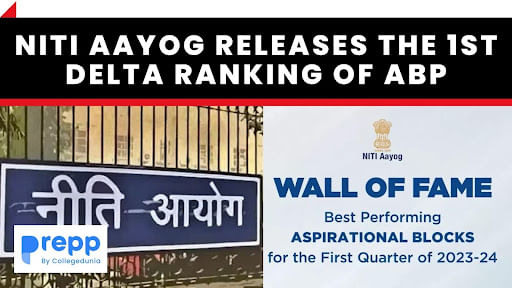
- Recently, the Niti Aayog released the 1st Delta Ranking of the Aspirational Block Programme (ABP) and the Aspirational District Programme (ADP).
- Tiriyani Block of Telangana secured the top position in the ABP while Rayagada in Odisha ranked first in the ADP for 2023.
Table of Contents
Delta Ranking of ADP and ABP 2023
- ADP: Rayagada district of Odisha secured the first rank.
- Jamui district of Bihar was ranked second among the Aspirational Districts.
- ABP: Tiriyani block of Kumuram Bheem Asifabad district, Telangana was ranked first.
- Kaushambi block of Kaushambi District, Uttar Pradesh secured the second rank.
Zonal rankings
- The blocks were geographically divided into six zones with two blocks from each zone being ranked.
- In each zone, the winners would receive ₹1.5 crores and the second-placed block would receive ₹1 crore.
- Zone 1: Hilly and North-eastern States, and Islands
- Amri block, West Karbi Anglong Assam was first and Ngopa block, Saitual Mizoram was second.
- Zone 2: Northern India
- Harraiya block, Basti, Uttar Pradesh secured first place followed by Virno block, Ghazipur, Uttar Pradesh
- Zone 3: Southern India
- Maski block, Raichur, Karnataka ranked first ahead of Narnoor, Adilabad, Telangana.
- Zone 4: Western India
- Sironcha and Aheri blocks of Gadhichiroli district, Maharashtra were declared winners.
- Zone 5: Central India
- Tirla block of Dhar district and Pati block of Barwani District of Madhya Pradesh were the top-ranked.
- Zone 6: Eastern India
- Andar, Siwan, Bihar, and Ramgarh in Dumka, Jharkhand were the top-ranked blocks.
How was the Delta Ranking calculated?
- The Delta Ranking is calculated based on the performance of the blocks and the progress achieved on the Key Performance Indicators (KPIs).
- The 40 key performance indicators (KPIs) across 5 themes were chosen to measure the progress of the blocks following extensive consultations.
- This was the first instance of rankings being calculated as part of the Aspirational Blocks Programme.
- It is a core strategy of the ABP which is based on the idea of competitive and cooperative federalism.
- It focuses on assessing the quantity i.e. the coverage of access rather than quality.
Wall of Fame
- A Wall of Fame at the Niti Aayog will display the projects undertaken by the top-performing blocks and districts in the ABP and ADP to improve their performance.
- It will also showcase the social impact created by the ABP and ADP in empowering, uplifting, and transforming lives.
- The key steps taken by the blocks and districts towards creating a Viksit Bharat by 2047 will also be highlighted.
Aspirational District Programme(ADP)
- Aspirational Districts are districts affected by poor socio-economic indicators.
- The Aspirational District Programme was launched in 2018 to transform these districts.
- The Aspirational Districts Programme aims to transform development into a mass movement facilitated by the Central, State and District Governments.
- 115 districts from 28 states constituting 20% of the total population of the country were chosen for the programme based on
- Hardships identified under the socio-economic caste census
- Key health and education performance indicators
- State of basic infrastructure
- NITI Aayog created a dashboard to monitor the real-time progress of the districts in partnership with the government of Andhra Pradesh.
- District collectors can input the latest available data into the dashboard which will also be open to the public
- Contours of the programme
- Convergence of central and state schemes
- Collaboration of central, state-level officers and district collectors
- Competition among districts
- Framework
- The programme is anchored at the Central level by the NITI Aayog while individual ministries are responsible for driving growth at the district level.
- States are the main drivers of the programme.
- A central Prabhari officer of the rank of joint secretary/additional secretary is nominated for each district.
- Objectives:
- Encourage districts to become one of the best in the country in the spirit of competitive & cooperative federalism.
- Focus on the strength of each district, identify low-hanging fruits for immediate improvement and measure progress through monthly rankings.
- Raise the living standards of its citizens and ensure inclusive growth for all
- Ensure localization of the Sustainable Development Goals for national progress.
- Parameters for Ranking: 49 Key Performance Indicators (KPIs) under 5 socio-economic themes
- Health & Nutrition (30%)
- Education (30%)
- Agriculture & Water Resources (20%)
- Financial Inclusion & Skill Development (10%)
- Infrastructure (10%)
To learn more, click the link.
Aspirational Block Programme(ABP)
- The Aspirational Block Programme, inspired by the Aspirational District Programme, was launched by the Niti Aayog in January 2023.
- It covers 500 blocks from 329 districts in 27 states and 4 Union Territories.
- Objective: Improve governance to enhance the quality of life of citizens and service delivery in remote and less developed blocks of India.
- NITI Aayog will partner with the states to release a quarterly ranking of the blocks.
- Themes:
- Health and Nutrition
- Education
- Agriculture and Allied Services
- Basic Infrastructure
- Social Development.
- Implementation: The program strategy has three levels:
- Convergence of Central and State Schemes
- Collaboration between NITI Aayog, Central Ministries and Departments, State Governments, and District and Block Administration
- Mass-movement-inspired competition among blocks.
- Nodal Officers:
- Block Officials have been identified as Prabharis and will be equipped to drive transformation in the blocks and will work under the guidance of the respective state and district administrations.
What are the challenges associated with the programmes?
- Inadequate coverage: Despite the programme’s inclusive nature, it does not cover critical and sensitive indicators like environment and gender.
- Implementation difficulties: Districts and blocks under the programmes tend to focus more on health, education, agriculture, and water resources.
- As a result, less attention is paid to the other indicators which compromises the envisioned development.
- Budgetary constraints: Insufficient budgetary resources are a major challenge faced in the implementation of the programme.
- This impacts the technical and human resource capacities at the district and block level.
- Inefficient coordination: The programme has been affected by a lack of coordination between the various levels of government involved in the project.
- This results in inefficient fund distributions, poor programme outcomes, and functioning of stakeholders.
- Delta Ranking: Critics have stated that the Delta Ranking is excessively focused on quantity i.e. coverage of access rather than quality.
- For example, timely delivery of textbooks is included in the ranking but quality of education is given a very low weightage.
Niti Aayog
To learn more about the Niti Aayog, click the link. |
Conclusion
The Aspirational Block Programme (ABP) and Aspirational District Programme (ADP) are significant steps in assessing and promoting development in remote areas. The programmes which aim to ensure social progress must also address implementation difficulties, budgetary constraints, and ensure a balanced approach towards quality and quantity.
(*Click this link to read prelims specific weekly current affairs articles)
FAQs
Question: What are blocks?
Answer:
A block is a district sub-division that represents a compact area for which effective plans are prepared and implemented through Gram Panchayats.
Question: What is competitive and cooperative federalism?
Answer:
- Competitive federalism: It is a type of federalism in which the relationship between the Central and state governments is vertical and between state governments is horizontal.
- Here, states compete among themselves and with the Centre for benefits.
- Cooperative federalism: It is a form of federalism in which the Centre and states share a horizontal relationship.
- Here, they cooperate in the larger public interest.
UPSC Mains Practice Question:
|
MCQs
Question: The Government of India has established NITI Aayog to replace the (UPSC 2015)
(a) Human Rights Commission
(b) Finance Commission
(c) Law Commission
(d) Planning Commission
Answer: (d) See the Explanation
The Government of India established the NITI Aayog to replace the Planning Commission in January 2015.
Therefore, option (d) is the correct answer.
Question: In India, which of the following review the independent regulators in sectors like telecommunications, insurance, electricity etc.? (UPSC 2019)
- Ad Hoc Committees set up by the Parliament.
- Parliamentary Department Related Standing Committees
- Finance Commission
- Financial Sector Legislative Reforms Commission
- NITI Aayog
Select the correct answer using the code given below.
(a) 1 and 2
(b) 1 , 3 and 4
(c) 3, 4 and 5
(d) 2 and 5
Answer: (a) See the Explanation
- Ad Hoc Committees, as the name indicates, are temporary, created for a specific task and cease to exist upon completion of that task. They can take up investigative or regulatory reviews. Hence statement 1 is correct.
- Parliamentary Department Related Standing Committees are permanent committees, constituted to deal with the demands for grants of the various Ministries/Departments of the Government.
- They also examine bills related to their ministries and provide oversight for regulators in the relevant sectors. Hence statement 2 is correct.
- The Finance Commission is primarily tasked with the distribution of taxes between the center and states and does not review independent regulators. Hence statement 3 is incorrect.
- The Financial Sector Legislative Reforms Commission was set up to rewrite and harmonize financial sector legislations, rules, and regulations and does not review functional aspects of independent regulators. Hence statement 4 is incorrect.
- NITI Aayog is a policy think tank of the Indian government, it does not conduct reviews of independent regulators. Hence statement 5 is incorrect.
Therefore, option (a) is the correct answer.
Download the PREPP App and attempt FREE IAS Exam Mock Tests and get complete study material!

Full Test - 04: UPSC CSE Prelims CSAT (Paper-II)
Full Test - 03: UPSC CSE Prelims CSAT (Paper-II)
UPSC CSE Prelims 2026 GS Paper 1 Question Paper (24-May-2026)
UPSC CSE Prelims 2026 CSAT Paper 2 Question Paper (24-May-2026)

17 February 2025 | The Hindu Must Read Articles | Current Affairs

16 February 2026 | The Hindu Must Read Articles | Current Affairs

13 February 2026 | The Hindu Must Read Articles | Current Affairs









Comments