Neutron Stars – Science & Technology Notes
Neutron stars are the collapsed cores of previously massive stars that have been crushed to a high density by supernova explosions. A neutron star is not as dense as a black hole, but it is denser than any other type of star known to science. In this article, we will discuss in detail regarding Neutron Stars which will be helpful for UPSC exam preparation.
Table of Contents
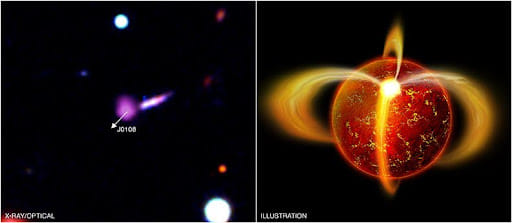
Illustration of Neutron Star
Neutron Stars – Background
- Neutron stars were first proposed in the 1930s, shortly after the neutron was discovered.
- Regular radio pulses from space were detected in the 1960s.
- Their origin was unknown, and some scientists speculated that they could be proof of extraterrestrial life.
- The regular signals were later discovered to be caused by a pulsar, a type of neutron star.
| Other Relevant Links | |
|---|---|
| Space Organisations | Space race/Space junk |
| South Asia Satellite: Significance | Solar Mission- ADITYA |
| Spitzer Space Telescope | Chandra X-Ray Observatory |
| Multi Application Solar Telescope | Thirty Metre Telescope |
| Resourcesat-2A | Astrosat |
| Sunspot | Magnetars |
| Air-breathing propulsion system | Space Junk |
| Graveyard Orbit | Supercluster of galaxies known as “Saraswati” |
What is a Neutron Star?
- Neutron stars are the remains of massive stars' cores that have reached the end of their lives.
- They are one of two evolutionary endpoints for the most massive stars, the other being black holes.
- Neutron stars are some of the universe's most extreme objects because they are the densest stellar objects, aside from what exists at the heart of a black hole.
- NASA estimates that our Milky Way galaxy contains up to a billion neutron stars.
- Because neutron stars began as stars, they can be found all over the galaxy in the same places where stars can be found. They, like stars, can be found alone or in binary systems with a companion.
- The vast majority of neutron stars discovered thus far are young neutron stars that sweep energetic radiation over Earth as they rotate at breakneck speeds.
- Older neutron stars that have had billions of years to cool and slow their spin are less visible, but are no less fascinating.
- Many neutron stars are likely undetectable because they emit insufficient radiation. They can, however, be seen under certain conditions.
- A few neutron stars have been discovered at the cores of supernova remnants, quietly emitting X-rays. However, neutron stars are more commonly found spinning wildly with extreme magnetic fields as pulsars or magnetars.
- Some neutron stars can be found in binary systems accreting materials from their companions and emitting electromagnetic radiation powered by the accreting material's gravitational energy.
- Neutron stars play a vital role in the universe. Recent research suggests that neutron star collisions are one of the primary sources of heavy elements such as gold and uranium in the universe.
- Nucleosynthesis refers to the process of forming new atomic nuclei from pre-existing protons and neutrons, which can occur during a neutron star collision, a supernova, star burning, or the Big Bang.
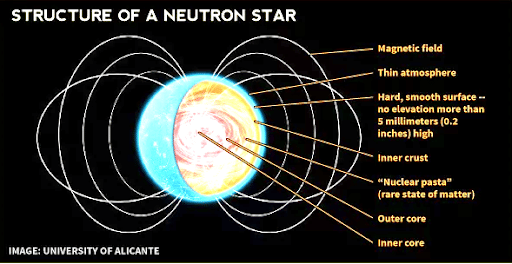
Structure of a Neutron Star
How Do Neutron Stars Form?
- A star's life, regardless of size, is a balancing act between the inward "push" of gravity and the outward "push" provided by photons generated at their cores as they conduct nuclear fusion, the forging of heavy atomic nuclei from light nuclei.
- Stars reach the end of their main sequence of nuclear-fuel-burning lives when they run out of hydrogen to fuse into helium.
- The outward energy is exhausted, and gravity triumphs, causing the star's core to collapse in on itself.
- As this occurs, nuclear fusion in the star's outer shell continues, causing these outer layers to "puff out."
- These shed outer layers cool the still collapsing core, which, if massive enough, will initiate a new round of nuclear fusion, forging helium into heavier elements such as carbon.
- Even stars with masses 10 to 20 times that of the sun have a limit to the heavy elements they can forge, usually resulting in a core of almost pure iron.
- Even this heavy element isn't dense enough to keep massive cores from collapsing further.
- The gravitational pressure is so strong that the negatively charged electrons and positively charged protons that make up the iron nuclei in this stellar core are crushed together, resulting in a sea of uncharged, or neutral neutrons.
- Some massive stellar cores are now saved from further collapse by a quantum phenomenon known as "neutron degeneracy pressure," which occurs when neutrons can no longer be packed any closer together, resulting in neutron stars.
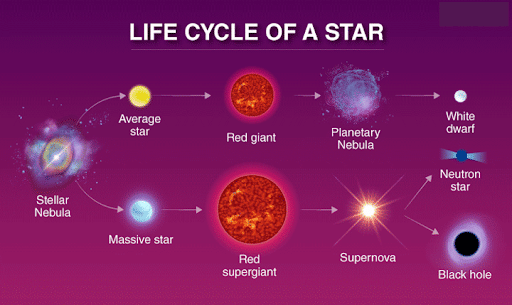
Life Cycle of a Star
Characteristics of a Neutron Star
- Neutron stars are the densest objects in the universe. They have a diameter of about 12 miles but are denser than our sun, which is more than 72,000 times larger than a neutron star.
- Because the cores of neutron stars have such strong gravity, most positively charged protons and negatively charged electrons in their interiors combine to form uncharged neutrons.
- Neutron stars emit no new heat. They are, however, extremely hot when they form and cool slowly.
- The average temperature of the neutron stars we can observe is about 1.8 million degrees Fahrenheit, compared to about 9,900 degrees Fahrenheit for the Sun.
- Neutron stars have a much stronger gravitational pull than the Earth.
- Neutron stars rotate in space as they form. Because of the conservation of angular momentum, this spinning speeds up as they compress and shrink—the same principle that causes a spinning skater to speed up when she pulls in her arms.
- Neutron stars are also thought to be responsible for a number of mysterious phenomena, such as Fast Radio Bursts (FRBs) and so-called Soft Gamma Repeaters (SGRs).
Types of Neutron Star
1) Pulsars
- The majority of neutron stars are observed as pulsars.
- Pulsars are rotating neutron stars that emit radiation pulses at very regular intervals ranging from milliseconds to seconds.
- Pulsars have extremely powerful magnetic fields that channel jets of particles out along their two magnetic poles.
- These accelerated particles produce extremely powerful light beams.
- Because the magnetic field is not always aligned with the spin axis, those particle and light beams are swept around as the star rotates.
- A pulsar can be compared to a lighthouse. A lighthouse emits a beam of light that sweeps across the sky at night. Even though the light is always on, you only see the beam when it is pointing directly at you.
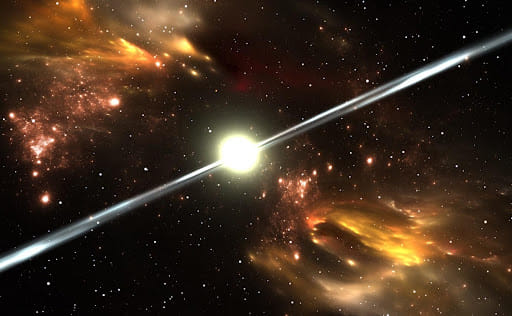
Beams of radiation by Pulsars
2) Magnetars
- A magnetar is another type of neutron star. The magnetic field in a typical neutron star is trillions of times that of the Earth's magnetic field; however, the magnetic field in a magnetar is 1000 times stronger.
- The crust of the star is locked together with the magnetic field in all neutron stars, so any change in one affects the other.
- The crust is under enormous strain, and even minor movement of the crust can be explosive.
- However, because the crust and magnetic field are linked, the explosion sends ripples through the magnetic field.
- Movements in the crust of a magnetar, with its massive magnetic field, cause the neutron star to emit a massive amount of energy in the form of electromagnetic radiation.
- SGR 1806-20, a magnetar, had a burst that released more energy in one-tenth of a second than the sun has emitted in the previous 100,000 years.
What happens when two neutron stars collide?
- Neutron stars can exist alone, only detectable by their surface temperature, or they can form alliances with "ordinary" stars, often syphoning off their material, or they can exist in binary systems with another neutron star.
- According to Einstein's general theory of relativity, as these binary neutron stars orbit each other, they create ripples in space-time known as gravitational waves.
- Just as material falling to the surface of a neutron star gives it angular momentum, gravitational waves carry angular momentum away from binary neutron stars.
- Loss of angular momentum causes neutron stars to collide, and as they do so, they emit more gravitational waves, increasing the rate at which angular momentum is lost.
- This eventually causes the neutron stars to collide and merge, resulting in an even larger neutron star.
- The violent event, a kilonova explosion, lasts only a few milliseconds after a billion years of prelude with stellar remnants dancing around each other.
- Kilonovas emit energy millions of times that of the sun, causing space-distorting gravitational waves and a brief but powerful burst of gamma rays, and are thought to be responsible for the formation of heavy elements such as gold, silver, and platinum.
Conclusion
When a massive star dies in a supernova, it has several options. That star can be completely destroyed, transformed into a black hole, or transformed into a neutron star. The outcome is determined by the mass of the dying star and other factors, all of which influence what happens when stars explode in a supernova.
| Other Relevant Links | |
|---|---|
| Science & Technology Policy in India | Scientific Policy Resolution 1958 |
| Science & Technology Policy of 1983 | Science & Technology Policy of 2003 |
| Science, Technology and Innovation Policy 2013 | New Initiatives Aligned with the National Agenda |
| India and World collaboration in science projects | Technology Vision Document 2035 |
FAQs
Question: What are neutron stars?
Answer: Neutron stars are the remnants of massive stars that have undergone a supernova explosion. They are incredibly dense, composed mostly of neutrons, and have a strong gravitational field.
Question: How are neutron stars formed?
Answer: Neutron stars form when a massive star exhausts its nuclear fuel, collapses under its gravity, and explodes as a supernova. The core left behind compresses into a dense neutron-rich object.
Question: What is the typical size of a neutron star?
Answer: Neutron stars are incredibly compact, typically having a radius of about 10-12 kilometers, despite containing a mass greater than that of the Sun.
Question: What is the role of neutron stars in astrophysics?
Answer: Neutron stars are critical in astrophysics for studying extreme states of matter, strong magnetic fields, and gravitational waves. They help scientists understand the universe’s fundamental forces.
Question: What is a pulsar?
Answer: A pulsar is a type of neutron star that emits beams of electromagnetic radiation from its magnetic poles. As it rotates, these beams sweep across space like a lighthouse beam.
MCQs
1. What is the primary composition of neutron stars?
A) Electrons
B) Protons
C) Neutrons
D) Quarks
Answer: (C) See the Explanation
Neutron stars are primarily composed of neutrons, formed after the collapse of a massive star, where electrons and protons combine under immense pressure.
2. How are neutron stars detected?
A) Through visible light emissions
B) By observing gravitational waves
C) By their radio wave emissions as pulsars
D) By infrared signals
Answer: (C) See the Explanation
Neutron stars are often detected as pulsars, which emit regular pulses of radio waves due to their rapid rotation and strong magnetic fields.
3. What is the maximum mass a neutron star can have before collapsing into a black hole?
A) 1 Solar Mass
B) 2-3 Solar Masses
C) 5 Solar Masses
D) 10 Solar Masses
Answer: (B) See the Explanation
The maximum mass of a neutron star is about 2-3 times the mass of the Sun. Beyond this, it collapses into a black hole due to gravitational forces.
4. What phenomenon occurs when two neutron stars collide?
A) Supernova
B) Gamma-ray burst
C) White dwarf formation
D) Quasar emission
Answer: (B) See the Explanation
When two neutron stars collide, they create a gamma-ray burst, one of the most energetic events in the universe, along with gravitational wave emissions.
5. What is the approximate density of a neutron star?
A) Equal to water
B) 1,000 times that of the Earth
C) 1014 grams per cubic centimeter
D) 106 grams per cubic centimeter
Answer: (C) See the Explanation
The density of a neutron star is approximately 1014 grams per cubic centimeter, making it one of the densest known objects in the universe.
GS Mains Questions and Model Answers
Q1: Explain the formation and characteristics of neutron stars.
Answer: Neutron stars are formed from the remnants of massive stars after a supernova explosion. When the core collapses, protons and electrons combine to form neutrons. These stars are incredibly dense, with a radius of 10-12 km, and possess intense gravitational and magnetic fields. They rotate rapidly and often emit radiation as pulsars. Neutron stars provide critical insights into extreme physical conditions, such as the behavior of matter under immense pressure and high-energy astrophysical phenomena.
Q2: Discuss the significance of neutron stars in understanding gravitational waves.
Answer: Neutron stars play a vital role in studying gravitational waves, especially during binary mergers. When two neutron stars collide, they emit gravitational waves detectable by observatories like LIGO and Virgo. These events confirm Einstein’s theory of general relativity and provide insights into the universe’s structure. The study of such collisions also reveals information about heavy element formation, such as gold and platinum, and enhances our understanding of astrophysical processes.
Q3: Evaluate the importance of studying pulsars in modern astrophysics.
Answer: Pulsars, a type of neutron star, are crucial for advancing modern astrophysics. Their precise radio pulses act as cosmic clocks, aiding in the detection of gravitational waves and testing general relativity. Pulsars also provide insights into the interstellar medium and magnetic fields. Studies of pulsars in binary systems help determine neutron star masses and internal compositions. These discoveries have profound implications for understanding the universe’s fundamental forces and extreme physical conditions.
Previous Year Questions on Neutron Stars
1. UPSC CSE Prelims 2021:
Question: Which astronomical object is referred to as a pulsar?
A) A rotating white dwarf
B) A type of black hole
C) A rapidly spinning neutron star
D) A young star in its formation stage
Answer: (C)
A pulsar is a rapidly spinning neutron star that emits regular beams of electromagnetic radiation, observable as pulses when the beam points toward Earth.
2. UPSC CSE Mains 2020:
Question: Discuss the role of neutron stars in the study of gravitational waves and cosmic events.
Answer: Neutron stars are essential in studying gravitational waves, particularly during binary mergers, which produce detectable waveforms. These events confirm Einstein’s general relativity and provide insights into the universe’s structure. Neutron star collisions also reveal the formation of heavy elements like gold and platinum. Observing such cosmic events enhances our understanding of extreme physical conditions, enriching astrophysical research and cosmology.
Download the PREPP App and attempt FREE IAS Exam Mock Tests and get complete study material!

Full Test - 04: UPSC CSE Prelims CSAT (Paper-II)
Full Test - 03: UPSC CSE Prelims CSAT (Paper-II)
UPSC CSE Prelims 2026 GS Paper 1 Question Paper (24-May-2026)
UPSC CSE Prelims 2026 CSAT Paper 2 Question Paper (24-May-2026)

17 February 2025 | The Hindu Must Read Articles | Current Affairs

16 February 2026 | The Hindu Must Read Articles | Current Affairs

13 February 2026 | The Hindu Must Read Articles | Current Affairs









Comments