Neutrino Observatory – Science & Technology Notes
The India based Neutrino Observatory (INO) Project is a multi-institutional effort to construct a world-class underground laboratory with a rock cover of approximately 1200 m for non-accelerator based high energy and nuclear physics research. The project is funded jointly by the Government of India's Departments of Atomic Energy (DAE) and Department of Science and Technology (DST). In this article, we will discuss in details regarding Neutrino Observatory which will be helpful for UPSC exam preparation.
Table of Contents
- Neutrino Observatory – Background
- Indian Neutrino Observatory (INO)
- Key Features
- Need for Indian Neutrino Observatory (INO)
- Significance of Indian Neutrino Observatory (INO)
- Issues Related to Indian Neutrino Observatory (INO)
- Neutrinos
- Why should the laboratory be situated underground?
- Why Tamil Nadu is against the setting up of Indian Neutrino Observatory (INO)?
- Conclusion
- FAQs
- MCQs

India based Neutrino Observatory
Neutrino Observatory – Background
- One of the first underground laboratories built to detect neutrinos was located more than 2000 metres underground at the Kolar Gold Field (KGF) mines in India.
- In 1965, the first atmospheric neutrinos were detected at this laboratory. Because of the mine closure, this laboratory has been closed.
- Most underground laboratories in the world are one kilometre or deeper underground.
- There are two kinds of underground laboratories: those found in mines and those found in road tunnels.
- There are now four major laboratories in the world: Sudbury, Canada, Kamioka, Japan, the Gran Sasso mountains in Italy, and the Soudan mines in the United States.
| Other Relevant Links | |
|---|---|
| NASA: Asteroid impact and deflection assessment mission | Commercial use of Lithium-Ionbattery technology |
| Hyperspectral imaging satellite | Water propulsion system in CUBESAT |
| Indian Space Vision-2025 | Major Policy Initiatives National Optical Fibre network |
| Spectrum Management | Cyber Law |
| Internet, Types of Network and e- Governance | Spectrum Policy in India |
| Mobile Spectrum | Cloud Computing |
| Big Data | Encryption |
| Biometrics | Virtual Reality |
What is Indian Neutrino Observatory (INO)?
- The Neutrino Observatory (INO) in India is a proposed pure-science underground laboratory.
- Its primary goal is to investigate the properties and interactions of neutrinos, which are naturally occurring, weakly interacting particles.
- The project's goal was to study neutrinos in a 1,200-meter-deep cave.
- The project is proposed for Pottipuram village in Tamil Nadu's Theni district.
- The proposed location in the Theni district was chosen because the rock burden of more than 1 km in all directions shields the detector from other cosmic rays.
- Because neutrinos can easily pass through any material, they will reach the detector while the other particles will be filtered out by the mountain's rock.
- The geographical location is also unusual, as all other neutrino detectors (in other countries) are located at latitudes greater than 35 degrees North or South. There are none near the equator.
- The Tata Institute of Fundamental Research (TIFR) and the Indian Institute of Mathematical Sciences (IIMSc) are spearheading the proposal to run the INO through seven primary and 13 participatory research institutes.
- The Neutrino Collaboration Group, which led the project, signed a Memorandum of Understanding in 2002, and the project was conceived in 2005.
Key Features
- The underground laboratory will include a large cavern measuring 132m X 26m X 20m and several smaller caverns connected by a 2100 m long and 7.5 m wide tunnel.
- Construction of an Iron Calorimeter (ICAL) detector for studying neutrinos, consisting of 50000 tonnes of magnetised iron plates arranged in stacks with gaps in between where Resistive Plate Chambers (RPCs) would be inserted as active detectors, with a total of around 29000 2m X 2m RPCs.
- The establishment of an Inter Institutional Centre for High Energy Physics (IICHEP) in Madurai for the operation and maintenance of the underground laboratory, human resource development, detector R&D, and its applications.
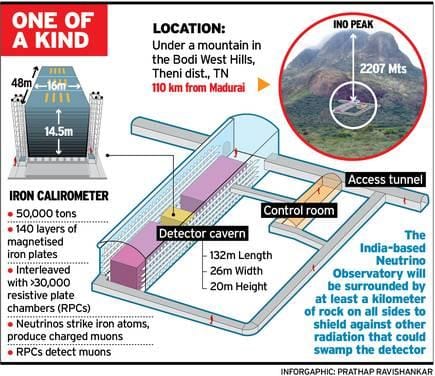
Features of Neutrino Observatory
Need for Indian Neutrino Observatory (INO)
- Neutrino detectors around the world appear to be finding evidence that these weakly interacting, little-understood particles are not as massless as previously thought.
- Not only do neutrinos have non-zero masses, but they also appear to mix and oscillate into one another as they travel through space.
- If this is true, it would not only be one of the first pieces of evidence for physics beyond the so-called Standard Model of Particle Physics, but it would also have a significant impact on many fields, including nuclear and particle physics, astrophysics, and cosmology.
- It is therefore critical to investigate the specifics of these particles' interactions.
- Of course, having a lab to do so is the best option. A neutrino lab must be located underground in order to maximise sensitivity to the interactions of these weakly interacting particles.
Significance of Indian Neutrino Observatory (INO)
- Understanding Sun's Properties: Visible light is emitted from the sun's surface, and neutrinos, which travel at close to the speed of light, are produced in the sun's core. The study of these neutrinos can help us understand what happens inside the sun.
- Constituents of Universe: Light emitted by distant stars, for example, can be studied by astronomers in order to detect new planets. Similarly, if the properties of neutrinos are better understood, they can be used in astronomy to figure out what the universe is made of.
- Probing Early Universe: Neutrinos interact very little with the matter around them, allowing them to travel long distances without interruption.
- We may be seeing extragalactic (originating outside the Milky Way galaxy) neutrinos from the distant past.
- These undamaged messengers can provide us with information about the universe's origin and the early stages of the infant universe, shortly after the Big Bang.
- Medical Imaging: Aside from direct future applications of neutrinos, there are technological applications of the detectors that will be used to study them.
- For example, X-ray machines, MRI scans, and other medical devices all arose from research into particle detectors.
- As a result, INO detectors may find use in medical imaging.
Issues Related to Indian Neutrino Observatory (INO)
- The proposed project area connects Kerala's Periyar Tiger Reserve with Srivilliputhur Meghamalai Tiger Reserve.
- Quarrying and construction will disturb wild animals that use the corridor for seasonal migration.
- The project in question is located on the hill slopes of the Western Ghats, which coincide with a significant tiger corridor, the Mathikettan-Periyar tiger corridor.
- The region serves as a significant watershed and catchment area for the rivers Sambhal and Kottakudi.
What are Neutrinos?
- Neutrinos are fundamental particles that are members of the lepton family.
- They are classified into three types, one of which is associated with electrons and the others with their heavier cousins, the muon and the tau.
- They have less mass, according to the standard model of particle physics.
- Recent experiments, however, indicate that these charge-neutral fundamental particles have a finite but unknown mass.
- A neutrino is a fundamental elementary particle that can be studied when solar radiation strikes the earth's atmosphere.
- They are difficult to detect because, due to their lack of electrical charge, they rarely interact with other forms of matter.
- They do, however, appear to play an important role in the universe of elementary physics, which physicists have been attempting to understand for several decades.
- They are created by high-energy processes such as those found within stars and supernovae.
- They are created on Earth by particle accelerators and nuclear power plants.
- So far, neutrino physics has mostly focused on sources in outer space, observing neutrinos from distant stars and galaxies.
Why should the laboratory be situated underground?
- Neutrino detectors are frequently built underground to protect them from cosmic rays and other sources of background radiation.
- Because of their extremely weak interaction with matter, neutrinos are difficult to detect in a laboratory.
- The background from cosmic rays (which interact much more readily than neutrinos) and natural radioactivity will make detection on Earth's surface nearly impossible. This is why most neutrino observatories are deep beneath the Earth's surface.
- The overburden provided by Earth matter is transparent to neutrinos, whereas most background from cosmic rays is significantly reduced depending on detector depth.
Why Tamil Nadu is against the setting up of Indian Neutrino Observatory (INO)?
- The Tamil Nadu government filed an affidavit in the Supreme Court to prevent the proposed Indian Neutrino Observatory in Theni district, at the Bodi West Hills site, from being built.
- According to the affidavit, the proposed particle physics project will have an impact on local biodiversity and tiger species in the Western Ghats' Periyar Tiger Reserve and Mathikettan Shola National Park.
- The affidavit came after the National Tiger Conservation Authority (NTCA) granted the project a no-objection certificate (NoC).
- According to the Tamil Nadu government, the project is located precisely on the hill slopes of this part of the Western Ghats, which align with a significant tiger corridor, namely the Mathikettan-Periyar tiger corridor.
- This corridor connects the Periyar Tiger Reserve in Kerala and the Mathikettan Shola National Park in Tamil Nadu.
- Quarrying and construction will disturb wild animals that use the corridor for seasonal migration.
- The region serves as a significant watershed and catchment area for the rivers Sambhal and Kottakudi.
- Though the experiments in the observatory would take place a kilometre underground, massive blasting, transportation, excavations, and tunnelling, among other activities, would jeopardise the zone's ecological sustainability deep in the Western Ghats.
- The Western Ghats were supremely protected because they are a global biodiversity hotspot and a treasure trove of biological diversity.
- Aside from elephants and tigers, the region is home to many endemic species of flowering plants, fish, amphibians, reptiles, birds, mammals, and invertebrates.
Conclusion
The Indian Neutrino Observatory (INO) holds immense potential for advancing our understanding of particle physics, astrophysics, and cosmology. However, addressing the concerns related to environmental impact, community engagement, and cultural preservation is crucial for the successful implementation of the project. INO's establishment can pave the way for groundbreaking discoveries and contribute to scientific progress on a global scale.
| Other Relevant Links | |
|---|---|
| Science & Technology Policy in India | Scientific Policy Resolution 1958 |
| Science & Technology Policy of 1983 | Science & Technology Policy of 2003 |
| Science, Technology and Innovation Policy 2013 | New Initiatives Aligned with the National Agenda |
| India and World collaboration in science projects | Technology Vision Document 2035 |
FAQs
Question: What is the Neutrino Observatory?
Answer: The Neutrino Observatory is a research facility designed to study neutrinos, which are subatomic particles that have very little mass and interact weakly with matter. It aims to answer fundamental questions about the universe and particle physics.
Question: Why is the study of neutrinos important?
Answer: Neutrino studies help scientists understand fundamental forces of nature, the evolution of the universe, and phenomena like dark matter and the behavior of particles under extreme conditions, contributing to advancements in physics.
Question: Where is the Neutrino Observatory located?
Answer: The Neutrino Observatory, also known as INO (India-based Neutrino Observatory), is being constructed in the state of Tamil Nadu, India, specifically in the Bodi West hills, to minimize interference from cosmic radiation.
Question: What are the key components of the Neutrino Observatory?
Answer: The main components of the Neutrino Observatory include a large underground detector, a magnetic calorimeter, and a neutrino beamline, which will allow researchers to observe neutrinos from the Earth’s crust and deep space.
Question: What are the potential benefits of the Neutrino Observatory project?
Answer: The Neutrino Observatory is expected to enhance India's research capabilities in particle physics, contribute to the global scientific community, and improve our understanding of cosmic processes, dark matter, and the origin of the universe.
MCQs
1. What is the primary goal of the Neutrino Observatory?
A) To study the Earth's core
B) To study the interaction of neutrinos
C) To study solar radiation
D) To detect dark matter
Answer: (B) See the Explanation
Explanation: The Neutrino Observatory is designed to study neutrinos, subatomic particles that interact weakly with matter, allowing for a deeper understanding of fundamental physics.
2. Where is the India-based Neutrino Observatory (INO) located?
A) Delhi
B) Tamil Nadu
C) Rajasthan
D) Karnataka
Answer: (B) See the Explanation
Explanation: The India-based Neutrino Observatory (INO) is located in Tamil Nadu, India, to ensure minimal interference from cosmic radiation for better neutrino detection.
3. What is a key feature of the Neutrino Observatory?
A) Large surface detectors
B) Underground location
C) Use of gamma rays
D) Above-ground telescopes
Answer: (B) See the Explanation
Explanation: The Neutrino Observatory is located underground to minimize cosmic radiation interference, which allows for precise measurements and study of neutrinos.
4. Why is the study of neutrinos important?
A) To study magnetic fields
B) To understand the weak interaction of particles
C) To explore outer space
D) To study solar winds
Answer: (B) See the Explanation
Explanation: Studying neutrinos helps scientists understand weak interactions in particle physics, the structure of matter, and the evolution of the universe.
5. Which scientific field does the Neutrino Observatory focus on?
A) Particle physics
B) Astrophysics
C) Seismology
D) Meteorology
Answer: (A) See the Explanation
Explanation: The Neutrino Observatory is primarily focused on particle physics, particularly the study of neutrinos and their interaction with other particles in the universe.
GS Mains Questions and Model Answers
Q1: Discuss the importance of the India-based Neutrino Observatory (INO) in global scientific research.
Answer: The India-based Neutrino Observatory (INO) plays a critical role in global scientific research, especially in the field of particle physics. By studying neutrinos, INO contributes to our understanding of weak interactions, dark matter, and cosmic processes. The facility will provide researchers with the tools to explore fundamental questions about the universe's structure and evolution. Its location, deep underground, ensures minimal interference from cosmic radiation, offering accurate data. INO's collaboration with global research institutions positions India as a key player in the study of subatomic particles and expands its scientific influence globally.
Q2: What are the potential applications of neutrino research at the India-based Neutrino Observatory?
Answer: Neutrino research at the India-based Neutrino Observatory has the potential to advance our understanding of fundamental physics, particularly the Standard Model of particle physics. Applications include improving our knowledge of neutrino oscillations, which may offer insights into the origin of the universe and dark matter. Moreover, the technology developed at INO may have applications in nuclear physics, astrophysics, and possibly in the development of new sensors or detectors for other scientific applications. Understanding neutrinos could also help explain the cosmic phenomena, such as supernovae and the behavior of stars.
Q3: How does the construction of the Neutrino Observatory contribute to India’s position in global scientific research?
Answer: The construction of the India-based Neutrino Observatory places India at the forefront of global scientific research, particularly in the field of particle physics. As a major international collaboration, the observatory allows Indian scientists to work alongside leading global experts and contribute significantly to groundbreaking research. It strengthens India's scientific capabilities, attracts international research funding, and enhances the country’s position as a leader in advanced technology. Additionally, the observatory fosters technological innovation, education, and the development of highly specialized skills, benefiting both Indian science and the global scientific community.
Previous Year Questions on Particle Physics
1. UPSC CSE Mains 2019 (GS Paper 3):
Question: "Explain the significance of neutrino studies in the field of particle physics and their potential impact on understanding the universe."
Answer: Neutrino studies are crucial in particle physics as they provide insights into weak interactions, one of the four fundamental forces of nature. Neutrinos are difficult to detect, but understanding their properties could help explain the origin of mass and offer a deeper understanding of the universe's structure. These studies also contribute to understanding dark matter and energy, fundamental particles that make up most of the universe yet remain invisible to current detection methods.
2. UPSC CSE Mains 2021 (GS Paper 3):
Question: "What is the role of underground laboratories like the India-based Neutrino Observatory in advancing global research in particle physics?"
Answer: Underground laboratories, such as the India-based Neutrino Observatory, provide a controlled environment free from cosmic radiation, essential for studying subatomic particles like neutrinos. These facilities enable scientists to conduct precise experiments and discover new phenomena in particle physics, such as neutrino oscillations and mass. By isolating the detector from surface-level interference, underground observatories enhance the accuracy of experiments and contribute to the global understanding of fundamental physics.
Download the PREPP App and attempt FREE IAS Exam Mock Tests and get complete study material!

Full Test - 04: UPSC CSE Prelims CSAT (Paper-II)
Full Test - 03: UPSC CSE Prelims CSAT (Paper-II)
UPSC CSE Prelims 2026 GS Paper 1 Question Paper (24-May-2026)
UPSC CSE Prelims 2026 CSAT Paper 2 Question Paper (24-May-2026)

17 February 2025 | The Hindu Must Read Articles | Current Affairs

16 February 2026 | The Hindu Must Read Articles | Current Affairs

13 February 2026 | The Hindu Must Read Articles | Current Affairs









Comments