Nagaland Nod for 33% Quota for Women in Urban Local Bodies
Primary Source: The Hindu
Click here for Daily Current Affairs
Why in the news?
- Recently, Nagaland's Legislative Assembly passed a bill to reserve 33% of seats in urban local bodies (ULBs) for women.
- This bill addresses a longstanding contentious issue, facilitating municipal elections in Nagaland after a 20-year hiatus.
Table of Contents
What is the Significant Development in Nagaland?
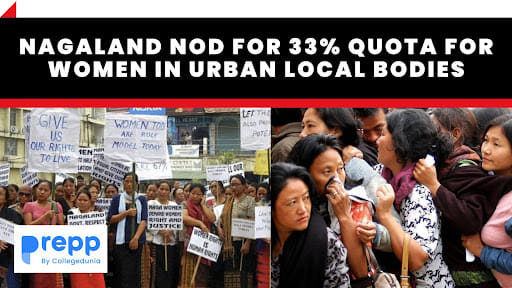
- Nagaland Assembly's Decision: The Nagaland Assembly unanimously passed a bill to reserve 33% of seats in urban local bodies (ULBs) for women.
- Supreme Court's Directive: The provision for one-third reservation for women in ULBs aligns with a directive from the Supreme Court of India.
- Delay in Municipal Elections: Municipal elections in Nagaland were overdue, with the last polls held in 2004. The delay was attributed to unresolved issues related to Naga peace talks and the controversy over women's reservation in ULBs.
- Civil Society's Role: The Naga Mothers’ Association, a prominent civil society organization, along with women legislators, expressed happiness over the bill's passage, highlighting the role of civil advocacy in effecting this change.
What are Urban Local Bodies (ULBs)?
|
What was the Hindrance?
- Earlier, apex tribal bodies in Nagaland opposed this reservation, claiming it infringed on Nagaland's special rights under Article 371(A) of the Indian Constitution.
- This article grants special status to Nagaland, acknowledging the unique customs and social practices of the Naga people.
- However, these bodies eventually accepted the reservation, marking a significant shift in local political and social attitudes.
What is Article 371(A)?
|
Other Important Constitutional Provisions
- Article 14: Ensures equality before the law and equal protection of the laws within the territory of India.
- Article 15: Prohibits discrimination on grounds of religion, race, caste, sex, or place of birth.
- Article 16: Provides for equality of opportunity in matters of public employment.
- 73rd and 74th Constitutional Amendments: These amendments, dealing with Panchayati Raj Institutions and Urban Local Bodies respectively, provide for the reservation of seats for women in these bodies.
What is the 74th Constitutional Amendment Act?
|
Exclusion from the Bill
- The Nagaland Municipal Bill, 2023, excludes provisions related to taxes on land and buildings.
- The earlier provision for reserving one-third of the ULB chairperson positions for women is not included in the new bill.
Conclusion
The bill marks a significant step towards gender equality in Nagaland's urban governance. With the bill's passage, Nagaland is poised to conduct municipal elections, addressing a critical gap in local governance since 2004.
(*Click this link to read prelims specific weekly current affairs articles)
FAQs
Question: What are Urban Local Bodies (ULB)?
Answer:
Urban Local Bodies (ULBs) refer to specific governmental entities that operate at the urban level, primarily tasked with the administration and governance of towns, cities, or any other urban area. ULBs come in various forms, such as municipal corporations, municipalities, and town councils, depending on the size and population of the urban area they govern.
Question: What is the 74th Constitutional Amendment Act?
Answer:
The 74th Constitutional Amendment Act, passed in 1992, was a significant reform in Indian governance, focusing on the decentralization of power to urban local bodies (ULBs). This amendment aimed to strengthen democracy at the grassroots level in urban areas and bring about efficient urban governance. It provides for the constitution of three types of municipalities:
- Nagar Panchayats for areas in transition from a rural area to an urban area.
- Municipal Councils for smaller urban areas.
- Municipal Corporations for larger urban areas.
Question: What is Article 371(A)?
Answer:
Article 371(A) of the Indian Constitution is a special provision that grants certain special rights and privileges to the state of Nagaland. This article is particularly significant because it acknowledges and protects the unique cultural heritage and social practices of the Naga people. One of the key aspects of Article 371(A) is that it gives the Nagaland Legislative Assembly the power to decide on matters related to Naga customary law and procedure, including those related to land and its resources.
UPSC Mains Practice Question:
|
MCQs
Question: Consider the following statements:
- The Women's Reservation Bill proposes to reserve 33% of all seats in the Lok Sabha and state legislative assemblies for women.
- The 73rd and 74th Constitutional Amendments provide for at least one-third reservation for women in local self-governing bodies.
- The National Commission for Women was set up in 1992 to address the issues of women's rights and representation.
How many of the statements given above are correct?
(a) Only one
(b) Only two
(c) All three
(d) None
Answer: (c) See the Explanation
The Women's Reservation Bill, also known as the Constitution (108th Amendment) Bill, proposes to amend the Constitution to reserve 33% of all seats in the Lok Sabha and state legislative assemblies for women. The main aim of this bill is to improve the representation of women in legislative bodies and thereby empower them politically. Hence, statement 1 is correct.
The 73rd and 74th Constitutional Amendments Act, 1992, provide for at least one-third reservation for women in all local self-governing bodies such as Panchayats and Municipalities. These amendments were landmark steps towards ensuring women's participation in local governance, which is crucial for their political empowerment. Hence, statement 2 is correct.
The National Commission for Women (NCW) was set up in January 1992 as a statutory body to review the constitutional and legal safeguards available for women, recommend remedial measures to address the issues affecting women, and facilitate redressal of grievances. It plays a significant role in ensuring women's rights and representation in various fields. Hence, statement 3 is correct.
Therefore, option (c) is the correct answer.
Question: Given below are two statements, one labeled as Assertion(A) and the other labeled as Reason (R) (UPSC 1997)
Assertion (A): Reservation of thirty-three percent of seats for women in Parliament and State Legislature does not require any Constitutional amendment.
Reason (R): Political parties contesting elections can allocate thirty-three percent of seats they contest to women candidates without any Constitutional amendment.
In the context of the above two statements which one of the following is correct?
(a) Both A and R are true and R is the correct explanation of A
(b) Both A and R are true but R is not the correct explanation of A
(c) A is true but R is false
(d) A is false but R is true
Answer: (d) See the Explanation
Reservation of 33% of seats for women in Parliament and state legislatures requires a Constitutional amendment. Recently the Parliament passed the 128th Constitutional Amendment Bill to grant 33% reservation to women in Parliament and state legislative bodies. Hence assertion is incorrect.
However, political parties are not constitutional bodies and can grant 33% of seats to women candidates without the need for a Constitutional amendment. Hence, the reason is correct.
Therefore, option (d) is the correct answer.
Question: Which article of the Indian Constitution provides special rights to Nagaland?
(a) Article 370
(b) Article 371(A)
(c) Article 32
(d) Article 15
Answer: (b) See the Explanation
Article 371(A) pertains specifically to Nagaland and gives it certain special rights, including matters related to land and its resources.
Therefore, option (b) is the correct answer.
Download the PREPP App and attempt FREE IAS Exam Mock Tests and get complete study material!

Full Test - 04: UPSC CSE Prelims CSAT (Paper-II)
Full Test - 03: UPSC CSE Prelims CSAT (Paper-II)
UPSC CSE Prelims 2026 GS Paper 1 Question Paper (24-May-2026)
UPSC CSE Prelims 2026 CSAT Paper 2 Question Paper (24-May-2026)

17 February 2025 | The Hindu Must Read Articles | Current Affairs

16 February 2026 | The Hindu Must Read Articles | Current Affairs

13 February 2026 | The Hindu Must Read Articles | Current Affairs









Comments