Multi Application Solar Telescope (MAST) – Science & Technology Notes
Multi-Application Solar Telescope (MAST), a 50 cm diameter class telescope, was installed by AMOS on the Udaipur Solar Observatory's Island on Lake Fatehsagar in India. Despite its small size, the telescope is expected to be competitive with large and expensive projects around the world due to its versatility in terms of science goals and its demanding optomechanical and thermal specifications. In this article, we will discuss in detail regarding Multi Application Solar Telescope which will be helpful for UPSC exam preparation.
Table of Contents
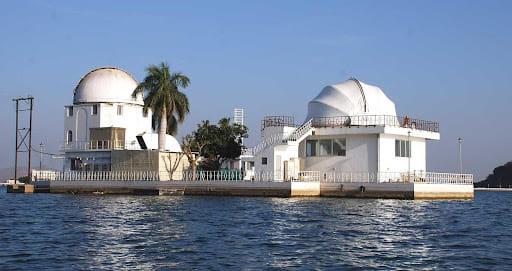
Udaipur Solar Observatory
What is Multi Application Solar Telescope?
- The Multi Application Solar Telescope (MAST) is a telescope for detailed study of solar activity including its magnetic field.
- It has been operationalized at the Udaipur Solar Observatory (USO) of Physical Research Laboratory (PRL).
- MAST is a 50-centimeter off-axis Gregorian-Coude telescope.
- USO tested the mast for onsite acceptance after it was built by Mechanical and Optical Systems (AMOS) of Belgium.
- Its back-end instruments, which include an adaptive optics system and a narrow band imaging polarimeter based on a tandem Fabry-Perot etalon pair and an LCVR polarimetric module, were developed in-house at USO.
| Other Relevant Links | |
|---|---|
| Space Organisations | Space race/Space junk |
| South Asia Satellite: Significance | Solar Mission- ADITYA |
| Spitzer Space Telescope | Chandra X-Ray Observatory |
| Thirty Metre Telescope | Resourcesat-2A |
| Astrosat | Sunspot |
| Magnetars | Neutron stars |
| Air-breathing propulsion system | Space Junk |
| Graveyard Orbit | Supercluster of galaxies known as “Saraswati” |
Multi Application Solar Telescope – Objectives
- The MAST's primary goal is to comprehend the evolution of the magnetic fields on the Sun and their relationship to solar activity.
- This is significant because solar eruptions cause extreme space weather conditions that endanger humans by disrupting satellite communication, navigation, and other activities in space, as well as affecting the climate on Earth.
- MAST, in particular, aims to image solar active regions (groups of sunspots) in two different layers of the solar atmosphere, namely the photosphere and chromosphere.
- MAST aims to measure magnetic fields in these two layers as well.
- It will provide 3D images of solar activities such as solar flares and solar blasts and will be used to study seismic effects of solar flares.
- It will also be useful for studying other planetary movements during the day.
Significance of Udaipur Solar Observatory (USO)
- The USO, regarded as Asia's best solar observing site, is located on an island in the middle of Lake Fatehsagar in Udaipur, Rajasthan, where the sky conditions are ideal for solar observations.
- The large body of water that surrounds the telescopes reduces the amount of heat that reaches the surface layers.
- This reduces turbulence in the air mass, which improves image quality and visibility.
- The dome of the Multi Application Solar Telescope is a collapsible dome made of tensile fabric.
- The Udaipur site can boast of more than 250 days of continuous sunshine, allowing for proper observation of the sun during the day.
- To avoid wind turbulence, the building has no sharp edges. It is painted with a paint that has a high infrared emission capability to reduce heating from sunlight.
- It is divided into two floors: the telescope floor, which is visible during observations, and the instrument floor, which is air-conditioned to protect all of the electronics.
- The primary goal of obtaining high spatial and temporal resolution observations of solar photospheric and chromospheric activity is to comprehend the various dynamic phenomena that occur on the Sun's surface.
- Dr. Arvind Bhatnagar designed the observatory in 1976 after seeing the Solar Observatory at Big Bear Lake in Southern California.
Physical Research Laboratory (PRL)
|
Conclusion
By providing regular observations of the solar photosphere and chromosphere, MAST at USO promises to be an important ground-based facility that will complement the science objectives of current and upcoming ground-based and space-based missions.
| Other Relevant Links | |
|---|---|
| Science & Technology Policy in India | Scientific Policy Resolution 1958 |
| Science & Technology Policy of 1983 | Science & Technology Policy of 2003 |
| Science, Technology and Innovation Policy 2013 | New Initiatives Aligned with the National Agenda |
| India and World collaboration in science projects | Technology Vision Document 2035 |
FAQs
Question: What is the Multi-Application Solar Telescope (MAST)?
Answer: The Multi-Application Solar Telescope (MAST) is a solar telescope designed to study the Sun's surface, its activities, and magnetic fields. It is located at the Udaipur Solar Observatory in India.
Question: Where is the MAST located?
Answer: The Multi-Application Solar Telescope (MAST) is located at the Udaipur Solar Observatory in Rajasthan, India, one of the best solar observing sites in the world.
Question: What are the main objectives of the MAST project?
Answer: The primary objective of MAST is to conduct research on solar physics, focusing on solar activities, solar flares, coronal mass ejections, and the Sun’s magnetic fields.
Question: What kind of observations can be made using MAST?
Answer: MAST is capable of high-resolution observations of the Sun, including its photosphere, chromosphere, and corona, allowing researchers to study solar phenomena in great detail.
Question: How does MAST contribute to solar research?
Answer: MAST contributes to solar research by providing critical data on the Sun’s activity, helping scientists understand solar phenomena and their impact on space weather, which affects communication and satellite systems.
MCQs
1. Where is the Multi-Application Solar Telescope (MAST) located?
A) Kodaikanal Solar Observatory
B) Udaipur Solar Observatory
C) Dehradun Solar Observatory
D) Nainital Solar Observatory
Answer: (B) See the Explanation
Explanation: The MAST is located at the Udaipur Solar Observatory in Rajasthan, India, which is considered one of the best places in the world for solar observation.
2. What is the primary objective of the MAST project?
A) To observe the Earth's atmosphere
B) To study the Moon's surface
C) To conduct research on solar physics
D) To observe planetary bodies
Answer: (C) See the Explanation
Explanation: The primary objective of MAST is to conduct solar physics research, focusing on solar flares, coronal mass ejections, and the Sun’s magnetic fields.
3. What type of solar observations does MAST provide?
A) Low-resolution observations
B) High-resolution observations
C) Infrared observations
D) Radio wave observations
Answer: (B) See the Explanation
Explanation: MAST provides high-resolution observations of the Sun’s surface, including its photosphere, chromosphere, and corona, which allows detailed studies of solar phenomena.
4. What solar phenomena does MAST help in studying?
A) Solar winds only
B) Solar flares and coronal mass ejections
C) Earth's magnetic field
D) Planetary atmospheres
Answer: (B) See the Explanation
Explanation: MAST is designed to study solar phenomena such as solar flares, coronal mass ejections, and the Sun’s magnetic fields, which affect space weather.
5. Why is the Udaipur Solar Observatory considered an ideal location for MAST?
A) It has a low population density
B) It has favorable weather conditions for solar observation
C) It is at a high altitude
D) It is close to a space research center
Answer: (B) See the Explanation
Explanation: The Udaipur Solar Observatory is considered one of the best locations in the world for solar observation due to its clear skies and minimal light pollution, providing optimal conditions for solar studies.
GS Mains Questions and Model Answers
Q1: Discuss the significance of the Multi-Application Solar Telescope (MAST) in the field of solar research.
Answer: The Multi-Application Solar Telescope (MAST) plays a critical role in advancing solar research by providing high-resolution observations of solar activities. Positioned at the Udaipur Solar Observatory, MAST enables the study of solar flares, coronal mass ejections, and magnetic fields. Understanding these phenomena is crucial for space weather prediction, which impacts satellite operations, communication systems, and navigation technologies. MAST contributes to global solar research initiatives by enhancing our understanding of the Sun's behavior, offering new insights into its role in shaping space weather and its impact on Earth.
Q2: Evaluate the potential contributions of MAST to space weather prediction and its global impact.
Answer: MAST significantly enhances space weather prediction by providing detailed observations of solar activities that affect Earth's magnetic field and satellite systems. Solar flares and coronal mass ejections are critical drivers of space weather, and their accurate prediction is essential for protecting satellite infrastructure, communication networks, and power grids. By analyzing the Sun's behavior through MAST's high-resolution observations, scientists can improve their models of solar activity, thus enhancing the global capacity to predict and mitigate the impact of space weather events on technology and infrastructure.
Q3: What are the technological advancements in solar observation made by MAST, and how do they benefit solar physics?
Answer: MAST incorporates cutting-edge technology to provide unprecedented levels of resolution in solar observations, particularly in the study of the Sun’s surface and magnetic fields. The high-resolution imaging capabilities of MAST allow scientists to closely monitor solar activities such as flares and sunspots, which are essential for understanding solar dynamics. MAST also aids in studying the solar corona and its impact on space weather. The technological advancements in imaging and data analysis contribute significantly to the field of solar physics, enabling more precise modeling of solar phenomena and improving the forecasting of space weather events.
Previous Year Questions on Solar Research and Space Technology
1. UPSC CSE Mains 2020 (GS Paper 3):
Question: "Examine the role of solar telescopes in advancing our understanding of solar phenomena and space weather."
Answer: Solar telescopes, like MAST, play a vital role in advancing solar research by providing detailed observations of solar activities such as flares, coronal mass ejections, and sunspots. These observations are crucial for understanding the Sun’s behavior and its impact on space weather. Solar flares and solar wind can affect satellite communication, navigation systems, and power grids on Earth. By improving space weather prediction capabilities, solar telescopes enhance our ability to protect technological infrastructure and enable better space exploration missions.
2. UPSC CSE Mains 2021 (GS Paper 3):
Question: "Discuss the significance of advancements in solar observation technologies, including telescopes, for space exploration and communication."
Answer: Advancements in solar observation technologies, particularly in telescopes like MAST, have significantly enhanced our understanding of solar phenomena that influence space weather. These observations are crucial for improving space weather prediction models, which affect communication satellites, GPS systems, and power grids. Furthermore, better solar observation aids in space exploration by providing insights into the Sun’s behavior, helping to protect spacecraft and astronauts from harmful solar radiation. The continuous development of solar observation technology is thus vital for both space exploration and the protection of Earth’s technological infrastructure.
Download the PREPP App and attempt FREE IAS Exam Mock Tests and get complete study material!

Full Test - 04: UPSC CSE Prelims CSAT (Paper-II)
Full Test - 03: UPSC CSE Prelims CSAT (Paper-II)
UPSC CSE Prelims 2026 GS Paper 1 Question Paper (24-May-2026)
UPSC CSE Prelims 2026 CSAT Paper 2 Question Paper (24-May-2026)

17 February 2025 | The Hindu Must Read Articles | Current Affairs

16 February 2026 | The Hindu Must Read Articles | Current Affairs

13 February 2026 | The Hindu Must Read Articles | Current Affairs









Comments