Mobile Spectrum – Science & Technology Notes
The radio frequencies assigned to the mobile industry and other sectors for communication over the airwaves are referred to as spectrum. Because the mobile industry has repeatedly demonstrated its ability to generate economic value and social benefit, operators are urging national regulators to release sufficient, affordable spectrum for mobile in a timely manner. With more frequencies, including both coverage and capacity bands, mobile operators will be able to connect more people at faster speeds. In this article, we will discuss in detail Mobile Spectrum which will be helpful for UPSC exam preparation.
Table of Contents
What is Spectrum?
- The invisible radio frequencies that wireless signals travel over are referred to as the spectrum.
- These signals allow us to make phone calls, tag friends on Instagram, hail an Uber, look up directions to a destination, and do everything else on our mobile devices.
- The wireless frequencies we use are only a small part of what is known as the electromagnetic spectrum.
- The electromagnetic spectrum is divided into "bands" based on the wavelengths—the distance over which the wave's shape repeats.
- The electromagnetic spectrum extends from three hertz (extremely low frequency) to 300 hertz (gamma rays).
- Within that space, the portion used for wireless communication ranges from about 20 KHz to 300 GHz.
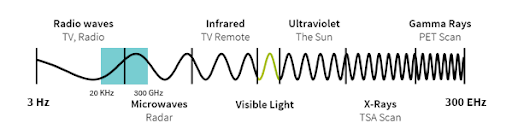
Spectrum Wavelengths
| Other Relevant Links | |
|---|---|
| NASA: Asteroid impact and deflection assessment mission | Commercial use of Lithium-Ionbattery technology |
| Hyperspectral imaging satellite | Water propulsion system in CUBESAT |
| Neutrino Observatory | Indian Space Vision-2025 |
| Major Policy Initiatives National Optical Fibre network | Spectrum Management |
| Cyber Law | Internet, Types of Network and e- Governance |
| Spectrum Policy in India | Cloud Computing |
| Big Data | Encryption |
| Biometrics | Virtual Reality |
How Does Spectrum Work?
- Because cellular communications can use a wide range of spectrum frequencies, different bands have slightly different characteristics.
- Spectrum can be divided into three categories for wireless communication: low-, mid-, and high-band spectrum.
- Low-band spectrum (less than 3 GHz) travels farther with less signal interruption. Today's wireless networks are primarily built on low-band spectrum, which has been used by the wireless industry to build high-speed wireless networks.
- When compared to low-band spectrum, high-band spectrum (above 24 GHz) travels much shorter distances—think metres, not miles—but offers high capacity and ultra-fast speeds.
- Mid-band spectrum (between 3 and 24 GHz) combines the characteristics of low- and high-band spectrum, resulting in a mix of coverage and capacity.
- These spectrum frequencies are shared by cell towers and our mobile devices. Today's most common cell sites are the 150-foot cell towers we're used to seeing along highways or atop tall buildings.
- Small cells, or small-scale antennas, are now being quickly deployed to densify network coverage and provide more frequent connection points for 5G's mid- and high-band spectrum.
What is Spectrum Management?
- Spectrum management refers to the process of planning, allocating, and coordinating the use of radio frequencies for various wireless communication services.
- It involves ensuring the equitable distribution of spectrum resources, minimizing interference, and maximizing the efficient utilization of available frequencies.
- Spectrum management is far more complex than simply allocating frequencies. Spectrum reuse is both desirable and required.
- Spectrum management is the control of all aspects of electromagnetic radiation.
- The goal is to protect users from harmful interference while allowing optimal spectrum use.
Spectrum Auctions
- Signals are required for devices such as cell phones and wireline telephones to connect from one end to the other.
- These signals are transmitted via airwaves (a medium for radio waves) and must be sent at specific frequencies to avoid interference.
- Interference can either prevent reception entirely, cause only a temporary loss of a signal, or affect the quality of the sound or picture produced by one's equipment.
- The Union government owns all publicly available assets within the country's geographical boundaries, including airwaves.
- With the growing number of mobile, wireline telephone, and internet users, the need for more signal space arises from time to time.
- The central government, through the Department of Telecom (Ministry of Communications), auctions off these assets from time to time in order to sell them to companies willing to build the necessary infrastructure to transport these waves from one end to the other.
- These airwaves are referred to as spectrum, and they are further subdivided into bands with varying frequencies.
- All of these airwaves are sold for a set period of time after which their validity expires, which is usually 20 years.
5G Spectrum
|
Conclusion
Spectrum is a perishable scarce resource that loses value when it is not used. It is critical for the government to ensure that the spectrum put on the market is sold in the most efficient manner possible. Countries with sound spectrum policies will provide widespread access to affordable and innovative mobile broadband services. In turn, a strong communications infrastructure brings significant broader economic benefits, such as increased productivity and living standards.
| Other Relevant Links | |
|---|---|
| Science & Technology Policy in India | Scientific Policy Resolution 1958 |
| Science & Technology Policy of 1983 | Science & Technology Policy of 2003 |
| Science, Technology and Innovation Policy 2013 | New Initiatives Aligned with the National Agenda |
| India and World collaboration in science projects | Technology Vision Document 2035 |
FAQs
Question: What is mobile spectrum?
Answer: Mobile spectrum refers to the range of electromagnetic frequencies used for transmitting wireless communications like voice, data, and video over mobile networks. It is essential for the functioning of mobile networks and services.
Question: Why is mobile spectrum important for mobile communication?
Answer: Mobile spectrum is crucial as it enables the transmission of signals between mobile devices and network towers. It directly impacts the quality, speed, and reliability of mobile communication services, including 4G and 5G networks.
Question: How is the mobile spectrum allocated in India?
Answer: In India, the mobile spectrum is allocated by the government through auctions conducted by the Department of Telecommunications (DoT). Telecom operators bid for specific frequency bands for their services.
Question: What are the different types of mobile spectrum bands?
Answer: The mobile spectrum is divided into various frequency bands, including Low Band (sub-1 GHz), Mid Band (1-6 GHz), and High Band (above 6 GHz), each serving different purposes like coverage, capacity, and speed.
Question: How does the government ensure the efficient use of mobile spectrum?
Answer: The government ensures efficient spectrum use through auctions, licensing, and regulatory policies. Additionally, spectrum sharing and trading mechanisms are encouraged to optimize usage and avoid spectrum scarcity.
MCQs
1. What is the role of the mobile spectrum in wireless communication?
A) It determines the speed of the mobile network
B) It is used for transmitting radio signals only
C) It is responsible for the communication between mobile devices and base stations
D) It is only used in satellite communications
Answer: (C) See the Explanation
The mobile spectrum enables communication between mobile devices and network towers (base stations). It is essential for data transmission, including voice, video, and internet connectivity over mobile networks.
2. Which organization is responsible for spectrum allocation in India?
A) TRAI (Telecom Regulatory Authority of India)
B) DoT (Department of Telecommunications)
C) Ministry of Communication
D) RBI (Reserve Bank of India)
Answer: (B) See the Explanation
The Department of Telecommunications (DoT) is responsible for the allocation and regulation of the mobile spectrum in India. It conducts spectrum auctions to allocate frequencies to telecom operators.
3. What is the main advantage of using higher frequency bands (High Band) in mobile communication?
A) Better coverage over a larger area
B) Improved speed and data capacity
C) Reduced latency
D) Lower power consumption
Answer: (B) See the Explanation
Higher frequency bands (High Band) allow for faster data transmission, increasing the capacity and speed of mobile networks, which is essential for advanced technologies like 5G.
4. What is spectrum sharing?
A) The allocation of spectrum to one telecom operator
B) The practice of using a single spectrum band across different regions
C) The sharing of spectrum between telecom operators to optimize usage
D) The division of spectrum into different frequency bands
Answer: (C) See the Explanation
Spectrum sharing involves allowing telecom operators to use the same frequency band to improve network efficiency, minimize unused spectrum, and reduce interference.
5. Which of the following is NOT a type of mobile spectrum band?
A) Low Band (sub-1 GHz)
B) Mid Band (1-6 GHz)
C) Ultra Band (above 10 GHz)
D) High Band (above 6 GHz)
Answer: (C) See the Explanation
There is no such thing as "Ultra Band" in the context of mobile spectrum. The main mobile spectrum bands are Low Band, Mid Band, and High Band.
GS Mains Questions and Model Answers
Q1: Examine the significance of mobile spectrum management for India’s digital economy.
Answer: Mobile spectrum management is essential for the growth of India’s digital economy, as it underpins mobile communications, including voice, data, and video. Efficient spectrum allocation and management are crucial for ensuring high-quality mobile services, promoting the adoption of technologies like 4G and 5G, and supporting India’s Digital India initiative. The government conducts spectrum auctions to allocate frequencies to telecom operators, ensuring optimal usage of available spectrum. However, challenges such as spectrum scarcity, inefficient use of available bandwidth, and the high cost of spectrum must be addressed to ensure sustainable growth. The ability to deploy 5G and other advanced technologies depends largely on the efficient use of the mobile spectrum. Thus, spectrum management plays a key role in bridging the digital divide and driving economic growth.
Q2: Discuss the challenges in the allocation and management of mobile spectrum in India.
Answer: The allocation and management of mobile spectrum in India face several challenges, including:
- Limited spectrum availability: There is a shortage of available spectrum, especially in high-demand frequency bands, making it difficult to meet the needs of telecom operators.
- High auction costs: Spectrum auctions often result in high prices for frequencies, leading to increased costs for telecom operators, which may be passed on to consumers.
- Inefficient usage: The uncoordinated use of spectrum by different telecom operators leads to inefficient deployment and underutilization in some regions.
- Technological constraints: The need for newer technologies like 5G requires the allocation of higher frequency bands, which come with challenges like signal propagation issues.
- Regulatory hurdles: The complex regulatory process and delays in policy changes often hinder the smooth allocation and efficient management of mobile spectrum.
Addressing these challenges requires improved policy frameworks, efficient spectrum sharing, and a balanced approach to auction pricing.
Q3: How does mobile spectrum influence the adoption of 5G technology in India?
Answer: The adoption of 5G technology in India heavily depends on the availability and efficient management of mobile spectrum. 5G requires large blocks of spectrum, especially in the high-frequency bands (above 6 GHz), to offer ultra-fast speeds, low latency, and higher capacity. The government has already initiated spectrum auctions to allocate these frequency bands to telecom operators. However, challenges such as high spectrum pricing, the need for significant investment in infrastructure, and the shortage of suitable spectrum in urban areas must be overcome. Furthermore, 5G adoption will require a robust network infrastructure, including the deployment of more base stations, fiber optic networks, and data centers. Therefore, mobile spectrum availability plays a critical role in the rollout of 5G services across the country.
Previous Year Questions on Science & Technology
1. UPSC CSE Prelims 2020:
Question: Which of the following frequency bands is associated with 5G technology?
A) 450 MHz
B) 700 MHz
C) 3.5 GHz
D) 10 GHz
Answer: (C) See the Explanation
5G technology primarily utilizes the 3.5 GHz frequency band, which provides the required speed and low latency for enhanced communication. Other frequency bands such as 450 MHz and 700 MHz are associated with earlier generation technologies.
2. UPSC CSE Mains 2019 (GS Paper 3):
Question: What are the key factors that impact mobile spectrum management in India?
Answer: Mobile spectrum management in India is influenced by factors such as:
- Availability of spectrum: Limited spectrum bandwidth, especially in high-frequency ranges.
- Regulatory framework: Government policies, auctions, and regulatory norms that dictate how spectrum is allocated.
- Technological advancements: The shift towards 5G and the need for new frequency bands.
- Infrastructure development: The deployment of network infrastructure to support high-frequency spectrum.
- Market competition: Telecom operators’ bidding behavior in spectrum auctions, impacting pricing and availability.
Effective management requires addressing these challenges to ensure sustainable growth and meet the demand for mobile services.
Download the PREPP App and attempt FREE IAS Exam Mock Tests and get complete study material!

Full Test - 04: UPSC CSE Prelims CSAT (Paper-II)
Full Test - 03: UPSC CSE Prelims CSAT (Paper-II)
UPSC CSE Prelims 2026 GS Paper 1 Question Paper (24-May-2026)
UPSC CSE Prelims 2026 CSAT Paper 2 Question Paper (24-May-2026)

17 February 2025 | The Hindu Must Read Articles | Current Affairs

16 February 2026 | The Hindu Must Read Articles | Current Affairs

13 February 2026 | The Hindu Must Read Articles | Current Affairs









Comments