MGNREGS Audit Crosses 50% Local Bodies In Just Six States
Relevance: GS2 - Government policies and interventions for development in various sectors and issues arising out of their design and implementation
(Source: The Hindu, 11/29/2023)
Click here for Daily Current Affairs
Why in the news?
Recently, the Management Information System (MIS) on Social Audit maintained by the Union Ministry of Rural Development (MoRD) revealed that only six of the 34 states and UTs have completed social audit of works done under the MGNREGS in more than 50% of gram panchayats.
Table of Contents
Agency responsible for maintaining the status of social audits of the MGNREGS scheme in India
Social Audit maintained by the Union Ministry of Rural Development (MoRD), the ministry in charge of the Mahatma Gandhi National Rural Employment Guarantee Scheme (MGNREGS),
What is the status of social audits of the MGNREGS scheme in India?
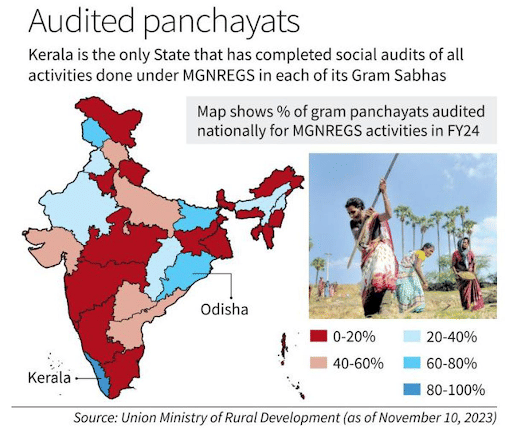
- Only six of the 34 States and union territories in the country have completed the social audit of works completed under the MGNREGS in more than 50% of gram panchayats.
- Kerala is the only State in the country to cover 100% of its gram panchayats.
- The other states that have completed social audits in more than 50% of Gram Panchayats are:
- Bihar (64.4%)
- Gujarat (58.8%)
- Jammu and Kashmir (64.1%)
- Odisha (60.42%)
- Uttar Pradesh (54.97%)
- Telangana (40.5%), Himachal Pradesh (45.32%), and Andhra Pradesh (49.7%) have completed social audits in nearly half of the gram panchayats.
- However, the completion of social audits was very low in Madhya Pradesh (1.73%), Mizoram (17.5%) Chhattisgarh (25.06%), and Rajasthan (34.74%).
What are social audits?
- A social audit is an evaluation of a scheme that is carried out on a joint basis by the government and the public, with an emphasis on people who will be affected by or benefit from the policy.
- It focuses on the social consequences of the scheme or policy.
- It helps measure, assess, and improve the performance of the scheme or policy.
- It also encourages effective leadership and strengthens supervision and accountability through evaluation and assessment.
Social audits in the MGNREGS
- According to Section 17 of the Mahatma Gandhi National Rural Employment Guarantee Act (MGNREGA), the execution of works under the scheme should be monitored by the gram sabha.
- Social audit units that must work independently of the authorities implementing the scheme are set up in each state.
- The social audit unit is responsible for flagging cases of malpractice but the State government is responsible for recovering the money and reprimanding the officials responsible.
- In December 2016, the Comptroller and Auditor General of India laid down the auditing standards for the MGNREGS scheme.
- As per these standards, each Social Audit Unit is entitled to funds equivalent to 0.5% of the MGNREGA expenditure incurred by the State in the previous year.
- Social audits of work done under the scheme involve
- Quality checks of infrastructure created under the MGNREGA
- Assessment of financial misappropriation in wages
- Examination for any procedural deviations.
Why are social audits necessary?
- The high rate of corruption has been one of the primary complaints against the scheme since its inception in 2005.
- Examples of corruption in the scheme include the siphoning of funds by officials, the issuance of fake job cards, ghost workers, etc.
- The lack of transparency and accountability in the program has only made things worse.
- As a result of the misuse of the funds, intended beneficiaries have not been able to access deserved benefits leading to poor quality of work, delays in project completion, etc.
- Improper implementation of projects has resulted in the loss of employment opportunities and adverse effects on the environment and rural infrastructure.
- Corruption leads to a reduction in the overall budget of the country's development programs which has a negative impact on the country's overall growth and development.
- Moreover, the rampant corruption in the scheme leads to a loss of public trust in the government and its programmes.
- In order to counter this, the MGNREGA Act has included social audit as an inbuilt anti-corruption mechanism.
Why have the social audits not been completed efficiently?
- According to the states, the major reason for the incomplete social audits was the lack of funds from the Union to the social audit units in the states.
- The delay in disbursal of funds to the units has led to delays in paying the salaries of the village-level auditors.
- According to the Union Ministry of Rural Development, less than 14% of the amount flagged by auditors to recover embezzled funds has been recovered so far in the present FY.
- In the ongoing financial year, misappropriation of ₹27.5 crore has been identified by the Social audit units.
- However, only 13.8% of the total embezzled funds have been recovered so far.
Impact
- The Union government has stated that funds to the states under the MGNREGS scheme would be withheld if the social audits were not conducted regularly.
- The lack of funds available to the social audit units has resulted in them having to operate with inadequate or untrained personnel, compromising the quality of the audits.
- The dismal recovery rate has further threatened the credibility of the audit process.
Kerala’s performance
- According to the state government, Kerala was the only state to hold periodic Social Audit Public Hearings also known as Janakeeya Sabhas at the panchayat level.
- The Janakeeya Sabhas are held so that public scrutiny of the audit reports can be conducted.
- In other states public scrutiny is done only at the block level.
- Kerala has taken numerous measures to make its social auditing mechanism robust such as encouraging the participation of the public in public hearings.
- A total of 15,962 grama sabhas and 941 Janakeeya Sabhas were organized for the social audit.
- There are 27 lakh people who depend on the scheme in the state.
- The government also plans to hold social audits twice a year with the efficiency of the scheme improved through a transparent process.
- According to the government, digital literacy has played a major role in ensuring the citizens of the state have access to the benefits of developmental activities.
- The state has claimed that the MGNREGS scheme has not been affected despite the drop in central allocation for the scheme.
- The number of working days under the scheme has increased in the state while it has dropped in other states across the country.
MGNREGS
Features
To learn more, click the link. |
Conclusion
- The MGNREGS social audit status highlights the need for effective implementation and financial support to combat corruption in the scheme. Timely funds and public participation are crucial for ensuring transparency, accountability, and the successful execution of developmental schemes nationwide.
(*Click this link to read prelims specific weekly current affairs articles)
FAQs
Question: What are gram sabhas?
Answer:
The Gram Sabha is the legislative body that operates at the village level and takes into account the annual budget and audit reports of the Gram Panchayat. It is a permanent body and consists of every person whose name is registered in the voter list of the perspective village. Members of the Gram Sabha are not elected and decisions taken by the Gram Sabha cannot be annulled by any other body.
Question: What is the Management Information System?
Answer:
The Management Information System (MIS) is one that helps in decision-making, control, and coordination in an organization. It is a people-oriented practice that encompasses computer techniques and services to interpret and analyze information in such a way that the results are accurate.
UPSC Mains Practice Question:
|
MCQs
Question: Among the following who are eligible to benefit from the “Mahatma Gandhi National Rural Employment Guarantee Act”? (UPSC CSE 2011)
(a) Adult members of only the scheduled caste and scheduled tribe households
(b) Adult members of below poverty line (BPL) households
(c) Adult members of households of all backward communities
(d) Adult members of any household
Answer: (d) See the Explanation
- The Mahatma Gandhi National Rural Employment Guarantee (MGNREGA) is the largest work guarantee programme in the world which was enacted in 2005 with the primary objective of guaranteeing 100 days of wage employment per year to every household whose adult members volunteer to do unskilled manual work.
- It aims at addressing the causes of chronic poverty through the ‘works’ (projects) that are undertaken, thus ensuring sustainable development.
- There is also an emphasis on strengthening the process of decentralization by giving a significant role to Panchayati Raj Institutions (PRIs) in planning and implementing these works.
Therefore, option (d) is the correct answer.
Download the PREPP App and attempt FREE IAS Exam Mock Tests and get complete study material!

Full Test - 04: UPSC CSE Prelims CSAT (Paper-II)
Full Test - 03: UPSC CSE Prelims CSAT (Paper-II)
UPSC CSE Prelims 2026 GS Paper 1 Question Paper (24-May-2026)
UPSC CSE Prelims 2026 CSAT Paper 2 Question Paper (24-May-2026)

17 February 2025 | The Hindu Must Read Articles | Current Affairs

16 February 2026 | The Hindu Must Read Articles | Current Affairs

13 February 2026 | The Hindu Must Read Articles | Current Affairs









Comments