Methane: More Potent, Less Persistent
Relevance: GS3 - Conservation, environmental pollution and degradation
(Source: The Hindu, 12/04/2023)
Click here for Daily Current Affairs
Why in the news?
Recently, a group of philanthropic bodies including the Sequoia Climate Foundation and the Bezos Earth Fund announced they would invest $450 million in solutions to tackle methane emissions.
Table of Contents
- What is methane?
- What are the major sources of methane emissions?
- Human activities
- Why is methane considered potent but less persistent?
- Why is reducing methane emissions significant?
- How much does India contribute to methane emissions?
- What can be done to reduce emissions from methane?
- Initiatives related to reducing emissions from methane
- Commitments made to reduce methane at COP-28
- FAQs
- MCQs
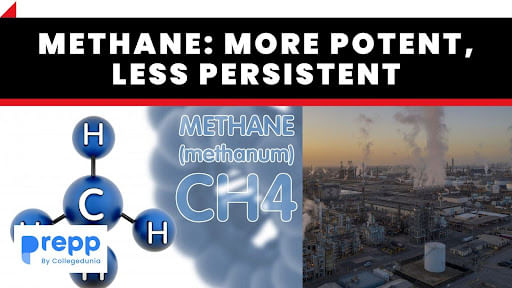
What is methane?
- Methane is one of the major greenhouse gases with a greater warming potential than carbon dioxide but a shorter life.
- Methane is a simple organic hydrocarbon.
- One molecule of methane (CH4) consists of one atom of carbon and four atoms of hydrogen.
- It occurs abundantly in nature and is the primary component of natural gas.
- It is a major greenhouse gas, contributing 16% of the global warming effect.
- It is the second largest contributor to climate change, behind carbon dioxide (CO2).
- However, there is a lack of clarity regarding the exact amount of methane that has been released into the atmosphere.
- Methane primarily leaves the atmosphere through oxidation, forming water vapour and carbon dioxide.
- Other impacts of methane on the atmosphere:
- Formation of tropospheric ozone
- Deterioration of air quality
- Health issues in humans and animals
- Reduced crop yields.
What are the major sources of methane emissions?
- 60% of methane emissions are due to anthropogenic activities while natural processes account for the remaining 40%.
- Natural sources: According to NASA, wetlands account for around one-third of global methane emissions.
- Wetlands are significant carbon sinks as they consist of waterlogged soils and permafrost.
- As a result of global warming, carbon is released into the atmosphere in the form of methane.
- Other natural sources of methane emissions are fresh waters, geologic seepage, wild animals, termites, wildfires, and vegetation.
Human activities
- Agriculture: Agriculture accounts for around one-fourth of the total methane emissions, with the major source within the sector being livestock.
- Methane is released by cows and sheep release methane during the digestion process and in their manure.
- Rice cultivation is the next major source of methane emissions in agriculture as waterlogged fields are suitable conditions for the survival of methane-emitting bacteria.
- Energy: The second largest source of anthropogenic methane emissions is the energy sector, specifically the coal, oil, and gas industries.
- Methane emissions occur both due to leakages in the infrastructure (pipeline) and direct release during maintenance operations.
- Waste: The decomposition of household wastes in landfills also acts as a major source of methane emissions.
Why is methane considered potent but less persistent?
- More potent: Methane has a Global Warming Potential (GWP) 28 times greater than that of CO2 over a 100-year timescale and 80 times greater over a 20-year scale.
- GWP is the measure of warming caused by a substance relative to that caused by the same mass of carbon dioxide.
- It is therefore more effective at trapping heat in the atmosphere than carbon dioxide.
- In addition to its direct warming potential, methane also contributes indirectly to global warming by releasing carbon dioxide.
| Substance | GWP |
|---|---|
| Carbon dioxide | 1 |
| Methane | 28 |
| Nitrous oxide | 265 |
| Sulfur hexaflouride | 23,500 |
- Less persistent: Methane has a much shorter lifespan (around 10 years) in comparison to CO2 (hundreds of years).
Why is reducing methane emissions significant?
- Methane is responsible for more than a quarter of the warming that the planet has experienced since the preindustrial era.
- Therefore, cutting methane emissions is crucial to achieve the goal of limiting global warming to within 1.5°C (as in the Paris Agreement).
- Moreover, reducing methane emissions will produce a more immediate effect on global warming.
How much does India contribute to methane emissions?
- India is the world’s fourth largest emitter of methane behind China, the United States, and Russia.
- The agriculture sector emits five times as much methane as the energy sector.
- According to India’s third Biennial Update Report, India’s methane emissions in 2016 were 409 million tonnes of CO2e.
- Of this, 73.96% was from the Agriculture sector, 14.46% from the Waste sector, 10.62% from the Energy sector, and 0.96% was from the Industrial Processes and Product Use sector.
What can be done to reduce emissions from methane?
- Fossil fuels: According to the International Energy Agency, rapid cuts in methane emissions from the fossil fuel industry could help prevent up to 0.1°C warming by 2050.
- The reduction of warming produced in this manner would be equivalent to that produced by removing all cars and trucks from roads across the world.
- Industry: Regular maintenance and repair of infrastructure where leakages are likely to occur.
- Routine practices like flaring and venting should be avoided when conducting pipeline maintenance to prevent leakages.
- This would help reduce super-emissions at no cost to the citizens and minimal cost to the producers.
- Norway has set an example in the extraction and supply of natural gas with minimum leakage that can be replicated by other countries.
- Agriculture: Stakeholders must take necessary action to ensure emissions from the agriculture sector, the major source of methane, can be reduced.
- Diets of livestock can be modified in such a manner that the health of the livestock improves while the environment is not adversely affected. For example, Harit Dhara.
- Water management techniques can be introduced in rice cultivation to reduce methane emissions.
Initiatives related to reducing emissions from methane
Global
- Methane Alert and Response System (MARS): MARS will integrate data from a large number of existing and future satellites with the ability to detect methane emissions anywhere in the world.
- It will help send out notifications to relevant stakeholders so that they act on them.
- The UN’s now fully operational methane alert and response system has already notified 127 major methane plumes across four continents.
- Global Methane Pledge: Around 100 countries pledged to reduce methane emissions by at least 30% by 2030 in comparison to 2020 levels at the Glasgow Climate Conference (UNFCCC COP 26).
- It is a US and EU-led initiative which was started in 2021.
- Global Methane Initiative (GMI): It is an international public-private partnership that aims to eliminate barriers related to the recovery and use of methane as a clean energy source.
- However, most of these countries have not explained how they plan to achieve these targets.
India
- ‘Harit Dhara’ (HD): It is an anti-methanogenic feed supplement that has been developed by the Indian Council of Agricultural Research (ICAR).
- It is capable of reducing methane emissions from cattle by 17-20% while ensuring higher milk production as well.
- India Greenhouse Gas Program: It is an industry-led voluntary framework for measuring and managing greenhouse gas emissions.
- It is an initiative led by WRI India (an NGO), the Confederation of Indian Industry (CII), and The Energy and Resources Institute (TERI).
- It aims to build comprehensive measurement and management strategies to reduce emissions and ensure the profitability, competitiveness, and sustainability of businesses and organizations in India.
- National Action Plan on Climate Change (NAPCC): It was launched in 2008 to create awareness among public representatives, government agencies, scientists, industry, and vulnerable communities.
- National Mission on Sustainable Agriculture (NMSA): It is an initiative of the Union Ministry of Agriculture and Farmers Welfare.
- It involves climate-resilient steps to contribute to reduced methane emissions in the agriculture sector such as methane reduction practices in rice cultivation.
- National Innovations in Climate Resilient Agriculture (NICRA): The Indian Council of Agricultural Research (ICAR) has developed several technologies that have the potential to mitigate methane emissions - System for Rice Intensification, Direct Seeded Rice, and Crop Diversification Programme.
- Krishi Vigyan Kendras are implementing capacity-building programmes on climate-resilient practices across the country.
- National Livestock Mission: The Department of Animal Husbandry and Dairying (DAHD) is implementing steps such as Breed Improvement and Balanced Rationing.
- It also includes steps such as green fodder production, silage making, chaff cutting, and total mixed ration.
- This is expected to help reduce methane emissions from ruminants.
- The government is attempting to incentivize cattle waste utilization and produce clean energy in villages through schemes such as
- Gobar (Galvanizing Organic Bio-Agro Resources) –Dhan’ scheme
- New National Biogas and Organic Manure Programme
Commitments made to reduce methane at COP-28
|
(*Click this link to read prelims specific weekly current affairs articles)
FAQs
Question: What is global warming?
Answer:
Global warming is a gradual increase in the earth’s temperature. It is generally caused by the greenhouse effect caused by increased levels of carbon dioxide, CFCs, and other pollutants.
Question: What is TERI?
Answer:
TERI or The Energy and Resources Institute is a non-profit research institution, based in New Delhi, that conducts research in energy, environment, and sustainable development. It was established in 1974 and aims to formulate local and national level strategies to tackle critical issues. Its key focus areas include clean energy, water management, pollution management, sustainable agriculture, and climate resilience.
UPSC Mains Practice Question:
|
MCQs
Question: Among the following crops, which one is the most important anthropogenic source of both methane and nitrous oxide? (UPSC CSE 2022)
(a) Cotton
(b) Rice
(c) Sugarcane
(d) Wheat
Answer: (b) See the Explanation
- Methane and nitrous oxide are greenhouse gases that contribute to global warming.
- Flooded rice cultivation has been identified as one of the leading global agricultural sources of anthropogenic methane (CH4) emissions.
- Paddies are a potential source of anthropogenic nitrous oxide (N2O) emission as both the soil and the rice plants emit N2O into the atmosphere.
Therefore, option (b) is the correct answer.
Question: Consider the following:
- Carbon monoxide
- Methane
- Ozone
- Sulfur dioxide
Which of the above are released into the atmosphere due to the burning of crop/biomass residue? (UPSC CSE 2019)
(a) 1 and 2 only
(b) 2, 3, and 4 only
(c) 1 and 4 only
(d) 1,2,3 and 4
Answer: (d) See the Explanation
- Biomass burning is a source of greenhouse gases, carbon dioxide, methane, and nitrous oxide.
- It is also a source of chemically active gases, including carbon monoxide, non-methane hydrocarbons, and nitric oxide.
- These gases, along with methane, lead to the chemical production of tropospheric ozone.
Therefore, option (d) is the correct answer.
Question: “System of Rice Intensification” of cultivation, in which alternate wetting and drying of rice fields is practiced, results in:
- Reduced seed requirement
- Reduced methane production
- Reduced electricity consumption
Select the correct answer using the code given below: (UPSC CSE 2022)
(a) 1 and 2 only
(b) 2 and 3 only
(c) 1 and 3 only
(d) 1, 2 and 3
Answer: (d) See the Explanation
- The System of Rice Intensification (SRI) was first developed in Madagascar in the 1980s and since then several countries in the world have been practicing it, including India. It promises to save 15 to 20% groundwater and improve rice productivity.
- Under SRI 2kg seed is required to grow a nursery for one acre against 5kg seed required in the traditional method. Hence statement 1 is correct.
- SRI is a holistic approach to sustainable rice cultivation. By minimizing water use and alternating wet and dry conditions, it minimizes methane production. Hence statement 2 is correct.
- With less consumption of water, the adoption of SRI saves total energy inputs. A study found in Vietnam has also proved that applying SRI methods can save around 23% of energy inputs while increasing energy outputs by 11%. Hence statement 3 is correct.
Therefore, option (d) is the correct answer.
Download the PREPP App and attempt FREE IAS Exam Mock Tests and get complete study material!

Full Test - 04: UPSC CSE Prelims CSAT (Paper-II)
Full Test - 03: UPSC CSE Prelims CSAT (Paper-II)
UPSC CSE Prelims 2026 GS Paper 1 Question Paper (24-May-2026)
UPSC CSE Prelims 2026 CSAT Paper 2 Question Paper (24-May-2026)

17 February 2025 | The Hindu Must Read Articles | Current Affairs

16 February 2026 | The Hindu Must Read Articles | Current Affairs

13 February 2026 | The Hindu Must Read Articles | Current Affairs









Comments