Measures On To Expand Cultivation Of GI-tagged Onattukara Sesame
Relevance: GS3 - Major crops-cropping patterns in various parts of the country, - different types of irrigation and irrigation systems storage, transport and marketing of agricultural produce and issues and related constraints; e-technology in the aid of farmers. Issues relating to intellectual property rights.
(Source: The Hindu, 11/21/2023)
Click here for Daily Current Affairs
Why in the news?
- Recently, authorities in Kerala have announced the expansion of the area cultivated under Onattukara sesame.
- Onattukara sesame is a medically useful variety of Sesame that has received a GI tag.
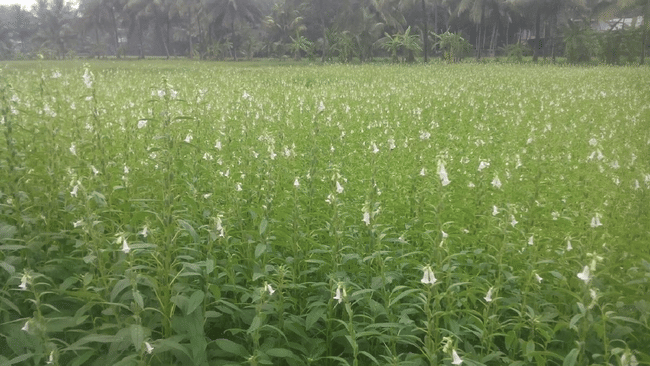
What is Onattukara sesame?
- It is a particular variety of sesame that is cultivated in the state of Kerala.
- It is currently grown on around 600 hectares of land across 43 local bodies in the Alappuzha, Kollam, and Pathanamthitta districts.
- It has received a GI tag due to its unique properties.
- The Onattukara Vikasana Agency (OVA) is the registered owner of the GI tag.
- The oil produced from this variety of sesame also has health benefits.
Medicinal Properties
- It has higher levels of Vitamin E and antioxidants than varieties of sesame grown in other regions.
- The relatively higher antioxidant content in Onattukara sesame helps fight free radicals, which destroy body cells.
- It contains oleic acid, linoleic acid, palmitoleic acid, etc which help maintain good health.
- It has a high content of unsaturated fat which makes it beneficial for heart patients.
Other varieties of sesame grown in the region
- Traditional Ayali variety, Kayamkulam-1, Thilak, Thilathara and Thilarani varieties.
- All the non-traditional varieties have been developed by the Onattukara Regional Agricultural Research Station (ORARS).
What measures have been taken to promote Onattukara sesame?
- The OVA has expressed plans to expand the area under sesame cultivation in the region to 2,000 hectares.
- A scheme has been launched to financially incentivize farmers growing sesame on their fields and homesteads within the Thekkekara Krishi Bhavan limits in Mavelikara.
- It was launched as a joint initiative between the local Krishi Bhavan, Onattukara Vikasana Agency, the Onattukara Regional Agricultural Research Station, Krishi Vigyan Kendra, Kayamkulam, and Mavelikara Thekkekara panchayat.
- Aim and incentives: Increase the area under sesame cultivation.
- Individuals, farming collectives, Kudumbashree groups, self-help groups, and joint liability groups will be given incentives for conducting sesame cultivation
- The incentives include financial assistance worth ₹40 per cent.
- The Thekkekara Krishi Bhavan would distribute seeds to farmers under the scheme.
- The sesame produced under the scheme would be procured by the OVA at the market price.
- Farmers and farming groups have also been permitted to utilize the labor and tractor of the Thekkekara Karshika Karma Sena for agricultural activities including preparing the field.
Other steps
- The OVA has planned to procure the sesame from farmers at ₹300 per kg.
- In January 2023, the OVA urged the government to announce a minimum support price for the procurement of Onattukara sesame.
- It also submitted a proposal to the Union Ministry of Panchayati Raj and the Kerala government to establish a sesame oil processing and value-addition plant at the ORARS.
- It has also included the expansion of the processing unit in Kulasekharapuram which will help in the sale of the Onattukara brand sesame oil.
- Steps have also been taken to collaborate with Oushadhi, Ayurveda resorts, and entrepreneurs and improve the marketing of sesame products via e-commerce and international markets.
Impact of GI tag on Onattukara sesame
- Farmers have been the biggest beneficiaries of the GI tag.
- Price: Since, the Onattukara sesame is a GI-tagged product, its price in the domestic and international markets has increased, benefitting farmers and other stakeholders.
- Acreage: This has been predicted to improve sesame acreage in the region leading to an increase in production.
- Popularity and awareness: The GI tag has raised awareness about its medicinal properties leading to greater demand for local needs and exports.
What is a GI tag?
- A geographical indication or GI is a sign used on products that have a specific geographical origin and possess qualities or a reputation that are due to that origin.
- It is a form of Intellectual Property Rights (IPR).
- It must possess a good reputation and distinct qualities of the place of origin and are generally registered on products produced by rural, marginal, and indigenous communities over generations.
- Only registered users have the right to use the product name of a GI-tagged product.
- However, it does not entitle the holder to prevent someone from making a product using the same techniques used in the standards for that indication.
- GI tags are issued by the Geographical Indication Registry under the Department of Industry Promotion and Internal Trade, Ministry of Commerce and Industry.
- The registration of a GI tag is valid only for a period of 10 years although it can be renewed from time to time for a further period of 10 years each.
- Type of Products: GI tags are used on the following types of products.
- Handicrafts
- Food items
- Wine & Drinks
- Industrial Products
- Agricultural Products
- Laws and treaties related to GI tags:
| WIPO | WTO | Indian laws |
|---|---|---|
|
|
|
(*Click this link to read prelims specific weekly current affairs articles)
FAQs
Question: What are Krishi Vikas Kendras?
Answer:
Krishi Vigyan Kendras are the centers for agriculture extensions created by the Indian Council for Agricultural Research (ICAR) and its affiliated institutions at the district level. It is an integral part of the National Agricultural Research System (NARS) and provides various types of farm support to the agricultural sector including awareness building about improved agricultural technologies. The first KVK was established in 1974 at Puducherry.
Question: What are anti-oxidants?
Answer:
Antioxidants, also known as free-radical scavengers, are substances that can prevent or slow the damage to cells caused by free radicals.
MCQs
Question: India enacted The Geographical Indications of Goods (Registration and Protection) Act, 1999 in order to comply with the obligations to (UPSC 2018)
(a) ILO
(b) IMF
(c) UNCTAD
(d) WTO
Answer: (d) See the Explanation
- The TRIPS Agreement is a part of the WTO agreements and as a member of the WTO, India is obligated to provide protection to geographical indications in accordance with the TRIPS Agreement.
- India enacted the Geographical Indications of Goods (Registration and Protection) Act, 1999 in order to comply with its obligations under the WTO.
Therefore, option (d) is the correct answer.
Question: The FAO accords the status of ‘Globally Important Agricultural Heritage System (GIAHS)’ to traditional agricultural systems. What is the overall goal of this
initiative? (UPSC 2016)
- To provide modern technology, training in modern farming methods, and financial support to local communities of identified GIAHS so as to greatly enhance their agricultural productivity
- To identify and safeguard eco-friendly traditional farm practices and their associated landscapers, agricultural biodiversity, and knowledge systems of the local communities.
- To provide Geographical Indication status to all the varieties of agricultural produce in such identified GIAHS
Select the correct answer using the code given below.
(a) 1 and 3 only
(b) 2 only
(c) 2 and 3 only
(d) 1, 2 and 3
Answer: (b) See the Explanation
- GIAHS aims to protect traditional agricultural systems. It will not provide any modern technology and training. Hence statement 1 is incorrect.
- GIAHS aims to identify and safeguard eco-friendly traditional farm practices and their associated landscapes, agricultural biodiversity, and knowledge systems of the local communities. Hence statement 2 is correct.
- There is no provision regarding providing GI tags to all the varieties of agricultural produce in such identified GIAHS. Hence statement 3 is incorrect.
Therefore, option (b) is the correct answer.
Download the PREPP App and attempt FREE IAS Exam Mock Tests and get complete study material!

Full Test - 04: UPSC CSE Prelims CSAT (Paper-II)
Full Test - 03: UPSC CSE Prelims CSAT (Paper-II)
UPSC CSE Prelims 2026 GS Paper 1 Question Paper (24-May-2026)
UPSC CSE Prelims 2026 CSAT Paper 2 Question Paper (24-May-2026)

17 February 2025 | The Hindu Must Read Articles | Current Affairs

16 February 2026 | The Hindu Must Read Articles | Current Affairs

13 February 2026 | The Hindu Must Read Articles | Current Affairs









Comments