Mars Orbiter Mission (MOM) – Science & Technology Notes
The Mars Orbiter Mission (MOM) of India, also known as Mangalyaan (Hindi for "Mars Craft"), is the country's first mission to Mars. The mission's goal is to test key technologies for interplanetary exploration and to study the Martian surface and atmosphere from orbit with its five science instruments. In this article, we will discuss in detail regarding Mars Orbiter Mission which will be helpful for UPSC exam preparation.
Table of Contents
What is Mars Orbiter Mission?
- On November 5, 2013, India's first interplanetary mission to Mars, the Mars Orbiter Mission (MOM), was launched aboard PSLV-C25.
- ISRO has become the fourth space agency to successfully launch a spacecraft into orbit around Mars.
- Despite having a mission life of 6 months, MOM will have been in orbit for 7 years on September 24, 2021.
- The primary goals of this mission are technological in nature, and include the design, development, and launch of a Mars Orbiter spacecraft capable of operating autonomously during the journey phase; Mars orbit insertion / capture; and in-orbit phase around Mars.
- MOM carries five scientific payloads to investigate the Martian surface, morphology, mineralogy, and atmosphere.
- ISRO lost contact with Mangalyaan in April 2022 after it passed into Mars' shadow for an extended period of time.
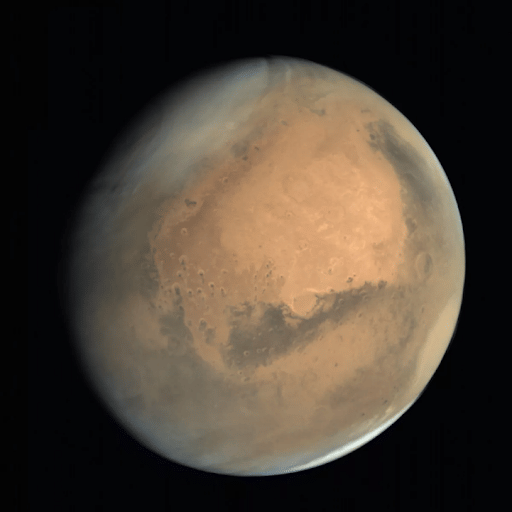
Global View of Mars from MOM
| Other Relevant Links | |
|---|---|
| GSLV and Various Engine | Recent National and International Space Missions |
| Cryogenic rockets | Scramjet Engine |
| GSLV Mk III-D1 OR GSAT-19 Mission | ISRO’s World Record PSLV C37 Launch |
| Global Positioning System | Galileo |
| GLONASS | IRNSS |
| GAGAN | Chandrayaan – I & II |
Mars Orbiter Mission – Objectives
One of the primary goals of India's first Mars mission is to develop the technologies required for the design, planning, management, and operation of an interplanetary mission. The mission's primary goals are as follows:
Technological Objectives
- Design and construction of a Mars orbiter capable of surviving and performing Earthbound manoeuvres, a 300-day cruise phase, Mars orbit insertion / capture, and an on-orbit phase around Mars.
- Deep space communication, navigation, mission planning, and management are all possible.
- Incorporate autonomous features to deal with unexpected situations.
Science Objectives
Indigenous scientific instruments explore Mars' surface features, morphology, mineralogy, and Martian atmosphere.
Mars Orbiter Mission – Scientific Payloads
- In the context of planetary evolution and extraterrestrial life, scientists continue to be fascinated by Mars.
- Based on our current understanding, Mars, which was previously thought to be a warm and wet planet, is now thought to be dry with a thin atmosphere.
- The mechanism by which this evolution occurred is still being studied. In this context, the Indian Mars Orbiter Mission carried the five scientific payloads listed below:
1) Mars Colour Camera (MCC)
- The Mars Colour Camera is a multi-purpose snap shot camera with an R-G-B Bayer pattern that maps various morphological features on Mars and returns visual images of Mars and its surroundings.
- MCC is also expected to observe and contribute to our understanding of known Mars events such as dust storms and dust devils.
2) Thermal Infrared Imaging Spectrometer (TIS)
- The Thermal Infrared Imaging Spectrometer is a grating-based spectrometer that will measure Martian surface thermal emission.
- TIS will process and analyse the data it collects in order to:
- Map the temperature of the Martian surface
- Investigate Mars' composition and mineralogy
3) Mars Methane Sensor (MSM)
- The Methane Sensor for Mars (MSM) is a differential radiometer that operates in the short wave infrared (SWIR) region and is based on Fabry-Perot Etalon filters. It measures solar radiance in two SWIR channels.
- The primary scientific goal of this payload is to detect and measure methane concentrations in the Martian atmosphere (if they exist) under clear sky conditions.
- It can measure the concentration of CH4 in the Martian atmosphere to within a few parts per billion.
4) Mars Exospheric Neutral Composition Analyzer (MENCA)
- The Mars Exospheric Neutral Composition Analyzer (MENCA)'s primary scientific goal is to investigate the neutral composition and density distribution of the Martian exosphere, as well as its radial, diurnal, and possibly seasonal variations.
5) Lyman Alpha Photometer (LAP)
- It will assist in studying the constituents of the Martian atmosphere.
What is the need to explore Mars?
- Understanding the solar system's history and evolution: Mars is considered a "sister planet" to Earth, and studying it can help scientists understand the solar system's early history and evolution as a whole.
- Searching for signs of past or present life: Mars may have once had life-supporting conditions, and there is evidence that liquid water may still exist on or beneath the planet's surface.
- Developing new technologies: The challenges of exploring Mars, such as the planet's distance from Earth and extreme environmental conditions, necessitate the development of new space exploration technologies and systems.
- Inspiring the public: Space exploration has the potential to capture the public's imagination and inspire people to pursue careers in science, technology, engineering, and mathematics.
- Establishing a human presence beyond Earth: Some people believe that it is critical for humanity to establish a permanent presence beyond Earth in order to ensure our species' long-term survival and prosperity.
Mars Orbiter Mission – Key Findings
- The solar coronal dynamics were studied using S-band radio signals from the MOM during the post-maxima phase of solar cycle 24.
- Enhanced Martian atmosphere escape during global dust storm.
- MENCA discovered 'hot' (suprathermal - more energetic than thermal) Argon in Mars' exosphere. During this observation, Mars was at perihelion.
- For the first time, observations from the Mars Exospheric Neutral Composition Analyzer (MENCA) show that the abundance of oxygen exceeds that of carbon dioxide at an altitude of ~270 ±10 km during the perihelion evening hours.
- Mars Colour Camera (MCC) observations were used to estimate atmospheric optical depth (AOD), and the studies revealed the presence of lee-wave clouds above the southern wall of Valles Marineris.
Mars Orbiter Mission – Achievements
- MOM's highly elliptical orbit geometry allows its Camera (MCC) to take snapshots of the entire disc of Mars at its farthest point and finer details at its closest point.
- The far side of Deimos, one of Mars' moons, was observed for the first time.
- One of the scientific payloads onboard MOM, the Mars Colour Camera, has produced over 1100 images and published a Mars Atlas.
- India's ability to successfully complete the complex mission to Mars in its first attempt at a low cost (Rs 450 Cr) has captured the world's attention and propelled India's image as a credible space fairing nation to new heights.
- This capability could pave the way for more opportunities in Space Commerce, such as launch services and satellite imagery marketing.
- The Mars Orbiter Mission is a national pride mission that has captured the attention of students, the general public, the media, and the international science/tech community.
- The Mangalyaan mission was the first time India sent a spacecraft to another planet, and its success has helped to raise the country's international standing in the field of space exploration.
- The Mangalyaan spacecraft has been collecting data on Mars' surface features and mineralogy, as well as the planet's atmospheric processes and trace gases. This information will help scientists better understand Mars' geological and climatological history.
- The Mangalyaan spacecraft has also been studying the surface radiation environment on Mars, which will help scientists better understand the effects of radiation on the planet's surface and atmosphere.
- The Mangalyaan spacecraft has been studying the interplanetary medium and the interaction between the solar wind and the Martian atmosphere, which will help scientists understand the processes that shape the Martian environment.
- The data collected by the Mangalyaan spacecraft will be used to help design and plan future Mars missions, both unmanned and manned.
- India is the world's first country to achieve Mars Orbit Insertion on the first try.
- MOM is the world's most affordable interplanetary space mission. It is the first Indian spacecraft to cross the Van Allen Belt 39 times.
Mars Orbiter Mission - Challenges
- Mars is much farther away from Earth than the Moon, so travelling there takes longer and requires more fuel.
- Because of the distance between Earth and Mars, signals take time to travel between the two planets, making communication and data transmission difficult.
- Propelling the spacecraft with enough velocity to escape Earth's gravitational pull, guiding it along the proper trajectory over vast distances, and finally slowing it down enough to enter orbit around MARS.
- Because communication signals to and from ground stations could take minutes to reach the spacecraft, it needed to be capable of operating autonomously.
- Since 1960, there have been 51 global missions to Mars, with an overall success rate of 42%, indicating that it was a difficult mission.
- Since Mars missions typically take several months to complete, spacecraft and their instruments must be capable of operating for extended periods of time without the need for maintenance or repair.
- Due to the distance between Earth and Mars, mission controllers cannot directly control the spacecraft in real time. Instead, the spacecraft must be capable of making decisions and acting autonomously using onboard computers and software.
- Mars has a thin atmosphere, low air pressure, extreme temperature variations, and high levels of radiation, all of which can pose problems for spacecraft and their instruments.
- Landing a spacecraft on the surface of Mars is especially difficult due to the planet's thin atmosphere, which makes it difficult to slow down and achieve a soft landing.
- Sending humans to Mars would present additional challenges, such as providing them with a habitable habitat, life support systems, and other resources necessary for survival on the planet.
Conclusion
ISRO is planning more missions to explore the inner solar system, such as the Venus orbiter Shukrayaan and the Aditya-L1 solar observatory, based on the experience gained from Mangalyaan and the technologies developed for it. ISRO also intends to launch Mangalyaan 2 with an upgraded orbiter and 100 kilogrammes of scientific instruments in 2024 or 2026. Overall, the Mangalyaan mission has provided access to the inner solar system for India's fledgling planetary programme.
| Other Relevant Links | |
|---|---|
| Science & Technology Policy in India | Scientific Policy Resolution 1958 |
| Science & Technology Policy of 1983 | Science & Technology Policy of 2003 |
| Science, Technology and Innovation Policy 2013 | New Initiatives Aligned with the National Agenda |
| India and World collaboration in science projects | Technology Vision Document 2035 |
FAQs
Question: What is the Mars Orbiter Mission (MOM)?
Answer: Mars Orbiter Mission (MOM) is India's first interplanetary mission, launched by ISRO in 2013. It aims to study the Martian atmosphere, surface, and mineral composition, making India the first Asian country to reach Mars.
Question: What are the objectives of MOM?
Answer: The primary objectives of MOM are to study the Martian surface, morphology, atmosphere, and mineral composition from orbit. It also aims to demonstrate ISRO's technological capability in interplanetary missions.
Question: How successful was the Mars Orbiter Mission (MOM)?
Answer: MOM was highly successful, as it reached Mars' orbit in 2014, just 11 months after launch. It made India the first Asian nation to reach Mars and the fourth space agency globally to achieve this feat.
Question: What instruments are onboard the Mars Orbiter Mission?
Answer: MOM is equipped with five scientific instruments: a Mars Colour Camera (MCC), Thermal Infrared Imaging Spectrometer (TIS), Methane Sensor for Mars (MSM), Lyman Alpha Photometer (LAP), and a Photometric Camera (PC).
Question: Why is the Mars Orbiter Mission significant for India?
Answer: MOM's success is a major achievement for India, demonstrating ISRO's growing capabilities in space exploration. It has placed India in an elite group of countries capable of interplanetary travel.
MCQs
1. What was the primary objective of the Mars Orbiter Mission (MOM)?
A) To establish a Martian colony
B) To study the surface, atmosphere, and mineral composition of Mars
C) To send human astronauts to Mars
D) To send satellites for communication
Answer: (B) See the Explanation
Explanation: The Mars Orbiter Mission (MOM) was primarily launched to study the surface, atmosphere, and mineral composition of Mars from orbit, helping scientists understand the planet’s conditions and evolution.
2. Which space agency launched the Mars Orbiter Mission (MOM)?
A) NASA
B) ISRO
C) ESA
D) Roscosmos
Answer: (B) See the Explanation
Explanation: The Mars Orbiter Mission (MOM) was launched by the Indian Space Research Organisation (ISRO) on November 5, 2013, making India the first Asian country to reach Mars.
3. How long did it take the Mars Orbiter Mission (MOM) to reach Mars?
A) 6 months
B) 8 months
C) 11 months
D) 15 months
Answer: (C) See the Explanation
Explanation: The Mars Orbiter Mission (MOM) reached Mars in 11 months after its launch, making it one of the fastest missions to reach Mars.
4. What are the key instruments onboard the Mars Orbiter Mission (MOM)?
A) Mars Colour Camera, Thermal Infrared Imaging Spectrometer, Methane Sensor
B) Mars Colour Camera, Lyman Alpha Photometer, X-ray Spectrometer
C) Mars Colour Camera, Photometric Camera, Methane Sensor
D) Mars Colour Camera, Gravitational Wave Sensor, Photometric Camera
Answer: (A) See the Explanation
Explanation: MOM is equipped with five scientific instruments: Mars Colour Camera (MCC), Thermal Infrared Imaging Spectrometer (TIS), Methane Sensor for Mars (MSM), Lyman Alpha Photometer (LAP), and a Photometric Camera (PC).
5. When was the Mars Orbiter Mission (MOM) launched?
A) 2011
B) 2012
C) 2013
D) 2014
Answer: (C) See the Explanation
Explanation: The Mars Orbiter Mission (MOM) was launched on November 5, 2013, by the Indian Space Research Organisation (ISRO).
GS Mains Questions and Model Answers
Q1: Discuss the technological and scientific challenges faced by ISRO during the Mars Orbiter Mission. How did ISRO overcome these challenges?
Answer: The Mars Orbiter Mission (MOM) presented several technological and scientific challenges for ISRO, including the complexity of interplanetary travel, ensuring the spacecraft's survival in harsh conditions, and achieving precise orbital insertion. One major challenge was the limited budget and timeframe—ISRO had just 11 months to reach Mars. To overcome these challenges, ISRO developed cost-effective solutions, such as using indigenously developed technology and simplifying the design to ensure reliability. The mission's success in reaching Mars orbit on the first attempt demonstrated ISRO's technological capabilities and efficient use of resources.
Q2: What is the significance of the Mars Orbiter Mission (MOM) in the context of India's space exploration ambitions?
Answer: The success of MOM marked a milestone in India's space exploration ambitions, showcasing ISRO's ability to successfully undertake interplanetary missions. MOM's success not only made India the first Asian country to reach Mars but also placed it among the four space agencies worldwide capable of interplanetary exploration. This achievement has bolstered India's global position in space science, demonstrated the viability of cost-effective space missions, and opened up new possibilities for future interplanetary missions, including those targeting Venus, Jupiter, and beyond.
Q3: Analyze the role of the Mars Orbiter Mission (MOM) in advancing scientific knowledge about Mars and space exploration.
Answer: MOM has significantly advanced scientific knowledge about Mars, contributing valuable data on the Martian atmosphere, surface, and mineral composition. The mission's findings, such as detecting methane in the Martian atmosphere, are crucial for understanding the planet’s potential to support life. The thermal infrared imaging and surface mapping conducted by MOM have provided insights into Martian weather patterns, topography, and mineral distribution. MOM's success has also paved the way for further exploration missions and deepened humanity's understanding of the solar system and interplanetary science.
Previous Year Questions on Space Exploration
1. UPSC CSE Mains 2020 (GS Paper 3):
Question: "What are the key challenges faced by India’s space agency (ISRO) in interplanetary missions? Discuss the success of the Mars Orbiter Mission (MOM) in overcoming these challenges."
Answer: India’s space agency faced challenges in terms of technological complexity, limited budget, and the tight timeline for interplanetary missions. MOM's success in overcoming these challenges was achieved through cost-effective solutions, efficient use of resources, and indigenously developed technology.
2. UPSC CSE Mains 2018 (GS Paper 2):
Question: "Discuss the significance of India’s Mars Orbiter Mission in terms of international collaboration and scientific progress."
Answer: MOM enhanced India’s international standing by showcasing its technological expertise and contribution to space science. It also opened avenues for future collaborations with space agencies around the world, strengthening scientific progress in the field of planetary exploration.
Download the PREPP App and attempt FREE IAS Exam Mock Tests and get complete study material!

Full Test - 04: UPSC CSE Prelims CSAT (Paper-II)
Full Test - 03: UPSC CSE Prelims CSAT (Paper-II)
UPSC CSE Prelims 2026 GS Paper 1 Question Paper (24-May-2026)
UPSC CSE Prelims 2026 CSAT Paper 2 Question Paper (24-May-2026)

17 February 2025 | The Hindu Must Read Articles | Current Affairs

16 February 2026 | The Hindu Must Read Articles | Current Affairs

13 February 2026 | The Hindu Must Read Articles | Current Affairs









Comments