Majority Of Cities Far From Clean Air Target, Says Study
Relevance: GS3 - Environmental pollution and degradation, environmental impact assessment.
(Source: The Hindu, 01/10/2024)
Click here for Daily Current Affairs
Why in the news?
- Recently, an analysis by Respirer Living Sciences and Climate Trends revealed that 27 out of 49 cities, with consistent data available, displayed a decline in PM 2.5 levels.
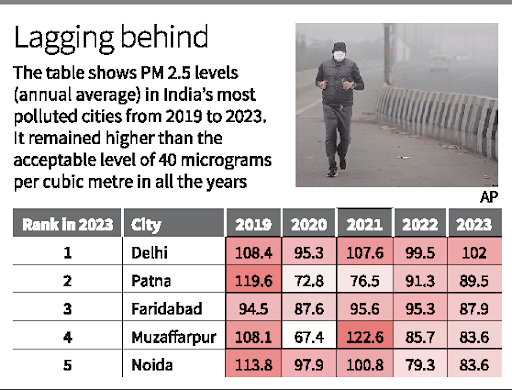
- The government had launched the National Clean Air Programme (NCAP) to reduce average particulate matter concentrations by 40% by 2026 but major cities have shown only marginal declines or increased pollution loads.
Table of Contents
What are the main findings of the ‘Respirer Living Sciences and Climate Trends’ report?
- 27 out of 49 cities showed a decline in PM 2.5 while four met or exceeded the targeted decline.
- The 49 cities had PM data available consistently over five years out of the 92 cities assessed for the study.
- Only marginal declines or increasing pollution loads of PM 2.5 were reported in major cities - Delhi (decrease by 5.9%), Navi Mumbai (46% rise), Mumbai (38.1% rise), Ujjain (46% rise), Jaipur (13%), Visakhapatnam (12% rise) and Pune (10% rise).
- Between 2019 and 2023, Varanasi reported a 72% average reduction in PM 2.5 levels.
- Agra too reported a 53% decline as did Jodhpur with a 50% decline.
- Jodhpur registered a 50% decline compared to 2019 levels, Kanpur (50%), Meerut (42%), and Lucknow (41%).
- All the cities, excluding Jaipur, that have already achieved the 2026 reduction targets are from Uttar Pradesh.
- PM 10 levels: Only Varanasi and Talcher have met the 40% target for reduction.
- Varanasi reported a 69% reduction in PM 10 levels.
What are the factors identified by the study for the diversity in PM concentrations?
- Vulnerability of the Indo-Gangetic Plain: 18 of the top 20 cities (minus Guwahati and Rourkela) with the highest PM 2.5 levels in 2023 were located in the Indo-Gangetic Plain (IGP).
- This indicated the region’s vulnerability to particulate matter pollution.
- Adverse meteorological conditions in the region prevent the particulate matter from being flushed out during the winter when PM concentrations peak.
- Number and spread of air quality monitors: Continuous ambient air quality monitors track fluctuations in chemical pollutants throughout the day.
- Large cities like Mumbai and Delhi have several such stations spread across them while smaller cities have very few such monitors.
- Just four of the 92 cities assessed have more than 10 stations with the majority of cities having less than 5 stations.
- Emission sources: The study found that PM2.5 and PM10 concentrations varied across cities due to the diversity in emissions sources.
- Natural sources such as volcanic eruptions, soil erosion, sea salt, etc, and anthropogenic sources such as traffic, agriculture, industry, etc.
National Clean Air Programme (NCAP)
- The National Clean Air Programme is a long-term and time-bound pollution-control initiative launched by the Union Ministry of Environment to reduce the concentration of coarse (PM10) and fine (PM2.5) particular matter.
- Aim: Reduce average particulate matter concentrations by 40% by 2026 compared to 2017 in 131 cities.
- It initially aimed to reduce pollution by 20-40% by 2024.
- Under the NCAP, city-specific action plans consisting of steps to enhance the network of air quality monitors, lowering vehicle and industrial emissions, building public awareness, etc have been developed.
- Progress:
- Efforts to reduce particulate matter pollution in cities have been fairly successful with reductions observed in top polluted cities.
- The revised goal of reducing PM concentration by 40% by 2026 indicates a commitment to the management and mitigation of air pollution.
- 132 non-attainment cities have been identified across the country based on air quality data from 2014-2018.
- Committees have been constituted at the central and state level to monitor the implementation of the city-specific action plans.
- A National Knowledge Network (NKN) has been constituted with a group of experts from reputed academic or research institutes to help the State and city administrations strategize and implement measures to tackle air pollution effectively and efficiently.
- PRANA portal: The Portal for Regulation of Air Pollution in Non-Attainment Cities (PRANA) was launched by the Union Ministry to provide information on policies, programmes, schemes, etc, and monitoring and feedback on such efforts for the improvement of air quality.
- Challenges:
- An increase in pollution concentrations has been observed in some urban areas.
- The programme lacks a robust fiscal and funding strategy which has hampered its effectiveness.
- Pollution reduction targets have not been made legally binding on the states.
- Inadequate monitoring of particulate matter concentrations.
Particulate Matter
|
Way forward
- Improved monitoring: Cities must add new air quality monitoring stations and enhance monitoring to improve understanding of pollution and implement mitigation.
- Coordinated approach: Close coordination across local and national jurisdictional boundaries will help implement cost-effective strategies to improve air quality management.
- Policy reforms: The approach towards improving air quality and the policies related to it must be updated to ensure appropriate air quality is maintained.
Conclusion
- The study by Respirer Living Sciences and Climate Trends underscores the persistent challenge related to air pollution in Indian cities as many cities have failed to meet the targets under the National Clean Air Programme. Therefore, r targeted interventions, enhanced monitoring infrastructure, and sustainable development are necessary to tackle particulate matter pollution in vulnerable cities.
(*Click this link to read prelims specific weekly current affairs articles)
FAQs
Question: What is air pollution?
Answer:
Air pollution is the release of pollutants harmful to human health and the environment into the atmosphere. It leads to the death of around seven million people per year globally with nine out of ten people breathing air that exceeds the WHO's pollution guideline levels.
Question: what is the National Knowledge Network (NKN)?
Answer:
NKN is a state-of-the-art pan-India network and is a revolutionary step towards creating a knowledge society without boundaries. It aims to connect all knowledge and research institutes in the country, utilizing a high-speed, low-latency network.
UPSC Mains Practice Question:
|
MCQs
Question: In the context of WHO Air Quality Guidelines, consider the following statements:
- The 24-hour mean of PM2.5 should not exceed 15 ug/m3 and annual mean of PM2.5 should not exceed 5 µg/m³.
- In a year, the highest levels of ozone pollution occur during periods of inclement weather.
- PM10 can penetrate the lung barrier and enter the bloodstream.
- Excessive ozone in the air can trigger asthma.
Which of the statements given above are correct? (2022)
(a) 1, 3 and 4
(b) 1 and 4 only
(c) 2, 3 and 4
(d) 1 and 2 only
Answer: (b) See the Explanation
- The World Health Organization(WHO) has released the Global Air Quality Guidelines(AQGs) which recommend air quality levels for six pollutants - particulate matter (PM) 2.5 and PM 10, ozone (O3), nitrogen dioxide (NO2), sulfur dioxide (SO2) and carbon monoxide (CO). Hence statement 1 is correct.
- Ozone at ground level is formed by the reaction with sunlight (photochemical reaction) of pollutants such as nitrogen oxides (NOx) from vehicle and industry emissions and volatile organic compounds (VOCs) emitted by vehicles, solvents, and industry.
- As a result, the highest levels of ozone pollution occur during periods of sunny weather and not during inclement weather. Hence, statement 2 is incorrect.
- PM affects more people than any other pollutant. It consists of particles with a diameter of 10 microns or less, (≤ PM10) and can penetrate and lodge deep inside the lungs while those of a diameter of 2.5 microns or less, (≤ PM2.5) can penetrate the lung barrier and enter the blood system.
- Chronic exposure to particles contributes to the risk of developing cardiovascular and respiratory diseases, as well as lung cancer. Hence, statement 3 is incorrect.
- Excessive ozone in the air can have a marked effect on human health. It causes breathing problems, triggers asthma, reduces lung function, and causes lung diseases.
- Ozone triggers asthma because it is very irritating to the lungs and airways. Hence statement 4 is correct.
Therefore, option (b) is the correct answer.
Question: Consider the following statements: [2017]
- Climate and Clean Air Coalition (CCAC) to Reduce Short Lived Climate Pollutants is a unique initiative of G20 group of countries.
- The CCAC focuses on methane, black carbon and hydrofluorocarbons.
Which of the statements given above is/are correct?
(a) 1 only
(b) 2 only
(c) Both 1 and 2
(d) Neither 1 nor 2
Answer: (b) See the Explanation
- In 2012, the governments of Bangladesh, Mexico, Sweden, Ghana, Canada, and the United States joined forces with the United Nations Environment Programme (UNEP) to launch efforts to address short-lived climate emissions as a joint and pressing issue.
- They established the Climate & Clean Air Coalition to advocate for immediate action on climate change, agricultural security, public health, and energy economy. Hence, statement 1 is incorrect.
- Following carbon dioxide, the most significant contributions to the man-made global greenhouse effect are short-lived climate contaminants such as methane, tropospheric ozone, black carbon, and hydrofluorocarbons. Hence, statement 2 is correct.
Therefore, option (b) is the correct answer.
Download the PREPP App and attempt FREE IAS Exam Mock Tests and get complete study material!
Live Test : UPSC IAS : GS - Modern History - Subject Knowledge Test

Live Test : UPSC CSE Prelims CSAT (Paper-II) (Oct 14 - 17)
Full Test - 04: UPSC CSE Prelims CSAT (Paper-II)
Full Test - 03: UPSC CSE Prelims CSAT (Paper-II)
UPSC CSE Prelims 2026 GS Paper 1 Question Paper (24-May-2026)
UPSC CSE Prelims 2026 CSAT Paper 2 Question Paper (24-May-2026)

17 February 2025 | The Hindu Must Read Articles | Current Affairs

16 February 2026 | The Hindu Must Read Articles | Current Affairs

13 February 2026 | The Hindu Must Read Articles | Current Affairs









Comments