Maharashtra State Govt Accepts Shinde Panel Report On Procedure To Grant Kunbi Certificates To Marathas
Relevance: Prelims: Fundamental Rights, ; GS2 - Polity & Governance
(Source: The Hindu, 11/01/2023)
Click here for Daily Current Affairs
Why in the news?
- Recently, the Maharashtra Government accepted the first report of a committee headed by retired high court judge Sandeep Shinde, appointed to decide the procedure for granting Kunbi caste certificates to the Marathas in the Marathwada region.
- A five-member committee led by retired judge Sandeep Shinde will establish the Standard Operating Procedure (SOP) for granting caste certificates based on Nizam-era documentation.
Table of Contents
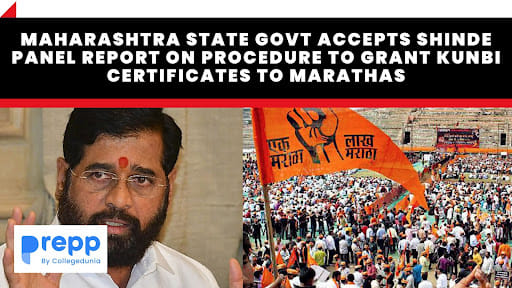
History of Demand for Reservation of Marathas
- The Marathas are a diverse group of castes, including peasants and landowners, constituting approximately 33% of the state's population.
- Historically, the Marathas have been recognized as a 'warrior' caste, known for their significant land holdings. They have played a pivotal role in the state's history.
- Since the formation of the Maharashtra state in 1960, the Maratha community has wielded considerable political power. Out of the 20 chief ministers who have served, 12 have been from the Maratha community.
- Despite facing challenges such as land division and agrarian issues, the Maratha community continues to play a crucial role in the state's rural economy.
- The Marathas have been advocating for reservation in government jobs and educational institutions for an extended period. The first protest took place 32 years ago, initiated by Mathadi Labour Union leader Annasaheb Patil in Mumbai.
- Since 1981, the issue of Maratha reservation has been a central focus in the state's political landscape, triggering widespread protests.
- Manoj Jarange, a Maratha activist, has been a prominent figure these days in the Maratha community's fight for reservation in Maharashtra. He has led multiple agitations and peaceful protests, including a 90-day dharna and a hunger strike.
Maratha Reservation Background
- In 2018, the Maharashtra government formed a nine-member State Backward Class Commission, led by Justice M.G. Gaikwad, which recommended reservation status for the Maratha community.
- In the same year (2018), the Maharashtra government passed a law that allocated 16% reservation in employment opportunities and educational admissions to the Maratha community.
- This law categorized the Maratha community as a socially and educationally backward class (SEBC).
- In 2021, the court held that the 2018 act goes against Articles 14 and 15 of the Indian Constitution. It exceeds the ceiling of 50% reservation set by the 1992 Indra Sawhney judgment.
- In November 2022, after the Supreme Court's validation of the 10% quota for Economically Weaker Sections (EWS), the state government announced that economically disadvantaged members of the Maratha community could utilize the EWS quota until the resolution of the Maratha reservation issue.
- Maharashtra currently offers 62% reservation in educational institutions and government jobs, including 10% for the economically weaker sections.
About Kunbi Community
- The Kunbi community in Maharashtra is associated with agriculture-related occupation and are grouped under the Other Backward Classes (OBC) category in the state.
- Giving Marathas Kunbi caste certificates would mean that Marathas would be counted as OBCs and would get the benefit of reservation that OBCs get.
- To be eligible for Kunbi certificates, individuals from the Maratha community in Marathwada must have references to their Kunbi status in Nizam-era revenue and education records.
Who are Kunbis?
- The community in Marathwada was initially categorized as Kunbis, a farmer community, when the region was part of the Hyderabad province.
- When Marathwada became part of Maharashtra, the community's classification changed to Marathas.
- In 1967, Punjab Rao Deshmukh advocated for OBC status for the Marathas in the Vidarbha region. Subsequently, in 2004, the Maharashtra government issued a Government Resolution (GR) classifying the Marathas in Vidarbha as Kunbis.
- Now, the Marathas in the Marathwada region are requesting Kunbi caste certificates, and the government has asked them to provide historical documents that establish their Kunbi status during the Nizam era.
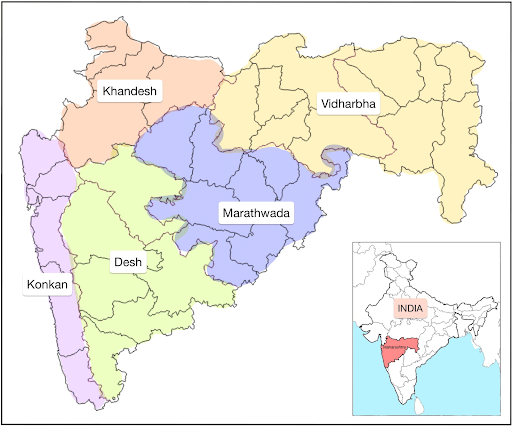
Marathwada Region
|
Constitutional Provisions related to Reservation of Weaker Section of Society
|
(*Click this link to read prelims specific weekly current affairs articles)
FAQs
Question: What is Kunbi Community?
Answer:
The Kunbi community in Maharashtra is associated with agriculture-related occupation and are grouped under the Other Backward Classes (OBC) category in the state.
Question: Where is Marathwada Region?
Answer:
Marathwada is a geographical region in the Indian state of Maharashtra, historically significant and known for its agriculture.
Question: What is Standard Operating Procedure (SOP)?
Answer:
SOP is a set of step-by-step instructions or guidelines established to ensure consistency and efficiency in performing tasks, in this context, for issuing caste certificates.
MCQs
Question: The first Indian ruler who joined the Subsidiary Alliance was: (UPSC 1994)
(a) The Nawab of Oudh
(b) The Nizam of Hyderabad
(c) Peshwa Baji Rao II
(d) The King of Travancore
Answer: (b) See the Explanation
- The Nizam of Hyderabad was the first to sign a Subsidiary Alliance System agreement.
- Tipu Sultan of Mysore had initially rejected membership in the alliance, but following the British victory in the Fourth Anglo-Mysore War, they were obliged to join a subsidiary alliance, and Mysore became a subsidiary state.
- Lord Wellesley (Governor-General of India) employed the Subsidiary Alliance System to bring the Indian states inside the British political power zone.
- The Nizam of Hyderabad, the feeblest of all monarchs, was the first Indian king to join the Subsidiary Alliance and come under British protection in 1798 A.D. under this philosophy.
Therefore, option (b) is the correct answer.
Download the PREPP App and attempt FREE IAS Exam Mock Tests and get complete study material!

Full Test - 04: UPSC CSE Prelims CSAT (Paper-II)
Full Test - 03: UPSC CSE Prelims CSAT (Paper-II)
UPSC CSE Prelims 2026 GS Paper 1 Question Paper (24-May-2026)
UPSC CSE Prelims 2026 CSAT Paper 2 Question Paper (24-May-2026)

17 February 2025 | The Hindu Must Read Articles | Current Affairs

16 February 2026 | The Hindu Must Read Articles | Current Affairs

13 February 2026 | The Hindu Must Read Articles | Current Affairs









Comments