Magnetars – Science & Technology Notes
A magnetar is a rare type of neutron star distinguished by an extremely powerful magnetic field. The field is 1,000 times stronger than that of a normal neutron star and a trillion times stronger than that of the Earth. The population of detected magnetars has grown to about 30 objects, with a clear phenomenological link to highly magnetised radio pulsars. In this article, we will discuss in detail regarding Magnetar which will be helpful for UPSC exam preparation.
Table of Contents
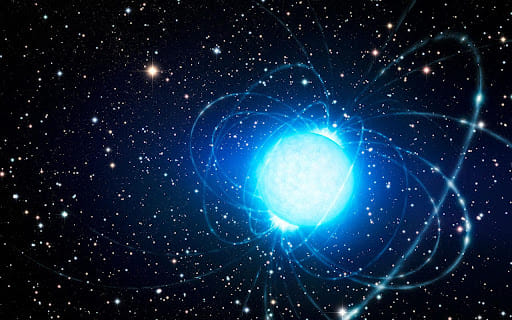
Illustration of a Magnetar
What is a Magnetar?
- A magnetar (short for magnetic star) is a neutron star with an extremely powerful magnetic field.
- With a magnetic field of ~1015 gauss, it is a thousand trillion times stronger than the Earth's and between 100 and 1,000 times stronger than that of a radio pulsar, making them the most magnetic objects known.
- They form in the same way that all neutron stars do, by the core-collapse of a massive star during a supernova explosion.
- It is unclear what conditions cause a magnetar to form instead of a regular neutron star or pulsar, but some theories suggest that in order to achieve such strong magnetic fields, the neutron star must first rotate between 100 and 1,000 times per second.
- A magnetar was first proposed in 1987 and was successfully used to explain soft gamma repeaters (SGR) in 1992.
- However, few took it seriously until 6 years later, when the detection of pulsations and the measurement of an SGR's spin-down rate suggested that it was a neutron star with an 8 x 10¹⁴ gauss magnetic field.
- Since then, the magnetar model has successfully explained both SGRs and anomalous X-ray pulsars, with the decay of the magnetic field driving the emission of X-rays and gamma rays.
- Magnetars, on the other hand, appear to be only X-ray bright for a short period of time, as their pulse periods are clustered between 6 and 12 seconds.
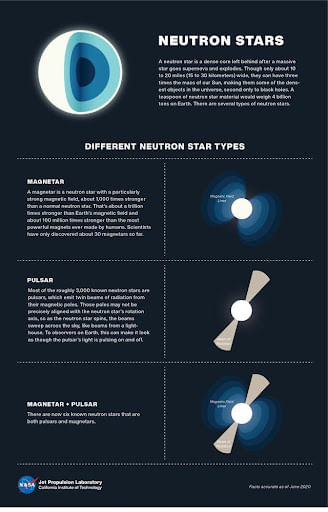
Types of Neutron Stars
| Other Relevant Links | |
|---|---|
| Space Organisations | Space race/Space junk |
| South Asia Satellite: Significance | Solar Mission- ADITYA |
| Spitzer Space Telescope | Chandra X-Ray Observatory |
| Multi Application Solar Telescope | Thirty Metre Telescope |
| Resourcesat-2A | Astrosat |
| Sunspot | Neutron stars |
| Air-breathing propulsion system | Space Junk |
| Graveyard Orbit | Supercluster of galaxies known as “Saraswati” |
Recent Study Regarding Eruption of a Magnetar
- Magnetars can be thousands of times brighter than our Sun even when inactive.
- However, in the case of GRB2001415, which occurred on April 15, 2020 and lasted only about one-tenth of a second, the energy released is equivalent to the energy that our Sun emits in one hundred thousand (100,000) years.
- The observations revealed multiple pulses, with the first appearing in tens of microseconds, which is much faster than other extreme astrophysical transients.
- It is thought that magnetar eruptions are caused by instabilities in their magnetosphere or by "earthquakes" ("starquakes") produced in their crust, a rigid and elastic layer about a kilometre thick.
- Regardless of the trigger, a type of wave will be created in the star's magnetosphere.
- These waves, which are well known in the Sun, are known as Alfvén waves, and they interact with each other while bouncing back and forth between the points at the base of its magnetic field lines, dissipating energy.
- The oscillations observed in the eruption are consistent with the emission produced by the interaction of Alfvén waves, the energy of which is quickly absorbed by the crust.
- Thus, the magnetic reconnection process ended in a few milliseconds, as did the pulses detected in GRB200415, which vanished 3.5 milliseconds after the main burst.
- The analysis of the phenomenon revealed that the volume of the flare was comparable to, if not greater than, that of the neutron star itself.
- The eruption was detected by the International Space Station's Atmosphere-Space Interactions Monitor (ASIM) instrument.
- By analysing minute scale data for over a year, the scientific team was able to solve the temporal structure of the event.
- Despite the fact that several papers have been published about the event, the fact that ASIM was the only mission to detect the main burst phase in the entire energy range of photons without saturation places the ASIM instrument in a unique position to reveal some of the mysteries surrounding magnetars.
How are Magnetars Formed?
- Massive stars, with masses ranging from 10 to 25 times that of the Sun, eventually collapse and shrink to form very compact objects known as neutron stars.
- Magnetars, which have intense magnetic fields, are a subset of these neutron stars.
- These are extremely dense and have breathtakingly fast rotation speeds, with rotational periods ranging from 0.3 to 12.0 seconds.
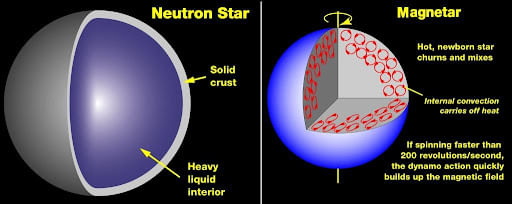
Formation of a Magnetar
Characteristics of Magnetars
- Magnetar eruptions are thought to be caused by instabilities in their magnetosphere or "starquakes" produced in their crust - a rigid, elastic layer about one kilometre thick.
- This creates waves in the magnetosphere, and the interaction between these waves causes energy dissipation.
- When magnetars are silent, they are extremely difficult to observe. They can only be seen during a flare, and these flares are so brief that it poses a formidable problem.
- A few magnetars are also pulsars, celestial lighthouses that sweep the sky with powerful radio beams (and, in rare cases, visible light beams, as in the Crab Nebula).
- Recently, astronomers were able to establish an accurate distance to a magnetar for the first time after detecting a magnetar that is also a pulsar.
- Magnetars, in addition to their extremely powerful magnetic fields, emit massive amounts of energy in the form of flares, X-rays, and gamma-ray bursts.
- As a result, they are associated with extreme events in the universe, making them, along with black holes, the most bizarre objects in the universe.
Conclusion
Magnetars are the most magnetic stars in the universe by far. You would die very quickly if you got any closer to a magnetar than about 600 miles (1,000 km). Its magnetic field would annihilate your body, ripping electrons from your atoms and transforming you into a cloud of monatomic ions, or single atoms devoid of electrons.
| Other Relevant Links | |
|---|---|
| Science & Technology Policy in India | Scientific Policy Resolution 1958 |
| Science & Technology Policy of 1983 | Science & Technology Policy of 2003 |
| Science, Technology and Innovation Policy 2013 | New Initiatives Aligned with the National Agenda |
| India and World collaboration in science projects | Technology Vision Document 2035 |
FAQs
Question: What is a magnetar?
Answer: A magnetar is a type of neutron star with an extremely strong magnetic field, which is around a thousand times stronger than ordinary neutron stars.
Question: How do magnetars emit radiation?
Answer: Magnetars emit radiation primarily through X-rays and gamma rays. This radiation is due to the intense magnetic fields that distort the star’s surface and cause violent bursts of energy.
Question: Why are magnetars important for astrophysics research?
Answer: Magnetars are important because their extreme magnetic fields and high-energy emissions provide unique insights into the behavior of matter under intense conditions, helping astrophysicists understand stellar evolution and the behavior of high-energy phenomena.
Question: How is the magnetic field of a magnetar different from that of Earth?
Answer: A magnetar's magnetic field is about 1,000 trillion times stronger than Earth's magnetic field, which is why it can influence nearby matter and emit powerful radiation.
Question: What happens when a magnetar undergoes a starquake?
Answer: When a magnetar undergoes a starquake, the sudden rearrangement of its magnetic field and crust causes violent bursts of X-rays and gamma rays, which are observed as high-energy outbursts from the magnetar.
MCQs
1. What is the primary characteristic of a magnetar?
A) A star with a large mass
B) A neutron star with a powerful magnetic field
C) A white dwarf star
D) A binary star system
Answer: (B) See the Explanation
Explanation: Magnetars are a type of neutron star with an extremely strong magnetic field, making them distinct from other types of stars.
2. How do magnetars primarily emit energy?
A) Radio waves
B) X-rays and gamma rays
C) Light waves
D) Infrared radiation
Answer: (B) See the Explanation
Explanation: Magnetars emit high-energy radiation, primarily in the form of X-rays and gamma rays, due to the violent interactions caused by their intense magnetic fields.
3. What causes the bursts of radiation emitted by magnetars?
A) Gravitational collapse
B) Fusion reactions
C) Starquakes and magnetic field rearrangement
D) Nuclear explosions
Answer: (C) See the Explanation
Explanation: The bursts of radiation from magnetars are caused by starquakes and rearrangements of their magnetic fields, which release massive amounts of energy.
4. Which of the following phenomena are observed in magnetars?
A) Solar flares
B) Starquakes and gamma-ray bursts
C) Supernovae
D) Planetary nebulae
Answer: (B) See the Explanation
Explanation: Magnetars are known for starquakes and gamma-ray bursts, which are emitted when their magnetic fields undergo rapid changes or distortions.
5. What makes the magnetic field of a magnetar so powerful?
A) Its large mass
B) The density of its core
C) The rapid rotation of the star
D) The collapse of its outer layers
Answer: (C) See the Explanation
Explanation: The rapid rotation of the magnetar, combined with its neutron star composition, generates an extremely powerful magnetic field, far stronger than that of ordinary stars.
GS Mains Questions and Model Answers
Q1: Explain the importance of studying magnetars in astrophysics. What can we learn from them?
Answer: Magnetars are crucial in astrophysics because their extreme magnetic fields and high-energy emissions offer insights into the behavior of matter under intense physical conditions. By studying magnetars, we can understand the formation and evolution of neutron stars, the effects of strong magnetic fields on stellar material, and the physics of starquakes. These studies can also contribute to our understanding of high-energy astrophysical phenomena, helping us uncover the mysteries of magnetism, radiation, and extreme states of matter in the universe.
Q2: How does the study of magnetars contribute to our understanding of neutron stars and their lifecycle?
Answer: Magnetars, being a subclass of neutron stars, provide a unique opportunity to study the extremes of stellar evolution. The study of magnetars helps us understand the lifecycle of neutron stars, from their formation after supernova explosions to their transition into highly magnetized states. The extreme magnetic fields of magnetars offer clues about the final stages of stellar collapse and the processes that lead to the formation of neutron stars. This research enhances our understanding of the physical properties of neutron stars, their behavior, and the broader context of stellar evolution.
Q3: Discuss the role of magnetars in the broader field of high-energy astrophysics. What impact do they have on our understanding of the universe?
Answer: Magnetars play a significant role in high-energy astrophysics by providing a natural laboratory for studying extreme physics. The high-energy emissions from magnetars, including gamma-ray bursts and X-rays, allow scientists to probe the fundamental forces that govern the universe, such as electromagnetism, gravity, and the interactions between matter and radiation. Their study contributes to a deeper understanding of phenomena like starquakes, magnetic field formation, and energy release in the cosmos, expanding our knowledge of the fundamental processes shaping the universe.
Previous Year Questions on Magnetars
1. UPSC CSE Mains 2020 (GS Paper 3):
Question: "Discuss the role of magnetars in understanding neutron stars and their significance in high-energy astrophysics."
Answer: Magnetars are crucial in understanding neutron stars because they represent the extreme end of neutron star evolution, characterized by exceptionally strong magnetic fields. The study of magnetars provides insights into the behavior of matter in these extreme conditions, helping to understand the lifecycle of neutron stars and the impact of magnetic fields on stellar material. Their high-energy emissions further contribute to the field of high-energy astrophysics, aiding in the study of gamma-ray bursts, starquakes, and cosmic radiation.
2. UPSC CSE Mains 2021 (GS Paper 1):
Question: "Explain the scientific significance of magnetars and their contribution to the field of astrophysics."
Answer: Magnetars, with their intense magnetic fields and high-energy radiation, play a pivotal role in advancing astrophysical research. Their unique characteristics offer a deeper understanding of the behavior of matter under extreme conditions, such as those found in neutron stars. Magnetars provide important data for the study of stellar evolution, the formation of magnetic fields, and the high-energy processes that govern the universe. Their extreme physical properties help expand our knowledge of high-energy phenomena and contribute to the broader field of astrophysics.
Download the PREPP App and attempt FREE IAS Exam Mock Tests and get complete study material!

Full Test - 04: UPSC CSE Prelims CSAT (Paper-II)
Full Test - 03: UPSC CSE Prelims CSAT (Paper-II)
UPSC CSE Prelims 2026 GS Paper 1 Question Paper (24-May-2026)
UPSC CSE Prelims 2026 CSAT Paper 2 Question Paper (24-May-2026)

17 February 2025 | The Hindu Must Read Articles | Current Affairs

16 February 2026 | The Hindu Must Read Articles | Current Affairs

13 February 2026 | The Hindu Must Read Articles | Current Affairs









Comments