Life Over Death: On Death Penalty Abolition and Parliamentary Panel Report
Primary Source: The Hindu
Click here for Daily Current Affairs
Why in the news?
- The article discusses the Indian parliamentary committee's stance on the death penalty in the context of the Bharatiya Nyaya Sanhita (BNS), a proposed criminal statute.
- The committee did not recommend abolishing the death penalty, instead leaving the decision to the government.
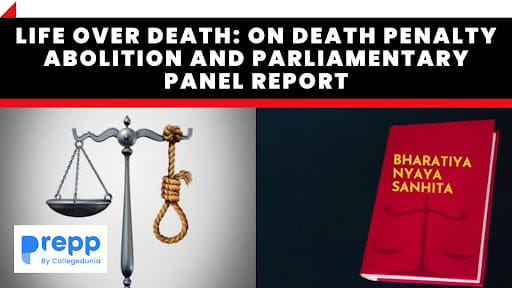
Death Penalty and its Evolution
- The death penalty, also known as capital punishment, is a government-sanctioned practice where a person is put to death by the state as a punishment for a crime.
- Typically, the death penalty is reserved for ‘rarest of the rare cases’.
- Under British colonial rule, the death penalty was formalized and codified, particularly with the introduction of the Indian Penal Code (IPC) in 1860, which included provisions for capital punishment.
- After independence in 1947, India retained the IPC, including its provisions for the death penalty.
- India has previously voted against a draft resolution on the repeal of the death penalty proposed by the UN General Assembly.
- A study by the National Law University Delhi found that, as of December 31, 2022, there were 539 inmates in India on death row, the most since at least 2016.
Important Constitutional Provisions
- Article 72: It grants the President the power to pardon, reprieve, respite, or remit punishments in all cases where the punishment or sentence is by a court-martial or in cases where the sentence is a death sentence.
- Article 161: It empowers the Governor of a state to pardon, reprieve, respite, remit, suspend, or commute sentences in certain cases where the sentence is for an offense against a law relating to a matter to which the executive power of the state extends.
Pardoning Powers in Constitution of India
|
What is Bharatiya Nyaya Sanhita (BNS) Bill 2023?
- The Bharatiya Nyaya Sanhita (BNS) is a proposed legal statute in India that is intended to replace the existing Indian Penal Code (IPC).
- It seeks to introduce a legal framework that is more in tune with the current societal norms, human rights standards, and technological advancements.
Key Proposals of the BNS Bill 2023
- Sedition: Revises the provision for sedition, focusing on acts that endanger India's sovereignty, unity, and integrity, with potential life imprisonment or imprisonment up to seven years plus fines.
- Murder: Maintains the death sentence or life imprisonment for murder, with added specifics for group-committed murder based on race, caste, or other grounds.
- Snatching: Introduces a new provision for "snatching," defining it as a form of theft with a potential sentence of up to three years in prison and fines.
- Terrorism: Defines terrorism for the first time, targeting acts that threaten India's unity, integrity, and security, or disturb public order.
- Defamation: Adds community service as a potential punishment for defamation, along with imprisonment or fines.
- Attempted Suicide: Proposes punishment for attempted suicide when intended to influence public servants, including imprisonment, fines, or community service.
- Offences Against Women: Includes provisions against deceitful acts in relationships and sexual offenses, with penalties extending up to ten years in prison and fines
Parliamentary Committee's Stance
- Lack of Recommendation: The parliamentary committee did not recommend the abolition of the death penalty. Their main recommendation was that the matter should be left for the government to consider.
- Observation on Judicial Fallibility: The committee acknowledged the argument against the death penalty, recognizing the fallibility of the judicial system and the risk of innocent people being wrongly sentenced to death.
- More Objective Definition: If the death sentence must be kept in place, the domain experts argued before the Committee that a more objective definition of the "rarest of rare case" doctrine should be provided.
Arguments in Favour of Death Penalty
- Retribution and Justice: One of the key arguments often made in favor of the death penalty is that it serves as a form of retribution. The idea is that the most severe crimes, such as murder, deserve the most severe punishment.
- Deterrence: Proponents claim that the fear of being sentenced to death can deter individuals from committing heinous crimes.
- Irreparable Harm and Public Safety: For crimes of extreme nature, where the perpetrator has caused irreparable harm, the death penalty is sometimes seen as a way to ensure that the individual cannot harm others in the future.
- Closure for Victims' Families: Some argue that executing a perpetrator can provide a sense of closure to the families of the victims.
- Legal Precedent and Tradition: In some cases, the argument for the death penalty is based on legal precedent and tradition. It is seen as an established part of the legal system in many countries and regions, having been a form of punishment for severe crimes throughout history.
Arguments Against Death Penalty
- Fallibility of the Judicial System: It's acknowledged that the judicial system can be fallible, which raises concerns about innocent people being wrongfully sentenced to death.
- Rising Instances of Death Sentences by Trial Courts: Despite the Supreme Court of India leaning away from capital punishment, there's an increasing trend of trial courts awarding death sentences.
- Lack of Deterrent Effect: Expert submissions and social science research suggest that the death penalty does not have a significant deterrent effect on crime.
- Global Opinion Against Capital Punishment: There is a growing global consensus in favor of abolishing the death penalty.
- Ineffectiveness as a Deterrent: Dissenting members of the report emphasize that capital punishment has not been effective as a deterrent.
- Alternative Punishments for Reform: Life imprisonment for the remainder of a convict's life is viewed as a more rigorous punishment that allows scope for reform.
- Socioeconomic Bias: Many of those on death row come from underprivileged backgrounds, indicating a possible bias in the imposition of the death penalty.
- Need for Reform in Criminal Laws: The proposed new body of criminal law, Bharatiya Nyaya Sanhita (BNS), closely resembles the existing laws. The enactment of BNS is seen as an opportunity to reconsider the necessity of the death penalty.
- Defining Life Imprisonment: BNS defines 'life imprisonment' as imprisonment for the remainder of one's natural life, suggesting this should be the alternative to the death penalty.
- Policy on Remission: The case for abolition is strengthened by the argument for a rational and universal policy on remission of life sentences, which should be based on humanitarian grounds rather than political considerations.
Conclusion
Despite expert submissions advocating for abolition and noting the fallibility of the judicial system, the committee deferred the decision of abolition of death penalty to the government. Enacting the draft bill provides an opportunity for Parliament to reconsider the retention of the death penalty and argues for a rational and universal remission policy to strengthen the case for its abolition.
(*Click this link to read prelims specific weekly current affairs articles)
FAQs
Question: What is death penalty?
Answer:
The death penalty, also known as capital punishment, is a government-sanctioned practice where a person is put to death by the state as a punishment for a crime. Typically, the death penalty is reserved for ‘rarest of the rare cases’.
Question: What is Bharatiya Nyaya Sanhita (BNS)?
Answer:
The Bharatiya Nyaya Sanhita (BNS) is a proposed legal statute in India that is intended to replace the existing Indian Penal Code (IPC). It seeks to introduce a legal framework that is more in tune with the current societal norms, human rights standards, and technological advancements.
Question: What is commutation?
Answer:
Commutation involves changing the type of punishment given to a lesser form. For example, a death sentence may be commuted to life imprisonment.
UPSC Mains Practice Question:
|
MCQs
Question: Consider the following statements regarding the Bharatiya Nyaya Sanhita (BNS):
- The BNS proposes the complete abolition of the death penalty in all circumstances.
- It redefines 'life imprisonment' as imprisonment for the remainder of the convict's natural life.
Which of the statements given above is/are correct?
(a) 1 only
(b) 2 only
(c) Both 1 and 2
(d) Neither 1 nor 2
Answer: (b) See the Explanation
The Bharatiya Nyaya Sanhita (BNS) is a proposed criminal statute in India. The BNS does not propose the complete abolition of the death penalty in all circumstances. The parliamentary committee did not recommend abolishing the death penalty and left the matter for the government to consider. Hence, statement 1 is incorrect.
The BNS redefines 'life imprisonment' as imprisonment for the remainder of the convict's natural life, providing a significant alternative to the death penalty and emphasizing the aspect of reform and punishment over mere retribution. Hence, statement 2 is correct.
Therefore, option (b) is the correct answer."
Download the PREPP App and attempt FREE IAS Exam Mock Tests and get complete study material!

Full Test - 04: UPSC CSE Prelims CSAT (Paper-II)
Full Test - 03: UPSC CSE Prelims CSAT (Paper-II)
UPSC CSE Prelims 2026 GS Paper 1 Question Paper (24-May-2026)
UPSC CSE Prelims 2026 CSAT Paper 2 Question Paper (24-May-2026)

17 February 2025 | The Hindu Must Read Articles | Current Affairs

16 February 2026 | The Hindu Must Read Articles | Current Affairs

13 February 2026 | The Hindu Must Read Articles | Current Affairs









Comments