Kurnool - Cuddapah Canal - Geography Notes
Kurnool Cuddapah Canal, also known as K.C. Canal, is an irrigation canal in the districts of Kurnool and Kadapa in the Indian state of Andhra Pradesh. The K.C.Canal was built as an irrigation and navigation canal between 1863 and 1870. This canal connects the Penner and Tungabhadra rivers. It begins at the Sunkesula barrage on the Tungabhadra River near Kurnool. This article will explain to you about Kurnool - Cuddapah Canal which will be helpful in Geography preparation for the UPSC Civil service exam.
|
Table of Contents |
Kurnool - Cuddapah Canal - Historical Background
- The K.C. Canal Project, which is part of the Tungabhadra Sub Basin in the Krishna basin, is a 130-year-old irrigation system in Andhra Pradesh.
- This canal system was built between 1863 and 1870 by a private Dutch company called Madras Irrigation & Canal, Co limited to provide navigation facilities as well as a supply of water for irrigation.
- This project arose from the policy of introducing Cuddapah into India, which was initiated in the middle of the nineteenth century.
- British capital and enterprise in irrigation works construction
- Based on Sir Arthur Cotton's recommendations, the Government of British India increased the irrigation component while decreasing the navigation component, and navigation was gradually phased out by around 1933.
|
|
|
|---|---|
| Periyar Diversion Scheme | Ganga- Cauvery Link Canal |
| Indira Gandhi Canal Project | Beas- Satluj Link Canal |
Kurnool - Cuddapah Canal
- The K.C.Canal was built as an irrigation and navigation canal between 1863 and 1870.
- This canal connects the Penner and Tungabhadra rivers. It begins at the Sunkesula barrage on the Tungabhadra River near Kurnool.
- The navigation system was abandoned in 1933, but the canal remained a major irrigation source.
- K.C. canal modernization aims to improve system efficiency by modernizing the entire canal and repairing/reconstructing structures.
- The project is currently under construction to stabilize the entire ayacut of the KC Canal and develop the 60,000-acre gap ayacut.
- The Kurnool-Cuddapah canal begins at Sunkesula anicut on the Tungabhadra River, travels through the Kurnool and Cuddapah districts, and ends at Cuddapah.
- Through controlling structures on these streams, this canal is linked to the natural streams Nippulavagu, Galeru, and Kunderu.
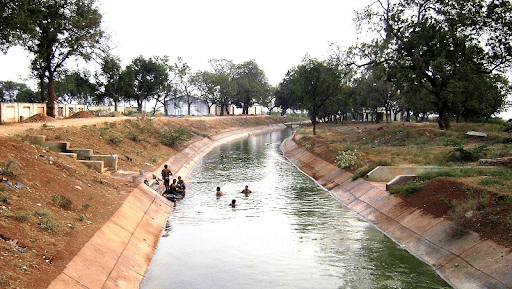
Kurnool - Cuddapah Canal
Kurnool - Cuddapah Canal - Significance
- The KC canal system was the first man-made conveyance scheme to move water from the Krishna River basin, where it is abundant, to the Pennar River basin, where it is scarce or could be better utilised for human development.
- This canal is linked to the natural streams Nippulavagu, Galeru, Kunderu, and Pennar via controlling structures on these streams, namely Lock-In-Sula, Santajutur anicut, Rajoli anicut, and Adinimmayapalli anicut.
- The goal of such schemes is to alleviate water shortages in the receiving basin for irrigation and drinking water.
- The KC Canal has enabled the use of water resources in drought-prone Kurnool and Kadapa districts in a uniform and cost-effective manner, resulting in significant output.
- Furthermore, it has aided in the improvement of irrigation potential and food grain production, resulting in socioeconomic development in the region.
- The navigation system was abandoned in 1933, but the canal remained a major irrigation source.
- K.C. canal modernization aims to improve system efficiency by modernizing the entire canal and repairing/reconstructing structures.
- KC Canal was modernized between 1996 and 2004 at a cost of over 2000 crore rupees.
- Furthermore, the parallel Srisailam RBC project to the west of the KC Canal and the Telugu Ganga Canal project to the east in the same value generated regenerated water (drainage losses) that flow into the river and can be picked up for KC Canal irrigation.
- As a result of the inefficiencies of these newly constructed canals, additional water is provided to the old, now modernized, canal.
Conclusion
Kurnool Cuddapah Canal, also known as K.C. Canal, is an irrigation canal in the Andhra Pradesh districts of Kurnool and Kadapa. The KC Canal has enabled the uniform and cost-effective use of water resources in the drought-prone Kurnool and Kadapa districts, resulting in significant output. It has also helped to improve irrigation potential and food grain production, resulting in socioeconomic development in the region.
|
|
|
|---|---|
| Geography Notes | Physical Geography |
| Water Resources in India | River Basins in India |
| India's Physiographic Divisions | Major Lakes in India |
| River Systems in Peninsular India | River Systems of Himalayan Drainage |
| Smaller Rivers of India flowing towards West | Smaller Rivers of India flowing towards East |
| Indian Drainage Systems | River Interlinking Project in India |
| Climatology | Geomorphology |
FAQs
Question: What is the Kurnool-Cuddapah Canal?
Answer: The Kurnool-Cuddapah Canal (KC Canal) is an irrigation canal in the Kurnool and Kadapa districts of Andhra Pradesh, linking the Penner and Tungabhadra rivers. Constructed between 1863 and 1870, it was initially intended for both irrigation and navigation purposes.
Question: What was the primary purpose of constructing the KC Canal?
Answer: The canal was built to provide irrigation facilities and navigation. However, the navigation component was phased out in 1933, and the focus shifted entirely to irrigation.
Question: Where does the KC Canal originate?
Answer: The KC Canal originates at the Sunkesula barrage on the Tungabhadra River near Kurnool.
Question: What role does the KC Canal play in modern irrigation?
Answer: The canal plays a critical role in irrigating drought-prone areas of Kurnool and Kadapa districts, improving agricultural productivity and socioeconomic development.
Question: How has the KC Canal been modernized?
Answer: The canal has undergone modernization to improve its efficiency and irrigation potential through reconstruction and system upgrades, reducing water wastage and enhancing its capacity.
MCQs
- The Kurnool-Cuddapah Canal connects which rivers?
A) Krishna and Godavari
B) Penner and Tungabhadra
C) Cauvery and Narmada
D) Mahanadi and Tapi
Answer: (B) See the Explanation
The KC Canal links the Penner and Tungabhadra rivers to facilitate irrigation in the Kurnool and Kadapa districts.
- In which year was the navigation system of the KC Canal phased out?
A) 1870
B) 1920
C) 1933
D) 1950
Answer: (C) See the Explanation
The navigation component of the KC Canal was gradually phased out by 1933, with the focus shifting to irrigation.
- What is the starting point of the KC Canal?
A) Rajoli Anicut
B) Sunkesula barrage on the Tungabhadra River
C) Chitravathi River
D) Adinimmayapalli Anicut
Answer: (B) See the Explanation
The canal originates at the Sunkesula barrage, facilitating water distribution for irrigation.
- Which of the following is true about the KC Canal?
A) It was never used for navigation
B) It primarily serves as an industrial canal
C) It was modernized in the late 20th century
D) It only connects urban centers
Answer: (C) See the Explanation
The canal underwent modernization between 1996 and 2004 to enhance its irrigation efficiency.
- The KC Canal helps in managing water from which river basin?
A) Mahanadi
B) Godavari
C) Krishna
D) Ganga
Answer: (C) See the Explanation
The KC Canal is part of the Tungabhadra sub-basin within the larger Krishna basin.
GS Mains Questions and Model Answers
Q1: Describe the historical development and significance of the Kurnool-Cuddapah Canal.
Answer: Constructed between 1863 and 1870, the KC Canal was built to provide irrigation and navigation in the Kurnool and Kadapa districts of Andhra Pradesh. While its navigation function was phased out in 1933, it remains a critical irrigation infrastructure. By connecting the Penner and Tungabhadra rivers, it has contributed to regional development, enhanced agricultural productivity, and supported socioeconomic growth in water-scarce areas. The canal’s modernization further improved its efficiency, making it vital for the local economy.
Q2: Assess the impact of the KC Canal modernization on agricultural productivity.
Answer: The modernization of the KC Canal, completed between 1996 and 2004, improved irrigation efficiency and water management, reducing wastage and increasing water availability for agriculture. This led to higher agricultural productivity, stabilized water distribution, and better drought mitigation in Kurnool and Kadapa districts, fostering socioeconomic growth and improved rural livelihoods.
Q3: Discuss the challenges and benefits associated with maintaining the Kurnool-Cuddapah Canal system.
Answer: Challenges include managing siltation, maintaining infrastructure, and ensuring equitable water distribution. However, the benefits, such as improved irrigation potential, increased agricultural productivity, and better water resource utilization, significantly outweigh these challenges. Effective maintenance, periodic upgrades, and community involvement are essential for sustainable management.
Previous Year Questions on Kurnool- Cuddapah Canal
1. UPSC CSE 2019
Question: Analyze the role of the Kurnool-Cuddapah Canal in addressing water scarcity in Andhra Pradesh.
Answer: The KC Canal plays a crucial role in mitigating water scarcity in the drought-prone districts of Kurnool and Kadapa. By connecting the Penner and Tungabhadra rivers, it ensures a stable water supply for irrigation, supporting agriculture and improving food security. Its modernization has further enhanced efficiency, benefiting local communities and fostering regional economic growth.
2. UPSC CSE 2020
Question: Evaluate the historical and modern significance of the Kurnool-Cuddapah Canal for regional development.
Answer: Historically, the KC Canal facilitated irrigation and navigation, contributing to regional growth. While navigation was phased out, its irrigation role has remained vital, enhancing agricultural productivity and socioeconomic development. Modernization efforts have further improved its operational efficiency, making it a key infrastructure for water resource management and drought mitigation in Andhra Pradesh.
Download the PREPP App and attempt FREE IAS Exam Mock Tests and get complete study material!

Live Test : UPSC CSE Prelims CSAT (Paper-II) (Oct 20 - 23)
Full Test - 04: UPSC CSE Prelims CSAT (Paper-II)
Full Test - 03: UPSC CSE Prelims CSAT (Paper-II)
UPSC CSE Prelims 2026 GS Paper 1 Question Paper (24-May-2026)
UPSC CSE Prelims 2026 CSAT Paper 2 Question Paper (24-May-2026)

17 February 2025 | The Hindu Must Read Articles | Current Affairs

16 February 2026 | The Hindu Must Read Articles | Current Affairs

13 February 2026 | The Hindu Must Read Articles | Current Affairs









Comments