Kidney Transplants in India: The Law, The Demand, The Alleged Rackets
Relevance: GS2 GS3 – Organ transplantation in India, Transplantation of Human Organs and Tissues Act, 1994, Science & Technology developments and everyday applications & effects, Kidney Transplant
Primary Source: The Indian Express
Click here for Daily Current Affairs
Why in the news?
- The article discusses kidney transplants in India, focusing on legal aspects, demand, and alleged illegal activities.
- An investigation by a leading newspaper led to government probes into allegations of Myanmarese villagers being lured into giving kidneys, implicating Apollo hospital in Delhi.
Table of Contents
- What is the issue?
- What is Organ Transplant?
- Current Scenario in India
- Prevalence of Kidney Transplants in India
- Addressing the Supply Gap
- Transplantation of Human Organs and Tissues Act, 1994
- Key Features of the Act
- Need for Increased Organ Donations
- Government Initiatives to Facilitate Organ Transplant
- Challenges with Organ Transplantation
- Way Forward
- Conclusion
- FAQs
- MCQs

What is the issue?
- The government has ordered a probe into allegations that poor villagers from Myanmar were being lured into donating their kidneys to rich patients, with the involvement of Delhi’s Apollo hospital.
- The law in India forbids organ donations and transplants in exchange for money to protect poor and vulnerable donors from exploitation.
- Despite these laws, there are allegations that Apollo hospital was involved in illegal kidney transplants.
- Apollo hospital has stated that all transplants were performed legally, with proper authorization from the relevant committees and certificates from the Myanmar embassy certifying donors as relatives of the recipients.
- There have been previous allegations of kidney scams in India, often involving forged documents to falsely establish a relationship between the donor and recipient.
- The Transplantation of Human Organs and Tissues Act, 1994 allows living donations, primarily from close relatives. Donations from non-relatives require additional scrutiny to ensure no financial transaction is involved.
What is Organ Transplant?
- Organ transplant is a medical procedure in which an organ is removed from one body and placed in the body of a recipient, to replace a damaged or missing organ.
- The donor and recipient may be at the same location, or organs may be transported from a donor site to another location.
- Transplants are performed for various organs such as the heart, kidney, liver, lungs, pancreas, intestine, and thymus.
- Types of Donors:
- Living Donors: A living person can donate a kidney, part of the liver, lung, intestine, or pancreas. Living donations are usually done between family members or close friends, but sometimes strangers donate.
- Deceased Donors: Organs can be donated by people who have died recently, typically those who have been declared brain-dead but whose organs are still functioning.
Current Scenario in India
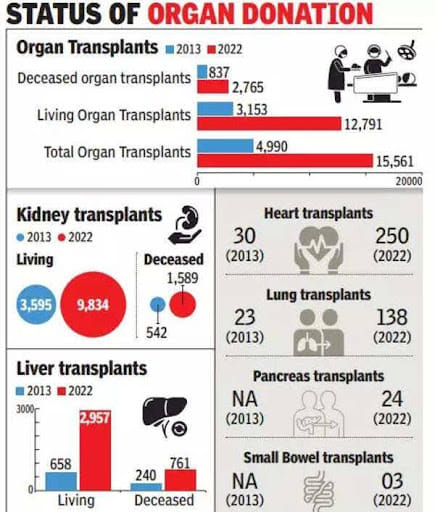
- From 2013 to 2022, the total organ transplants surged more than threefold, rising from 4,990 to 15,561.
- Kidney transplants are the most frequent, followed by liver, heart, lung, pancreas, and small intestine transplants.
- In 2022, there were approximately 12,791 transplants using organs from living donors and 2,765 from deceased donors.
- Of all the organs transplanted, only 14% (1,743) came from deceased donors, with the majority being kidney and liver donations from living donors.
- In 2021, almost all the organs donated after death were in 15 states, and the top five contributed to over 85% of these donations.
- The states of Telangana, Tamil Nadu, Karnataka, Gujarat, and Maharashtra have recorded the highest counts of deceased organ donors.
- Meanwhile, regions such as Delhi-NCR, Tamil Nadu, Kerala, Maharashtra, and West Bengal stand out for having a significant number of living organ donors.
Prevalence of Kidney Transplants in India
- There is a high demand for kidney transplants in India, with approximately 200,000 Indians reaching end-stage kidney failure annually. However, only about 12,000 kidney transplants are performed each year.
- The kidney is a commonly targeted organ for transplant due to its high demand, relatively lower risk to the donor, and the organ's ability to survive for 24-36 hours outside the body.
- A kidney transplant in India costs about Rs 5 lakh, making it more accessible to a broader population.
- There are over 500 centers in India capable of performing kidney transplants.
Addressing the Supply Gap
- To increase the organ supply, the government is promoting deceased donations, as organs from brain death cases are ideal for donation.
- The government has initiated an Aadhaar-linked registry of donors to facilitate this process. However, currently, only 16% of transplants use organs from deceased donors.
- Increasing awareness and reducing the number of people requiring organ transplants are seen as key strategies to address this gap.
Transplantation of Human Organs and Tissues Act, 1994
The Transplantation of Human Organs and Tissues Act, 1994, is a comprehensive piece of legislation enacted by the Government of India to regulate the removal, storage, and transplantation of human organs and tissues for therapeutic purposes. The Act also aims to prevent commercial dealings in human organs.
Key Features of the Act
- Regulation of Organ Transplantation: The Act provides a legal framework for the transplantation of human organs and tissues, ensuring that such procedures are carried out in a safe, ethical, and lawful manner.
- Authorization Committees: The Act mandates the establishment of authorization committees at state and hospital levels to oversee and authorize the process of organ donation and transplantation, ensuring that all necessary consents are obtained and that there is no commercial transaction involved.
- Definition of 'Brain Death': One of the significant contributions of this Act is the legal recognition of 'brain death' as a form of death. This definition has been crucial in facilitating organ donations from brain-dead patients, significantly increasing the organ pool for transplantation.
- Consent for Organ Donation: The Act requires that the donor's consent (or the consent of the next of kin in case of deceased donors) be obtained before organ removal. In the case of living donors, it emphasizes that the donation should be voluntary and without any form of coercion or financial inducement.
- Restrictions on Organ Trade: The Act strictly prohibits the sale and purchase of human organs. It lays down stringent penalties, including imprisonment and fines, for anyone involved in commercial dealings of human organs. Violations can lead to imprisonment of up to 10 years and fines up to Rs 1 crore.
- Eligibility for Donation: The Act specifies the conditions under which individuals can donate organs. For living donors, it restricts organ donation primarily to relatives, while also allowing for altruistic donations under strict scrutiny.
- For living donations, especially from close relatives, it's mandatory to submit documents that establish identities, family trees, and proof of the donor-recipient relationship. This also includes financial background checks of the donors.
- For donations from unrelated individuals, there must be documentation and photographic evidence of a long-term association or friendship.
- These cases undergo additional scrutiny by an external committee to prevent illegal transactions.
- Registration of Hospitals: Hospitals that perform organ transplants must be registered under this Act. This registration process ensures that the hospitals have the necessary infrastructure and expertise to conduct transplant procedures safely and ethically.
- Amendments and Updates: The Act has been amended over the years, including significant changes in 2011 to further strengthen the legal framework, improve the regulation of organ donations, and expand the scope to include tissues in addition to organs.
Need for Increased Organ Donations
- India ranks third globally in the number of organ transplants conducted, yet the demand for organs significantly surpasses the number of available transplants.
- The rise in lifestyle-related diseases is escalating the need for organs, especially hearts and lungs, which can typically be obtained only from deceased donors.
- Annually, about 150,000 people die in road accidents in India, many of whom could potentially be organ donors.
- Transplantation of organs also alleviates the strain on the healthcare system by diminishing the necessity for repeated hospitalizations, multiple surgeries, and extended treatments.
- Despite these needs, India's organ donation rate is only 0.52 per million population, considerably lower than countries like Spain, which has a rate of 49.6 per million.
- The act of organ donation holds the power to save multiple lives, as a single donor can provide various organs and tissues.
Government Initiatives to Facilitate Organ Transplant
- Transplantation of Human Organs and Tissues Act (THOTA): Implemented in 1994, this act regulates organ transplantation in India and establishes the National Organ and Tissue Transplant Organization (NOTTO), along with State Organ and Tissue Transplant Organizations (SOTTO), to supervise organ donation and transplantation activities.
- National Organ Transplant Programme (NOTP): Initiated in 2014, this program aims to develop a national database for organ donors and recipients, increase the number of organ transplant facilities, and enhance public understanding of organ donation.
- Deceased Organ Donation Program: Launched by the Ministry of Health and Family Welfare, this initiative promotes organ donation from deceased individuals.
- National Organ Donation Day: Observed on November 27, this day is designated by the Indian government to amplify awareness about the significance of organ donation and motivate individuals to commit to organ donation.
- Swasth Bharat Yatra: This government-led initiative advocates for healthy living, prevention of lifestyle diseases, and raises awareness about organ donation, encouraging the public to pledge their organs.
- National Organ and Tissue Transplant Registry: This registry maintains a comprehensive record of organ donations and transplants in India, aiding in the formulation of policies and strategies to foster organ donation and transplantation.
- Organ Retrieval Banking Organization: Part of the All India Institute of Medical Sciences (AIIMS) in New Delhi, this organization is tasked with the retrieval, preservation, and allocation of organs for transplantation in the Delhi-NCR area.
Challenges with Organ Transplantation
- Awareness Deficit: A significant gap in public understanding about the critical role of organ donation and transplantation contributes to a scarcity of donated organs.
- Donor Shortage: Even with growing awareness, the number of organ donors remains insufficient. This is due to various factors, including religious beliefs and distrust in the medical system.
- Legal and Ethical Challenges: Numerous legal and ethical considerations are involved in organ donation. These include issues related to consent, the fair allocation of organs, and equitable distribution.
- Organ Trafficking and Illicit Market: The illegal trade of organs and the existence of an underground market. Criminal operations exploiting the high demand for organs, thereby disrupting legitimate donation procedures.
- Transport and Preservation Difficulties: Organ transport and preservation require specific conditions to maintain their suitability for transplantation, presenting logistical challenges, particularly for organs with limited viability periods.
- Medical Compatibility: Not every donated organ is viable for transplantation due to various medical reasons or other limiting factors, affecting the number of organs available for transplant.
- Financial Implications: The high costs associated with organ transplantation can be a barrier, restricting some patients' access to these life-saving procedures.
Way Forward
- Collaborate with artists, influencers, and famous personalities to launch powerful campaigns that underline the importance of organ donation.
- Conduct interactive workshops for healthcare professionals, focusing on simulation-based learning and case studies to enhance skills in donor identification and family communication.
- Work with educational bodies to increase student awareness about organ donation through seminars and discussions.
- Organize community events that highlight inspiring stories of organ donors and recipients.
- Involve religious figures to dispel myths and clarify misconceptions surrounding organ donation, focusing on its altruistic nature.
- Implement a recognition program for donors and their families, celebrating their altruistic actions with awards and certificates.
- Establish partnerships among medical institutions to streamline and improve the efficacy of organ transplant procedures.
- Encourage the perception of organ donation as an act of selflessness and empathy.
Conclusion
There are legal, ethical, and logistical challenges surrounding kidney transplants in India. There is a need for legal compliance, increased deceased organ donation, reduce the number of people requiring transplants in India and public education to bridge the demand-supply gap and prevent illegal activities.
(*Click this link to read prelims specific weekly current affairs articles)
FAQs
Question: What is the legal framework governing organ transplants in India?
Answer:
The legal framework is primarily governed by the Transplantation of Human Organs and Tissues Act, 1994. This act allows living donations, typically from close relatives like parents, siblings, children, spouse, grandparents, and grandchildren. Altruistic donations from non-immediate relatives or friends are subject to additional scrutiny to prevent financial transactions.
Question: What are the requirements for living organ donations in India?
Answer:
For living donations from close relatives, whether Indian or foreign nationals, documents establishing identities, family tree, proof of donor-recipient relationship, and financial status of the donor are required. In cases of donations from unrelated persons, evidence of long-term association or friendship, along with all other necessary documents, must be presented and are subject to review by an external committee.
Question: What are the consequences of illegal organ transplants in India?
Answer:
Engaging in illegal organ transplants, including offering payment for organs, initiating or advertising such transactions, sourcing organ suppliers, or aiding in the creation of false documents, is punishable by imprisonment of up to 10 years and a fine of up to Rs 1 crore.
UPSC Mains Practice Question:
|
MCQs
Question: Of the four landmarks in medical history given below, which one was the first to take place? (UPSC 1996)
(a) Organ transplant
(b) Bypass surgery
(c) Test tube baby
(d) Plastic surgery
Answer: (d) See the Explanation
Plastic surgery – 1827
Organ transplant – 1954
Bypass surgery – 1960
Test tube baby – 1978
Therefore, option (d) is the correct answer.
Question: Which of the following statements about the Transplantation of Human Organs and Tissues Act, 1994, is correct?
(a) It only allows organ donations from deceased persons.
(b) It permits living donations from close relatives without any scrutiny.
(c) It allows living donations from close relatives and scrutinizes altruistic donations from others.
(d) It completely prohibits living organ donations.
Answer: (c) See the Explanation
The Act permits living organ donations, primarily from close relatives like parents, siblings, etc., and imposes additional scrutiny for altruistic donations from distant relatives or friends to prevent financial exploitation.
Therefore, option (c) is the correct answer.
Download the PREPP App and attempt FREE IAS Exam Mock Tests and get complete study material!

Full Test - 04: UPSC CSE Prelims CSAT (Paper-II)
Full Test - 03: UPSC CSE Prelims CSAT (Paper-II)
UPSC CSE Prelims 2026 GS Paper 1 Question Paper (24-May-2026)
UPSC CSE Prelims 2026 CSAT Paper 2 Question Paper (24-May-2026)

17 February 2025 | The Hindu Must Read Articles | Current Affairs

16 February 2026 | The Hindu Must Read Articles | Current Affairs

13 February 2026 | The Hindu Must Read Articles | Current Affairs









Comments