Kants Gaseous hypothesis - Geography Notes
Kants Gaseous Hypothesis proposes that the Solar System formed from gas and dust orbiting the Sun. Immanuel Kant, a German philosopher, presented the Gaseous hypothesis about the origin of the earth in 1755, which was based on Newton's law of gravity. Kant believed that primordial matter was initially scattered and consisted of cold, motionless, solid particles. It collided with each other due to gravity, which produced heat, which caused angular momentum, and it began rotating. This article will explain to you The gaseous hypothesis of Kant which will be helpful in Geography preparation.
|
Table of Contents |
Gaseous hypothesis
- In 1755, Prussian philosopher Immanuel Kant published his gaseous hypothesis in his treatise "The General Natural History and Theory of the Heavens" or "The Essay on the Working and Mechanical Origin of the Entire Universe on the Basis of Newtonian Laws."
- Kant's hypothesis was based primarily on Newton's laws of gravitation and rotation.
- On the basis of a few assumptions, Kant proposed his gaseous hypothesis of Earth's origin.
- He assumed that the universe was littered with the supernaturally created primordial hard matter.
- This substance was made up of small, hard, and cold particles. Under the influence of gravitational pull, these particles were drawn together.
- They eventually began to collide against one another. Because of the friction between these particles, heat was generated, and the temperature of the primordial matter began to rise.
- The collision also caused random motion in the primordial matter, as well as angular velocity.
- As a result, the original cold and motionless cloud of primordial matter evolved into a vast hot nebula.
- It was so vast that it stretched from the sun in the centre to the orbit of the farthest planet. The change in temperature transformed primordial matter from solid to gaseous.
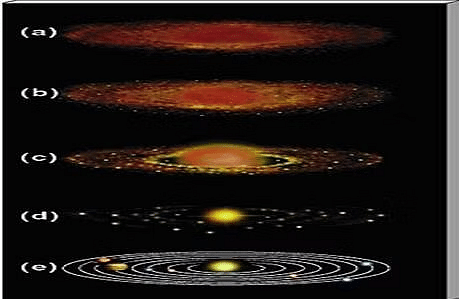
Gaseous Hypothesis
- Our planet is made up of one of the nine rings that separated from the nebula.
- The gaseous mass of some planets throws away rings that become their satellites through small-scale repetition of the same process.
- Our current sun is the last remnant of the original gaseous mass.
- As a result, the entire solar system, including the sun, eight planets, and their satellites, was created.
Significance of the Gaseous hypothesis
- The first theory was founded on gravity and motion.
- Kant's theory was the first to be founded on basic scientific facts like Newton's laws of gravity and motion.
- Simple. Kant's hypothesis appears to be more straightforward and logical.
- This theory laid the groundwork for future ideas about the origin of the earth.
- For example, Laplace's Nebular theory was heavily influenced by his theory, and it paved the way for the postulation of Laplace's theory.
Criticism of the Gaseous hypothesis
- The origin of primordial matter is unknown.
- Kant's hypothesis was based on the basic assumption that there was a primordial matter in the universe. He has not explained where the primordial matter came from.
- Gravitational pull is a problem.
- According to Kant, the collision of primordial matter particles was caused by gravitational pull.
- Scientists have speculated on whether or not this force existed prior to the collision, and if so, what prevented it from acting and the collision from occurring.
- The origin of angular momentum is unknown. Kant did not explain how angular momentum was generated in the primordial matter after particle collisions.
- Newton's first law of motion states that "a body remains at rest or in uniform motion unless and until an external force is applied to it."
- As a result, it is obvious that an external force is required to generate angular momentum.
- Kant made no mention of such a force and was unable to explain it satisfactorily.
Conclusion
In 1755, German philosopher Immanuel Kant delivered his treatise titled "The General Natural History and Theory of the Heaven" or "The Essay on the Working and Mechanical Origin of the Entire Universe on the Basis of Newtonian Laws." His hypothesis received worldwide acclaim at first, but it was later disproved because it was based on incorrect concepts and incorrect application of Newtonian laws of gravitation.
FAQs
Question: What is Kant’s Gaseous Hypothesis?
Answer: Kant's Gaseous Hypothesis suggests that the solar system originated from a vast cloud of gas and dust, which gradually condensed under gravitational forces to form planets and the Sun.
Question: Who proposed the Gaseous Hypothesis?
Answer: The Gaseous Hypothesis was proposed by Immanuel Kant in 1755, who theorized the origin of the solar system from a gaseous cloud.
Question: What role does gravity play in Kant’s Gaseous Hypothesis?
Answer: According to Kant, gravity caused the particles in the gaseous cloud to move towards the center, leading to the formation of celestial bodies like the Sun and planets.
Question: How did Kant’s Gaseous Hypothesis influence later theories?
Answer: Kant's ideas laid the groundwork for later models of solar system formation, such as the Nebular Hypothesis by Laplace, which expanded on the role of rotating gas clouds.
Question: What is the key difference between Kant’s and Laplace’s theories?
Answer: Kant focused on the gravitational collapse of a gaseous cloud, while Laplace emphasized the importance of a rotating nebula in forming the solar system.
MCQs
- Who proposed the Gaseous Hypothesis for the formation of the solar system?
a) Isaac Newton
b) Immanuel Kant
c) Galileo Galilei
d) Johannes Kepler
Answer: (B) See the Explanation
Immanuel Kant proposed the Gaseous Hypothesis in 1755, explaining the formation of the solar system from a cloud of gas and dust.
- What is the key element in Kant’s Gaseous Hypothesis?
a) Ice formation
b) Gravitational collapse of a gas cloud
c) Volcanic activity
d) Magnetic forces
Answer: (B) See the Explanation
Kant's hypothesis is based on the gravitational collapse of a gaseous cloud, which leads to the formation of planets and the Sun.
- Which later scientist expanded on Kant’s Gaseous Hypothesis?
a) Charles Darwin
b) Carl Sagan
c) Pierre-Simon Laplace
d) Stephen Hawking
Answer: (C) See the Explanation
Pierre-Simon Laplace expanded on Kant’s ideas, developing the Nebular Hypothesis, which focused on the role of a rotating nebula.
- What did Kant suggest was the origin of the solar system?
a) A massive asteroid collision
b) A rotating gas and dust cloud
c) Nuclear fusion
d) Explosive volcanic activity
Answer: (B) See the Explanation
Kant theorized that the solar system originated from a rotating gas and dust cloud that gradually condensed.
- What forms the central body in Kant’s Gaseous Hypothesis?
a) The Earth
b) The Sun
c) The Moon
d) A black hole
Answer: (B) See the Explanation
According to Kant, the Sun forms at the center of the collapsing gas cloud, with the planets forming around it.
GS Mains Questions and Model Answers
Q1: Analyze the contribution of Kant’s Gaseous Hypothesis to the understanding of the solar system’s formation.
Answer: Kant’s Gaseous Hypothesis was a pioneering theory that laid the groundwork for modern astronomical theories regarding the formation of the solar system. Kant proposed that the system originated from a gaseous cloud that gradually condensed under the force of gravity, leading to the formation of the Sun and planets. This theory was one of the first to offer a natural explanation for celestial formation. Kant’s ideas greatly influenced later developments, such as Laplace’s Nebular Hypothesis, which built upon Kant’s model by introducing the concept of a rotating nebula.
Q2: Discuss how Kant’s Gaseous Hypothesis influenced later scientific theories about planetary formation.
Answer: Kant’s Gaseous Hypothesis significantly influenced subsequent scientific theories about planetary formation. His idea that the solar system originated from a condensing gas cloud under gravitational forces was expanded upon by Laplace, who introduced the notion of a rotating nebula. This marked the transition towards understanding the formation of the Sun and planets as a process governed by natural forces rather than supernatural intervention. Modern theories of solar system formation, including the protoplanetary disk model, trace their intellectual roots back to Kant’s pioneering work.
Q3: Evaluate the limitations of Kant’s Gaseous Hypothesis in light of modern astronomical discoveries.
Answer: While Kant’s Gaseous Hypothesis was revolutionary for its time, it had limitations that were addressed by later theories. Kant’s model lacked detailed mechanisms to explain the specific formation of planets and their orbital dynamics. Modern discoveries, such as the existence of protoplanetary disks around young stars and the role of angular momentum in shaping planetary systems, have expanded our understanding beyond Kant’s original hypothesis. Additionally, modern astronomical tools like telescopes and space probes have provided direct evidence of planetary formation that was unavailable in Kant’s era.
Previous Year Questions on Kants Gaseous hypothesis
1. UPSC CSE Prelims 2018:
Question: Who among the following proposed the Gaseous Hypothesis regarding the formation of the solar system?
A. Laplace
B. Kant
C. Copernicus
D. Newton
Answer: B
Explanation: Immanuel Kant proposed the Gaseous Hypothesis in 1755, suggesting that the solar system formed from a gaseous cloud under gravitational forces.
2. UPSC CSE Mains 2016 (GS Paper 1):
Question: Discuss the significance of Kant’s Gaseous Hypothesis in the evolution of modern theories of solar system formation.
Answer: Kant’s Gaseous Hypothesis marked a significant shift in the understanding of the solar system’s origin. He proposed that a gaseous cloud condensed due to gravitational forces, leading to the formation of the Sun and planets. This idea influenced later models like Laplace’s Nebular Hypothesis, which emphasized the role of rotation in the collapse of the gas cloud. Kant’s hypothesis provided a natural explanation for the formation of celestial bodies, laying the foundation for modern astronomical theories.
3. UPSC CSE Prelims 2017:
Question: Kant’s Gaseous Hypothesis is related to the origin of:
A. Volcanoes
B. The Solar System
C. Life on Earth
D. Black Holes
Answer: B
Explanation: Kant’s Gaseous Hypothesis explains the formation of the solar system from a gas cloud that gradually condensed to form the Sun and planets.
Download the PREPP App and attempt FREE IAS Exam Mock Tests and get complete study material!
UPSC IAS : CSAT - Mini Live Test

Live Test : UPSC CSE Prelims CSAT (Paper-II) (Oct 20 - 23)
Full Test - 04: UPSC CSE Prelims CSAT (Paper-II)
Full Test - 03: UPSC CSE Prelims CSAT (Paper-II)
UPSC CSE Prelims 2026 GS Paper 1 Question Paper (24-May-2026)
UPSC CSE Prelims 2026 CSAT Paper 2 Question Paper (24-May-2026)

17 February 2025 | The Hindu Must Read Articles | Current Affairs

16 February 2026 | The Hindu Must Read Articles | Current Affairs

13 February 2026 | The Hindu Must Read Articles | Current Affairs









Comments