Jal Marg Vikas Project - Geography Notes
Jal Marg Vikas Project (JMVP) is a national waterway development project in India. JMVP was launched as a national integration initiative with the goal of reducing rail and road congestion, carbon footprint, and resource depletion. It is being implemented with World Bank assistance. The Union Ministries of Road Transport & Highways, Shipping and Water Resources, River Development & Ganga Rejuvenation are in charge of it. This article will explain to you the Jal Marg Vikas Project which will be helpful in Geography preparation for the UPSC Civil service exam.
|
Table of Contents |
Jal Marg Vikas Project
- JMVP was announced by the government in the 2014-15 budget to allow commercial navigation of vessels weighing at least 1500 tonnes on the Ganga river.
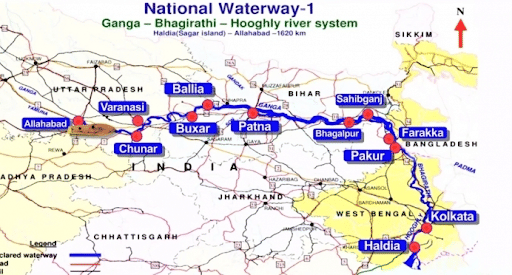
- The project calls for the construction of a 1620-kilometre-long waterway on the Ganga River between Allahabad and Haldia.
- The project spans the states of Uttar Pradesh, Bihar, Jharkhand, and West Bengal.
- The project intends to build a three-metre-deep fairway to allow commercial navigation of at least 1500-tonne vessels on the river.
- It also includes the construction of a fairway, multimodal terminals, the improvement of open river navigation techniques, conservation efforts, a modern River Information System (RIS), and other projects.
- The World Bank is funding the project.
- The Jal Marg Vikas Project is expected to cost $800 million and is scheduled to be completed in December 2023.
|
|
|
|---|---|
| Inland: National Waterways | Shipping industry in India |
| Factors affecting Inland waterways | Major Ports of World and India |
| Significance and Challenges | Ports: Inclusive centres of economic development |
| Challenges in Port Development | Sagarmala Project |
| Coastal Shipping | International Sea Routes |
| Shipping Canals | The Panama Canal |
| The Suez Canal | Environmental issues of maritime shipping |
Jal Marg Vikas Project - Objectives
- To provide an environmentally friendly and cost-effective alternative mode of transportation.
- To reduce the country's logistics costs.
- Mammoth Infrastructure Development, including multimodal and intermodal terminals, ferry services, navigation aids, and Ro-Ro facilities.
- To improve India's socio economic situation in order to create a large number of jobs.
Jal Marg Vikas Project - Importance
- The construction and operation of National waterway-1 will provide an alternative mode of environmentally friendly and cost-effective transportation.
- The project will help to reduce logistics costs in the country as well as traffic congestion on roads and railways.
- It will result in massive infrastructure development such as multimodal and intermodal terminals, Ro-Ro facilities, ferry services, and navigation aids.
- It will also stimulate socioeconomic development and result in job creation.
Initiatives under Jal Marg Vikas Project
- As part of the Jal Marg Vikas Project for the development and regulation of inland waterways, the Inland Waterways Authority of India has undertaken a number of initiatives.
- Construction of a multi-modal terminal in Haldia, West Bengal, at a cost of Rs 517.36 crore.
- In October 2016, a contract worth Rs. 280.90 crore was awarded for the construction of a multi-modal terminal in Sahibganj.
- To build a new navigation lock at Farakka Barrage at a cost of Rs 359.19 crore.
- Fairway construction between Varanasi and Haldia with a depth of 3 metres and a distance of 1380 km.
- The Inland Waterways Authority of India is developing the Kolkata and Patna terminals through a public-private partnership (PPP).
- IWAI signed a contract in August 2016 to design vessels specifically for navigation on NW-1.
- River Information Services (RIS) will be established on National Waterway -1.
National Waterway-1
- The National Waterway -1, also known as the Ganga-Bhagirathi-Hooghly river system, runs approximately 1,620 kilometres from Allahabad to Haldia (the longest in India).
- It connects major cities and their industrial hinterlands in West Bengal, Jharkhand, Bihar, and Uttar Pradesh.
- It is an important component of India's Eastern Transport Corridor.
- Along with NH-2, this corridor connects the National Capital Region (NCR) to the eastern and northeastern states.
- Through the Kolkata Port, it will also provide an important link to Bangladesh, Myanmar, Thailand, Nepal, and other east and south-east Asian countries.
Conclusion
The union government announced JMVP to allow commercial navigation of at least 1500 tonne vessels on the Ganga River. The project calls for the construction of a waterway on the Ganga River between Allahabad and Haldia (NW-1). It includes the construction of fairways, multimodal terminals, the improvement of open river navigation techniques, conservation projects, and a modern river information system. The World Bank is funding the project.
|
|
|
|---|---|
| Geography Notes | Human Geography |
| Transport, Communication and Trade in India | Water Transport |
| Role of Transport in Regional Development | Human Settlements |
| Transcontinental Railways | Human Development |
FAQs
Question. What is the Jal Marg Vikas Project (JMVP)?
Answer: The Jal Marg Vikas Project is a flagship initiative by the Government of India aimed at developing and improving the National Waterway 1 (NW-1), which runs along the Ganga River. The project is designed to promote inland water transport (IWT) as a sustainable and efficient mode of transportation, reducing traffic on roads and railways and providing a cost-effective alternative for freight movement.
Question. What are the main objectives of the Jal Marg Vikas Project?
Answer: The primary objectives of the JMVP are to enhance the navigational capacity of National Waterway 1, increase the usage of inland waterways for freight transport, improve port and terminal infrastructure, and promote sustainable and eco-friendly transportation. The project also aims to boost trade, create jobs, and contribute to regional economic growth.
Question. Which areas are covered under the Jal Marg Vikas Project?
Answer: The project focuses on National Waterway 1, which runs along the Ganga River, spanning from Varanasi in Uttar Pradesh to Haldia in West Bengal. It aims to develop this stretch to accommodate larger vessels and improve connectivity between inland ports along the river.
Question. What are the expected benefits of the Jal Marg Vikas Project?
Answer: The benefits of the JMVP include the reduction of congestion on road and rail networks, lower transportation costs, and increased efficiency in goods movement. It also aims to reduce carbon emissions by promoting an environmentally friendly mode of transport. Additionally, the project is expected to create employment opportunities and foster regional development, especially in areas along the Ganga.
Question. What is the role of the Inland Waterways Authority of India (IWAI) in the project?
Answer: The Inland Waterways Authority of India (IWAI) is the implementing agency for the Jal Marg Vikas Project. It is responsible for developing and maintaining the infrastructure for navigation, including terminal construction, dredging, and ensuring safe and efficient operations along National Waterway 1. IWAI also plays a key role in improving the regulatory framework and promoting the use of inland waterways in the country.
MCQs
- Which river is the focus of the Jal Marg Vikas Project?
a) Yamuna
b) Ganga
c) Godavari
d) Brahmaputra
Answer: (B) See the Explanation
The Jal Marg Vikas Project focuses on the Ganga River, specifically improving National Waterway 1 for inland water transport.
- What is the main objective of the Jal Marg Vikas Project?
a) To improve road infrastructure
b) To promote the use of inland waterways for freight transport
c) To develop railway infrastructure
d) To improve air transport connectivity
Answer: (B) See the Explanation
The main objective of the Jal Marg Vikas Project is to enhance the use of inland waterways as a cost-effective and eco-friendly mode of transportation for freight.
- Who is responsible for the implementation of the Jal Marg Vikas Project?
a) Ministry of Shipping
b) Inland Waterways Authority of India (IWAI)
c) Indian Railways
d) National Highway Authority of India
Answer: (B) See the Explanation
The Inland Waterways Authority of India (IWAI) is the key agency responsible for implementing the Jal Marg Vikas Project.
- What is the primary benefit of the Jal Marg Vikas Project?
a) Increased road traffic
b) Reduced cost of transporting freight via inland waterways
c) Reduced rail traffic
d) Improved air quality in urban areas
Answer: (B) See the Explanation
The project aims to lower the cost of transporting freight by improving the navigability of National Waterway 1, which provides an efficient alternative to road and rail transport.
- Which of the following areas is not directly covered under the Jal Marg Vikas Project?
a) Varanasi
b) Haldia
c) Patna
d) Kanpur
Answer: (D) See the Explanation
The Jal Marg Vikas Project focuses on National Waterway 1, which spans from Varanasi to Haldia along the Ganga River, but does not specifically cover Kanpur.
GS Mains Questions and Model Answers
Q1: Evaluate the role of the Jal Marg Vikas Project in promoting sustainable transport in India.
Answer: The Jal Marg Vikas Project plays a critical role in promoting sustainable transport in India by enhancing the navigational capacity of National Waterway 1 along the Ganga River. By shifting a portion of freight transport from road and rail to inland waterways, the project aims to reduce congestion on highways and railways, leading to lower transportation costs and increased efficiency. Inland waterways are considered an eco-friendly mode of transport, as they produce lower carbon emissions compared to road and rail transport. The project aligns with India’s broader goals of reducing environmental impact, improving logistics efficiency, and ensuring sustainable economic development. It also plays a key role in reducing the pressure on existing infrastructure while providing a cleaner, greener alternative for freight transport.
Q2: Discuss the expected socio-economic impact of the Jal Marg Vikas Project on the regions along the Ganga.
Answer: The Jal Marg Vikas Project is expected to have a transformative socio-economic impact on the regions along the Ganga River, particularly in Uttar Pradesh, Bihar, and West Bengal. By improving connectivity and promoting the use of inland waterways, the project will stimulate economic growth through enhanced trade and commerce. It will also create employment opportunities in the transport, logistics, and port infrastructure sectors. As the project facilitates smoother and more efficient transportation, it will encourage industrial growth, especially in manufacturing and export-oriented businesses. Additionally, by reducing transportation costs, agricultural products from the Ganga basin can be exported more competitively, benefiting farmers and agricultural workers. The development of ports and terminals will also lead to better infrastructure, contributing to regional development and poverty reduction.
Q3: Analyze the challenges faced by the Jal Marg Vikas Project and suggest measures to overcome them.
Answer: While the Jal Marg Vikas Project holds significant potential, it faces several challenges. One major challenge is the need for extensive dredging to maintain navigability, as the Ganga River has fluctuating water levels and silting issues. Ensuring consistent dredging and maintaining the river's depth are crucial for the smooth operation of the project. Additionally, the lack of modern port infrastructure and efficient management at several points along the river needs to be addressed. Environmental concerns such as the impact of dredging and other activities on aquatic ecosystems are also critical. To overcome these challenges, the government should focus on improving the regulatory framework, ensuring environmental sustainability, and investing in advanced technology for better river management. Collaboration with local stakeholders and continuous monitoring of the project will also be key in addressing potential bottlenecks and ensuring its long-term success.
Previous Year Questions on Jal Marg Vikas Project
1. UPSC CSE 2021
Question: "What is the primary objective of the Jal Marg Vikas Project?"
Answer: The primary objective of the Jal Marg Vikas Project is to enhance the navigability of National Waterway 1 along the Ganga River, enabling more efficient and eco-friendly transportation of freight via inland waterways.
2. UPSC CSE 2019
Question: "Evaluate the potential benefits and challenges of using inland waterways for freight transportation in India, with a focus on the Jal Marg Vikas Project."
Answer: Inland waterways, especially those under the Jal Marg Vikas Project, offer several benefits such as reducing road and rail congestion, providing a greener alternative for transport, and reducing logistics costs. However, challenges like sedimentation, inconsistent river depth, environmental impact, and inadequate port infrastructure need to be addressed to ensure the project's long-term viability.
Download the PREPP App and attempt FREE IAS Exam Mock Tests and get complete study material!

Live Test : UPSC CSE Prelims CSAT (Paper-II) (Oct 20 - 23)
Full Test - 04: UPSC CSE Prelims CSAT (Paper-II)
Full Test - 03: UPSC CSE Prelims CSAT (Paper-II)
UPSC CSE Prelims 2026 GS Paper 1 Question Paper (24-May-2026)
UPSC CSE Prelims 2026 CSAT Paper 2 Question Paper (24-May-2026)

17 February 2025 | The Hindu Must Read Articles | Current Affairs

16 February 2026 | The Hindu Must Read Articles | Current Affairs

13 February 2026 | The Hindu Must Read Articles | Current Affairs









Comments