Jaishankar Hopes India And The U.K. Will Find Mutually Beneficial ‘Landing Point’ For Trade Deal
Relevance: GS2- Bilateral, regional and global groupings and agreements involving India and/or affecting India’s interests, GS3- Liberalization
(Source: The Hindu, 11/15/2023)
Click here for Daily Current Affairs
Why in the news?
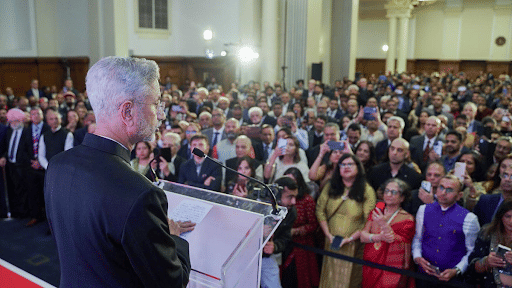
- Recently, Indian External Affairs Minister S. Jaishankar expressed hope that India and the U.K. could find a mutually beneficial landing point for the Free Trade Agreement (FTA) being negotiated between the two countries.
- India and the U.K. have been attempting to reframe their relationship on the basis of the ‘Roadmap to 2023’ plan announced in 2021.
What has the External Affairs Minister said?
- Mutual landing point: The External Affairs Minister was hopeful that Indian and the UK negotiating teams could find a mutually beneficial agreement for the Free Trade Agreement between the two countries.
- Agenda 2030: India and the UK were trying to reframe their relationship based on the ‘Roadmap to 2023’.
- The Roadmap to 2023 was announced by Prime Minister Narendra Modi and then U.K. Prime Minister Boris Johnson in May 2021.
- It aims to elevate the India-UK partnership across multiple domains such as connectivity, defense, health, trade, and climate action.
- Need for cooperation: The Minister observed that India and Britain share similar interests across issues and expressed interest in greater collaboration between the two countries.
- He also credited the U.K. for helping India with the successful conduct of the G-20 Summit hosted by India in 2023.
- He also cited the example of India and the U.K.’s collaboration in their work on vaccines during the COVID-19 pandemic.
Free Trade Agreement
|
India and UK FTA
- India and the U.K. launched the talks for a free-trade agreement (FTA) in January 2022, with the aim of concluding talks by Deepavali (October 24, 2022).
- However, the deadline failed as a result of the political developments in the U.K..
- There are 26 chapters in the agreement covering goods, services, investments, and intellectual property rights.
- Virtual sessions of negotiations between India and the UK are progressing with the countries looking to conduct negotiations for proposed free trade agreements to settle differences on issues such as automobiles, medical devices, and the movement of professionals.
- Expectations from the FTA:
- India has demanded greater access for its skilled professionals from sectors like IT, and healthcare in the UK market, as well as market access for several goods with zero customs duties.
- The U.K. has sought a significant reduction in import duties imposed by India on goods such as scotch whiskey, automobiles, lamb meat, chocolates, and some confectionary items.
- The U.K. also wants more opportunities for U.K. services in Indian markets such as telecommunications, and legal and financial services.
- Points of contention:
- Issues that need resolution include rules of origin; intellectual property rights (IPRs); social security agreements; duty concessions on electric vehicles, scotch whiskey, lamb meat, chocolates and certain confectionary items; and liberalisation of norms in services sectors like banking and insurance.
- India has expressed concerns over any attempts to compromise on the production of generic medicines, which are a significant life-saving intervention.
- Bilateral investment treaty: The proposed bilateral investment treaty (BIT) is being negotiated as a separate agreement between India and the U.K.
- The treaty could help promote and protect investments in both countries although both countries have yet to resolve their differences over the mechanism for dispute settlement.
- India has proposed to first utilize all local judicial remedies for the settlement of disputes before initiating an international arbitration.
- The FTA is significant for India as it could serve as a template for its discussions with the EU and EFTA countries.
India-U.K. Trade
|
Why is the India-UK FTA important for India?
- Increasing Exports: A successful FTA between India and the UK will help boost bilateral trade.
- This will encourage exports in sectors such as textiles, leather goods, footwear, etc.
- Moreover, these sectors are employment-intensive which will further benefit the economy and the workforce.
- Facilitate trade in services: India and the U.K. believe that the FTA will enable certainty, predictability, and transparency in bilateral trade.
- This will lead to the creation of a mutually beneficial, liberal, competitive, and facilitative services regime across sectors like IT/ITES, healthcare, education, etc.
- Focus on the West: India has increasingly focused on completing trade deals with its Western partners - the U.S.A., the U.K., and the EU - since opting out of the Regional Comprehensive Economic Partnership in 2019.
- Strategic Advantage: India believes that stronger bonds between India and the U.K., which is also a permanent member of the UNSC, can be developed through trade.
- This will help the country seek the U.K.’s support on global issues such as reform of multilateral institutions, dispute settlement, etc.
India UK Roadmap 2030
Health
Climate
Trade
Education
Science and Technology
Defense
Other Areas of Cooperation
|
Conclusion
- The ongoing negotiations between India and the U.K. for a Free Trade Agreement hold strategic significance and carry economic, diplomatic, and geopolitical implications. It will provide opportunities for enhanced bilateral trade, cooperation in various sectors, and reinforce India's focus on global partnerships for sustained growth and influence.
(*Click this link to read prelims specific weekly current affairs articles)
FAQs
Question: What is the ‘Rules of origin’ provision?
Answer:
The ‘Rules of origin’ provision in an FTA mandates minimum processing in the partner country for a product to be labeled as originating goods. This prevents countries from dumping third-party goods into India through labeling alone, enforcing prescribed value addition. These norms are crucial in preventing the dumping of goods in the Indian market.
Question: What are the EFTA countries?
Answer:
The European Free Trade Association (EFTA) is an intergovernmental organization established in 1960 as an alternative trade bloc for the European states unable or unwilling to join the European Union (EU). It consists of Iceland, Liechtenstein, Norway, and Switzerland. The EFTA is India's 9th largest trading partner, accounting for about 2.5% of India's total merchandise trade in 2020-21.
UPSC Mains Practice Question:
|
MCQs
Question: The emerging trading blocs in the world, such as NAFTA, ASEAN, and the like, are expected to : (UPSC CSE 1996)
(a) act as constrictions in free trade across the world
(b) promote free trade on the lines laid down by the WTO
(c) permit transfer of technology between member countries
(d) promote trade in agricultural commodities between countries of the North and South
Answer: (b) See the Explanation
- Emerging trade blocks have been established with the aim of enabling free trade between member nations.
Therefore, option (b) is the correct answer.
Question: Consider the following statements:
- FTA members shall not erect higher or more restrictive tariffs on trade with non-members than prior to the formation of the FTA.
- It encourages trade protectionism.
Which of the above statements is/are correct?
(a) 1 only
(b) 2 only
(c) Both 1 and 2
(d) None of the above
Answer: (a) See the Explanation
- FTA members should not erect higher or more restrictive tariffs or non-tariff barriers on trade with non-members than prior to the formation of the FTA. Hence statement 1 is correct.
- A free trade policy allows products and services to be bought and sold across international borders with little or no restrictions from the government in the form of taxes, subsidies, quotas, or prohibitions.
- FTAs are directly opposed to the concept of trade protectionism. Hence statement 2 is incorrect.
Therefore, option (a) is the correct answer.
Download the PREPP App and attempt FREE IAS Exam Mock Tests and get complete study material!

Full Test - 04: UPSC CSE Prelims CSAT (Paper-II)
Full Test - 03: UPSC CSE Prelims CSAT (Paper-II)
UPSC CSE Prelims 2026 GS Paper 1 Question Paper (24-May-2026)
UPSC CSE Prelims 2026 CSAT Paper 2 Question Paper (24-May-2026)

17 February 2025 | The Hindu Must Read Articles | Current Affairs

16 February 2026 | The Hindu Must Read Articles | Current Affairs

13 February 2026 | The Hindu Must Read Articles | Current Affairs









Comments