IT Ministry Issues Warning to Social Media Sites on Deepfakes
Primary Source: The Hindu
Click here for Daily Current Affairs
Why in the news?
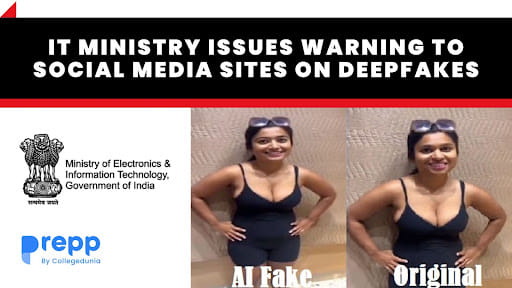
- Recently, the IT Ministry has issued a warning to social media platforms in the wake of a viral deepfake video featuring actor Rashmika Mandanna.
- Social media sites were reminded of the legal implications under Section 66D of the Information Technology Act, 2000.
Table of Contents
What are Deepfakes?
- Deepfakes are highly realistic and often convincing digital forgeries of videos, images, or audio recordings.
- They are generated using artificial intelligence (AI) and machine learning techniques, particularly deep learning, from which the term "deepfake" is derived.
- Deepfakes are made using algorithms called generative adversarial networks (GANs), among other techniques.
- A GAN consists of two parts: the generator, which creates images or videos, and the discriminator, which evaluates their authenticity. They work in tandem to improve the quality of the forgeries.
- With deepfake technology, creators can make people appear to say or do things they never did.
- This includes facial expressions, lip movements, voice, and even body language if full-body deepfakes are made.
Government’s Action Against Deepfakes
- Issuing Notices: The IT Ministry has sent notices to social media intermediaries (like Facebook, Twitter, Instagram, etc.) reminding them that online impersonation, including the creation and dissemination of deepfakes, is illegal under Section 66D of the Information Technology Act, 2000.
- Content Takedown: The IT Ministry has instructed these platforms to remove content that qualifies as deepfakes within 36 hours, as required by the IT Rules, 2021.
- Due Diligence and Reasonable Efforts: The IT Ministry has told social media companies that they need to exercise due diligence and make reasonable efforts to identify and flag misinformation and deepfakes.
- Prohibition of Impersonating Content: The IT Rules, 2021, as cited in the article, specifically prohibit hosting any content that impersonates another person. This includes deepfakes where someone's appearance and voice can be manipulated to appear as someone else.
- Requirement for Prompt Action: Social media firms are required to quickly take down artificially morphed images or videos of an individual when they are alerted to such content.
Ethical Concern Regarding Deepfake Technology
- Invasion of Privacy: Deepfakes can be created without the consent of the individuals whose images or voices are being used. This constitutes a significant invasion of privacy and can lead to distress.
- Impersonation and Fraud: Deepfakes can be used to impersonate individuals, potentially leading to fraud. Under Section 66D of the Information Technology Act, 2000, impersonation is illegal, reflecting the concern over fraudulent activities.
- Misinformation and Disinformation: The ability to create convincing fake videos can be misused to spread misinformation and disinformation.
- Reputational Damage: Deepfake technology can be used to create content that can damage an individual’s reputation by depicting them in situations that are compromising, false, or defamatory.
- Psychological Impact: The impact on mental health can be profound, especially if such content were to be released during one's formative years, such as during school or college.
- Harassment and Abuse: Deepfakes can be a tool for cyberbullying and harassment. Particularly for women, there is the concern of ‘deepfake pornography’ which can be used to create explicit content without their consent, leading to emotional and psychological trauma.
- Legal and Accountability Issues: There is a complex legal landscape regarding who is responsible for deepfake content—the creator, the person who disseminates it, or the platforms hosting it.
- Erosion of Trust: On a broader societal level, deepfakes can erode trust in media and communications. When it becomes difficult to discern what is real and what is fake, overall trust in the information ecosystem can diminish.
- Security Concerns: Deepfakes pose a security threat as they could potentially be used to mimic the identity of key individuals in sensitive positions, leading to security breaches.
- Economic Impact: Fake videos could potentially be used to manipulate stock markets or harm businesses by fabricating false statements by CEOs or spreading disinformation about products.
Laws Against Deepfakes in India
India does not have any specific laws that exclusively address deepfakes. However, various provisions of existing laws can be applied to tackle issues arising from deepfakes.
- Section 66E of the IT Act of 2000: This section applies in cases of deepfake offenses that entail recording, publishing, or sending a person's photographs in mass media, infringing on their privacy.
- Offenders face up to three years in prison or a fine of up to two lakh rupees.
- Section 66D of the IT Act of 2000: It allows for the prosecution of those who utilize communication devices or computer resources with the criminal goal of cheating or impersonating someone.
- It is punishable by up to three years in prison and/or a fine of up to one lakh rupees.
- Copyright Protection: The Indian Copyright Act of 1957 protects works such as films, music, and other creative content.
- Copyright holders can sue persons who construct deepfakes utilizing copyrighted works without permission.
- Penalties for copyright infringement are set out in Section 51 of the Copyright Act.
- Government Advisory: On January 9, 2023, the Ministry of Information and Broadcasting issued a warning to media outlets to be cautious when airing content that could be modified or tampered with.
- The Ministry also suggested that manipulated content be labeled as "manipulated" or "modified" to alert viewers that the content has been altered.
Global Initiatives to Combat Deepfakes
- European Union: To combat the spread of disinformation by deepfakes, the European Union amended its Code of Practice on Disinformation in 2022.
- United States: The bipartisan Deepfake Task Force Act was introduced in the United States to aid the Department of Homeland Security (DHS) in combating deepfake technology.
- China: It will implement comprehensive deep synthesis regulations beginning in January 2023. The law, which aims to reduce deception, mandates unambiguous labeling and traceability of deep synthesis content. Individual consent is required, as is obedience to laws and public morals. Service providers must put in place review systems and work with authorities.
Way Forward
Enhanced Platform Responsibility
- Social media platforms need to strengthen their content moderation policies specifically regarding deepfakes.
- Implementation of more sophisticated algorithms and AI tools that can detect and flag deepfake content before it goes viral.
- Compliance with local laws, such as the IT Rules 2021 in this case, which require the takedown of such content within a stipulated time frame.
Collaboration with AI Experts and Researchers
- Engage with AI experts to stay ahead of deepfake technology and develop countermeasures.
- Invest in research to create digital watermarking and authentication technologies to verify the authenticity of digital content.
User Education and Awareness
- Social media sites should invest in educating users about the existence and dangers of deepfakes.
- Run awareness campaigns to help users identify deepfakes and encourage them to report suspicious content.
Robust Reporting Mechanisms
- Provide clear and accessible reporting mechanisms for users to flag deepfakes.
- Take proactive steps to review flagged content and take appropriate action swiftly.
Legal Enforcement and Deterrence
- Law enforcement agencies should have clear guidelines and sufficient resources to pursue individuals or entities that create or disseminate deepfakes with the intent to harm others.
Technical Measures
- Adoption of blockchain and other technologies to track the origin and spread of digital content.
- Utilization of biometric data (where legal and ethical) to authenticate content.
International Collaboration
- Since social media platforms operate on a global scale, international collaboration is key in addressing the challenge of deepfakes.
- Work with international bodies to create a set of standards and best practices for managing deepfake content.
Psychological Support
- Recognizing the mental health impact, social media platforms could provide resources and support for victims of deepfakes.
Conclusion
The IT Ministry's warning to social media sites underscores the urgent need for regulatory measures to combat the rise of deepfakes and online impersonation. The enforcement of IT Rules, 2021, signifies a move towards greater accountability for social media platforms in moderating content and protecting individuals from digital impersonation.
(*Click this link to read prelims specific weekly current affairs articles)
FAQs
Question: What are deepfakes?
Answer:
Deepfakes are synthetic media where a person in an existing image or video is replaced with someone else's likeness using artificial intelligence.
Question: What are the laws in India against deepfakes?
Answer:
India does not have any specific laws that exclusively address deepfakes. However, various provisions of existing laws can be applied to tackle issues arising from deepfakes.
- Section 66E of the IT Act of 2000: This section applies in cases of deepfake offenses that entail recording, publishing, or sending a person's photographs in mass media, infringing on their privacy. Offenders face up to three years in prison or a fine of up to two lakh rupees.
- Section 66D of the IT Act of 2000: It allows for the prosecution of those who utilize communication devices or computer resources with the criminal goal of cheating or impersonating someone. It is punishable by up to three years in prison and/or a fine of up to one lakh rupees.
UPSC Mains Practice Question:
|
MCQs
Question: With the present state of development, Artificial Intelligence can effectively do which of the following? (UPSC 2020)
- Bring down electricity consumption in industrial units
- Create meaningful short stories and songs
- Disease diagnosis
- Text-to-speech conversion
- Wireless transmission of electrical energy
Select the correct answer using the code given below:
(a) 1, 2, 3 and 5 only
(b) 1, 3, and 4 only
(c) 2, 4, and 5 only
(d) 1, 2, 3, 4 and 5
Answer: (b) See the Explanation
The correct answer, according to the UPSC answer key, is option (b). This question was posed in the year 2020. However, in the current state of research, Artificial Intelligence can perform almost all of the aforementioned activities/tasks.
Artificial intelligence is any machine that demonstrates human-like characteristics such as learning and problem-solving. It is a broad field of computer science focused with creating intelligent machines capable of performing activities that normally need human intelligence.
Artificial intelligence has the ability to reduce energy waste, minimize energy costs, and enable and expedite the implementation of clean renewable energy sources in global power networks. Hence, statement 1 is correct.
Artificial intelligence, like humans, can engage meaningful conversations and produce music and stories. Hence, statement 2 is correct.
Speech recognition with Google Assistant Deep neural networks are used by AI to learn how to recognize spoken commands and inquiries, as well as for text-to-speech conversion. Hence, statement 4 is correct.
Online prediction of receiver positions is required in wireless power transmission to optimally charge the power receivers. AI has a very high prediction accuracy. Hence, statement 5 is correct.
Question: In India, it is legally mandatory for which of the following to report on cyber security incidents? (UPSC 2017)
- Service providers
- Data centers
- Body corporate
Select the correct answer using the codes given below:
(a) 1 only
(b) 1 and 2 only
(c) 3 only
(d) 1, 2 and 3
Answer: (d) See the Explanation
Cybersecurity incidents are defined as any actual or suspected adverse event in relation to cybersecurity that violates an explicitly or implicitly applicable security policy, resulting in unauthorized access, denial of services, unauthorized use of computer resources for data processing or storage, or unauthorized changes to data.
In India, Section 70-B of the Information Technology Act, 2000 (the "IT Act") empowers the Central Government to appoint the Indian Computer Emergency Response Team (CERT) to report such situations.
Rule 12 of the CERT Rules allows any individual, company, or organization to submit cybersecurity incidents to the CERT-In. Hence, all of the statements are correct.
Therefore, option (d) is the correct answer.
Download the PREPP App and attempt FREE IAS Exam Mock Tests and get complete study material!

Full Test - 04: UPSC CSE Prelims CSAT (Paper-II)
Full Test - 03: UPSC CSE Prelims CSAT (Paper-II)
UPSC CSE Prelims 2026 GS Paper 1 Question Paper (24-May-2026)
UPSC CSE Prelims 2026 CSAT Paper 2 Question Paper (24-May-2026)

17 February 2025 | The Hindu Must Read Articles | Current Affairs

16 February 2026 | The Hindu Must Read Articles | Current Affairs

13 February 2026 | The Hindu Must Read Articles | Current Affairs









Comments