ISRO’s World Record PSLV C37 Launch – Science & Technology Notes
On February 15, 2017, ISRO set a world record and made history by successfully launching 104 satellites in a single mission. India surpassed Russia's previous record of 37 satellites launched in 2014. The satellites were launched by the Indian Space Research Organization's (ISRO) PSLV C37 launch vehicle. In this article, we will discuss in detail regarding ISRO’s World Record PSLV C37 Launch which will be helpful for UPSC exam preparation.
Table of Contents
What is PSLV C37?
- PSLV-C37 carries two ISRO Nano satellites – INS-1A and INS-1B.
- INS is a versatile and modular Nao satellite bus system envisioned for future science and experimental payloads.
- The INS system is developed as a co-passenger satellite to accompany bigger satellites on PSLV.
- The primary objectives of INS system are to:
- Design and develop a low-cost modular nano satellite in the weight range of 10 kg capable of carrying payloads up to a weight of 5 kg.
- Provide and opportunity for ISRO technology demonstration payloads.
- Provide a standard bus for launch on demand services.
- Provide an opportunity to carry innovative payloads for Universities/ R&D labs.
- PSLV-C37 took off from the First Launch Pad as planned. After a flight of 16 minutes and 48 seconds, the satellites reached a polar Sun Synchronous Orbit of 506 km inclined at an angle of 97.46 degrees to the equator (very close to the intended orbit), and all 104 satellites successfully separated from the PSLV fourth stage in a predetermined sequence, beginning with the Cartosat-2 series satellite and followed by INS-1 and INS-2.
- The PSLV has now launched a total of 46 Indian satellites.
- Following separation, the two solar arrays of the Cartosat-2 series satellite were automatically deployed, and the satellite was handed over to ISRO's Telemetry, Tracking, and Command Network (ISTRAC) in Bangalore.
- Two of the 103 co-passenger satellites carried by PSLV-C37 are Indian technology demonstration satellites, ISRO Nano Satellite-1 (INS-1) weighing 8.4 kg and INS-2 weighing 9.7 kg.
- With the successful launch of PSLV C37, India's workhorse launch vehicle PSLV has launched 180 customer satellites from other countries.
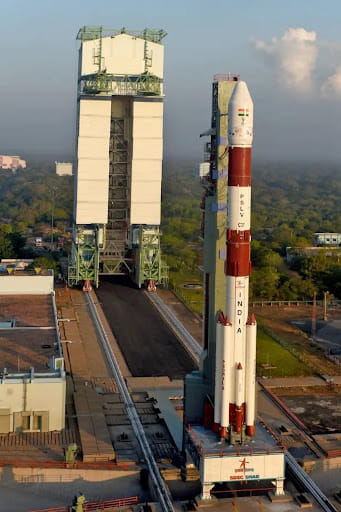
PSLV C37
| Other Relevant Links | |
|---|---|
| GSLV and Various Engine | Recent National and International Space Missions |
| Cryogenic rockets | Scramjet Engine |
| GSLV Mk III-D1 OR GSAT-19 Mission | Global Positioning System |
| Galileo | GLONASS |
| IRNSS | GAGAN |
| Chandrayaan – I & II | Mars Orbiter Mission |
Significance of PSLV C37 Launch
- ISRO launched 104 satellites, three of which are Indian and 101 of which are foreign.
- 101 foreign nano satellites from six countries were launched, bringing the international dimension to a new level.
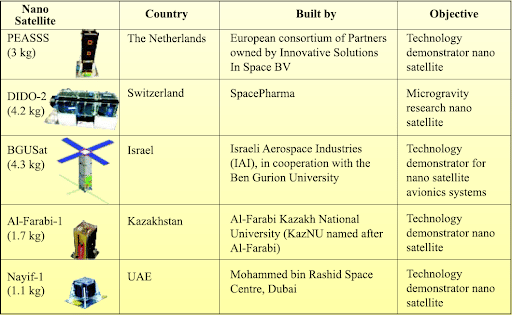
- There were 96 from the United States, and one each from Israel, Kazakhstan, the United Arab Emirates, the Netherlands, and Switzerland.
- PSLV carried a 714-kilogram main earth observation satellite (Cartosat 2 series) and 103 smaller "nanosatellites" weighing a total of 664 kilogrammes.
- This is the PSLV's heaviest variant, weighing approximately 320 tonnes at lift-off and standing 44.4 metres tall.
- An Indian cartographic satellite, capable of high-resolution imaging, is also on board. It is expected to be used to keep an eye on regional rivals Pakistan and China. INS -1A and INS -1B are two other Indian satellites.
- The launch took place from the Sriharikota spaceport in Andhra Pradesh.
- All 104 satellites were launched into space in about 18 minutes, each travelling at a speed of over 27,000 km per hour - 40 times the speed of a typical passenger airline.
- Planet Inc., based in San Francisco, owns nearly 90 small satellites known as "Doves." The Dove constellation will be used to take low-cost images of the Earth.
- This is ISRO's second successful launch attempt, following the June 2015 launch of 23 satellites in a single rocket.
CARTOSAT-2
- The Cartosat-2 series satellite is the primary satellite carried by PSLV-C37.
- The satellite weighs approximately 680kg and is designed to last 5 years.
- It is a sun-synchronous earth observation satellite that provides images of the Earth. It has a panchromatic camera that takes black-and-white images of the Earth.
- This satellite's images and data are useful for cartographic applications, infrastructure, and Land Information System (LIS) and Geographical Information System (GIS) applications.
- Cartosat-2 series satellite imagery will be useful for cartographic applications, urban and rural applications, coastal land use, utility management such as road network monitoring and water distribution, change detection to highlight geographical and manmade features.
- Under the Amrut Planning Scheme, the data sets could be used for urban planning in 500 cities.
International Satellites
DOVE (Flock-3P), USA
- DOVE Flock-3P nano satellites are a fleet of remote sensing satellites that will image the entire Earth every day for commercial, environmental and humanitarian purposes.
- The Dove satellites are designed, built and operated by Planet Inc., headquartered in San Francisco, USA.
LEMUR, USA
LEMUR nano-satellites of Spire Global Inc., San Francisco, USA are meant for providing vessel tracking using Automatic Identification System (AIS), besides carrying out weather measurement using GPS Radio Occultation.
Conclusion
This mission presented numerous technical challenges, such as launching a large number of satellites in a single mission within the time constraints. Another complexity associated with this mission was ensuring adequate separation between all 104 satellites during their orbital injection as well as their subsequent orbital life. ISRO has strengthened its impeccable scientific credentials as a reliable partner for space initiatives with this launch.
| Other Relevant Links | |
|---|---|
| Science & Technology Policy in India | Scientific Policy Resolution 1958 |
| Science & Technology Policy of 1983 | Science & Technology Policy of 2003 |
| Science, Technology and Innovation Policy 2013 | New Initiatives Aligned with the National Agenda |
| India and World collaboration in science projects | Technology Vision Document 2035 |
FAQs
Question: What is the significance of the PSLV-C37 launch by ISRO?
Answer: The PSLV-C37 launch was significant because it set a world record by successfully launching 104 satellites in a single mission, surpassing the previous record of 37 satellites held by Russia. This achievement demonstrated ISRO’s capability to carry out high-density satellite launches with precision and efficiency.
Question: What types of satellites were launched by PSLV-C37?
Answer: The PSLV-C37 launch carried 104 satellites, including 96 from foreign countries and 3 from India. The satellites served various purposes, including Earth observation, communication, scientific research, and technology demonstration. Most of them were small-sized, demonstrating the growing global demand for CubeSats and small satellite technologies.
Question: How did ISRO manage to successfully launch 104 satellites in a single mission?
Answer: ISRO achieved this feat through meticulous planning and innovative payload deployment techniques. The satellites were arranged in multiple layers and deployed in a precise sequence, using the PSLV’s multiple payload deployment mechanisms. This strategy ensured that all satellites were successfully placed into their intended orbits without interference.
Question: What technological innovations were involved in the PSLV-C37 launch?
Answer: The PSLV-C37 mission incorporated several technological innovations, including the use of a new payload adapter system and the deployment of small satellites using the "release mechanism" designed by ISRO. These innovations ensured the successful deployment of satellites at precise intervals, allowing for safe and efficient deployment of a large number of satellites simultaneously.
Question: What does the success of PSLV-C37 mean for India’s space program?
Answer: The success of PSLV-C37 is a testament to ISRO’s increasing capabilities in satellite launching. It bolstered India’s reputation in the global space community, showcasing ISRO’s ability to handle complex, high-volume missions. This achievement is likely to attract more international collaborations and commercial satellite launches, strengthening India’s position as a leading spacefaring nation.
MCQs
1. What world record was set by ISRO’s PSLV-C37 mission?
A) Most number of Earth observation satellites launched
B) Most number of satellites launched in a single mission
C) First successful mission to Mars
D) First launch of a communication satellite
Answer: (B) See the Explanation
ISRO’s PSLV-C37 mission set a world record by successfully launching 104 satellites in a single mission, breaking the previous record of 37 satellites.
2. How many satellites did ISRO’s PSLV-C37 launch carry in total?
A) 98
B) 104
C) 120
D) 50
Answer: (B) See the Explanation
PSLV-C37 successfully launched a total of 104 satellites, 96 of which were from foreign countries, making it a record-breaking launch.
3. What was the primary payload of PSLV-C37?
A) Weather observation satellite
B) Communication satellite
C) Small satellites and CubeSats
D) GPS satellite
Answer: (C) See the Explanation
The primary payload of PSLV-C37 was a mix of small satellites and CubeSats, including both Indian and foreign satellites, for various purposes like communication and Earth observation.
4. What innovation helped ISRO deploy 104 satellites in a single mission?
A) Use of a multi-payload adapter
B) New rocket propulsion system
C) Automated satellite deployment system
D) Use of small-sized satellites only
Answer: (A) See the Explanation
ISRO used a new multi-payload adapter system to arrange and deploy the satellites in precise intervals, ensuring the successful deployment of 104 satellites.
5. Which rocket launched the PSLV-C37 mission?
A) GSLV Mk III
B) GSLV-D5
C) PSLV
D) Ariane 5
Answer: (C) See the Explanation
The PSLV-C37 mission was launched aboard the Polar Satellite Launch Vehicle (PSLV), which is known for its reliability and versatility in launching a variety of payloads.
GS Mains Questions and Model Answers
Q1: Analyze the significance of PSLV-C37 for India’s position in the global space industry.
Answer: PSLV-C37 marked a significant milestone for India, positioning ISRO as a leading player in the global space industry. By successfully launching 104 satellites, ISRO not only demonstrated its technical prowess but also showcased its cost-effectiveness in conducting large-scale space missions. This achievement has boosted India’s reputation in the global space community, attracting more international collaborations and commercial satellite launches. The ability to handle complex multi-payload launches provides India with a competitive edge in the commercial space launch market, enabling ISRO to attract customers from various countries for launching satellites, further establishing India as a hub for space exploration.
Q2: What are the potential benefits and challenges associated with launching 104 satellites in a single mission?
Answer: The potential benefits of launching 104 satellites in a single mission include cost reduction, efficiency in satellite deployment, and the ability to meet the growing demand for small satellite launches. Additionally, it demonstrates technological innovation, showcasing ISRO's capability to handle complex launches with precision. However, challenges include the need for precise deployment mechanisms, managing satellite coordination, and ensuring the safety of each satellite during launch and deployment. Furthermore, handling the logistical aspects of the launch and maintaining operational satellites in orbit require advanced infrastructure and continual monitoring.
Q3: Discuss the role of satellite technology in India's socio-economic development and its contribution to global space missions.
Answer: Satellite technology plays a pivotal role in India’s socio-economic development by enabling critical services in communication, agriculture, disaster management, weather forecasting, and environmental monitoring. India’s advancements in satellite technology have contributed to the efficient delivery of services, especially in rural and remote areas, enhancing connectivity, improving crop yields, and providing real-time data for disaster response. Moreover, India’s space missions, like the PSLV-C37, contribute to global space exploration by providing cost-effective satellite launch services to other nations. As a result, India has become an important partner in the global space economy, promoting international cooperation in space research and technology.
Previous Year Questions on Space Exploration
1. UPSC CSE Prelims 2020:
Question: The PSLV-C37 mission was launched to place how many satellites into orbit?
A) 37
B) 104
C) 56
D) 88
Answer: (B)
Explanation: PSLV-C37 launched 104 satellites in a single mission, setting a new world record for the most satellites launched simultaneously.
2. UPSC CSE Mains 2021 (GS Paper 3):
Question: "Evaluate the technological advancements in ISRO’s PSLV-C37 mission and their implications for India’s space program."
Answer: The PSLV-C37 mission demonstrated several technological advancements, particularly in the precision deployment of multiple satellites. It highlighted ISRO’s ability to launch a large number of satellites simultaneously, which is crucial for addressing the growing global demand for satellite launches. This achievement has placed ISRO in a strong position to offer cost-effective and efficient satellite launching services on the global stage. The success of PSLV-C37 further strengthens India’s space capabilities, making it a key player in the commercial space launch market, while also contributing to India’s space research and development agenda.
Download the PREPP App and attempt FREE IAS Exam Mock Tests and get complete study material!

Full Test - 04: UPSC CSE Prelims CSAT (Paper-II)
Full Test - 03: UPSC CSE Prelims CSAT (Paper-II)
UPSC CSE Prelims 2026 GS Paper 1 Question Paper (24-May-2026)
UPSC CSE Prelims 2026 CSAT Paper 2 Question Paper (24-May-2026)

17 February 2025 | The Hindu Must Read Articles | Current Affairs

16 February 2026 | The Hindu Must Read Articles | Current Affairs

13 February 2026 | The Hindu Must Read Articles | Current Affairs









Comments