Internet of Things (IoT) – Science & Technology Notes
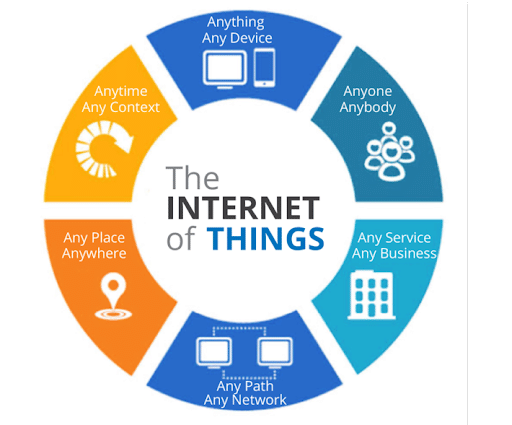
The Internet of Things (IoT) is a network of physical objects — "things" — embedded with sensors, software, and other technologies for connecting and exchanging data with other devices and systems via the internet. These gadgets range from common household items to sophisticated industrial tools. Experts predict that the number of connected IoT devices will increase to 10 billion by 2020 and 22 billion by 2025. In this article, we will discuss in detail regarding Internet of Things (IoT) which will be helpful for UPSC exam preparation.
Table of Contents
Internet of Things
What is Internet of Things?
- The internet of things, or IoT, is a networked system of interconnected computing devices, mechanical and digital machines, objects, animals, or people with unique identifiers (UIDs) and the ability to transfer data without requiring human-to-human or human-to-computer interaction.
- A thing in the internet of things can be a person implanted with a heart monitor, a farm animal implanted with a biochip transponder, a car with built-in sensors to alert the driver when tyre pressure is low, or any other natural or man-made object that can be assigned an Internet Protocol (IP) address and can transfer data over a network.
- Organisations in a variety of industries are increasingly utilising IoT to operate more efficiently, better understand customers in order to provide better customer service, improve decision-making, and increase the value of the business.
| Other Relevant Links | |
|---|---|
| Digital India | Quantum computing |
| Project brainwave | Sagar Vani System |
| Locky Ransomware, Petya, WannaCry | Hindi word for computer i.e., “SANGANAK” |
| India’s first technology and innovation support centre (TISC) | Net neutrality |
| National cyber coordination center | Hortnet |
| Digital Transaction Methodologies | Bitcoins |
| Cyber Swachhta Kendra | Bharat Net Project |
| Wi-Fi Technology | Digital Terrestrial Television Transmission System |
How Does Internet of Things Work?
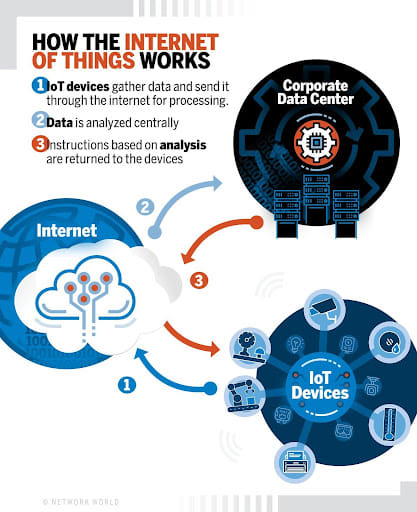
A typical IoT system operates by collecting and exchanging data in real time. An IoT system is made up of three parts:
Smart Devices
- This is a device with computing capabilities, such as a television, security camera, or exercise equipment.
- It collects data from its surroundings, user inputs, or usage patterns and transmits it to and from its IoT application via the internet.
IoT Application
- An IoT application is a set of services and software that combines data from various IoT devices.
- It analyses this data and makes informed decisions using machine learning or artificial intelligence (AI) technology.
- These decisions are communicated to the IoT device, which responds intelligently to inputs.
Graphical User Interface
- A graphical user interface can be used to manage an IoT device or fleet of devices.
- A mobile application or website that can be used to register and control smart devices is a common example.
Technologies Used in Internet of Things
1) Sensors and Actuators
- Sensors are devices that detect environmental changes such as temperature, humidity, light, motion, or pressure.
- Actuators are devices that can change the physical environment by opening or closing a valve or turning on a motor.
- These devices are central to IoT because they enable machines and devices to interact with the physical world.
- When sensors and actuators work together to solve problems without the need for human intervention, automation is possible.
2) Connectivity Technologies
- IoT devices must be connected to the internet in order to transmit data from sensors and actuators to the cloud.
- Wi-Fi, Bluetooth, cellular, Zigbee, and LoRaWAN are among the connectivity technologies used in IoT.
3) Cloud Computing
- The vast amounts of data generated by IoT devices are stored, processed, and analysed in the cloud.
- The infrastructure and tools required to store and analyse this data, as well as build and deploy IoT applications, are provided by cloud computing platforms.
4) Big Data Analytics
- Businesses must use advanced analytics tools to extract insights and identify patterns from the massive amounts of data generated by IoT devices in order to make sense of it all.
- Machine learning algorithms, data visualisation tools, and predictive analytics models are examples of such tools.
5) Security and Privacy Technologies
- IoT security and privacy are becoming increasingly important as IoT deployments spread.
- To protect IoT devices and the data they generate from cyber threats, technologies such as encryption, access controls, and intrusion detection systems are used.
What is Industrial Internet of Things (IIoT)?
|
Applications of Internet of Things (IoT)
| Sector | Application |
|---|---|
| Healthcare |
|
| Manufacturing |
|
| Retail |
|
| Agriculture |
|
| Transportation |
|
Benefits of Internet of Things
1) Improved Efficiency
- Businesses can improve efficiency and productivity by using IoT devices to automate and optimise processes.
- IoT sensors, for example, can be used to monitor equipment performance and detect or even resolve potential issues before they cause downtime, lowering maintenance costs and increasing uptime.
2) Data Driven Decision Making
- IoT devices generate massive amounts of data that can be used to inform better business decisions and create new business models.
- Businesses can gain insights into customer behaviour, market trends, and operational performance by analysing this data, allowing them to make more informed decisions about strategy, product development, and resource allocation.
3) Cost Savings
- IoT can help businesses reduce costs and improve profitability by automating repetitive tasks and reducing manual processes.
- IoT devices, for example, can be used to monitor and optimise energy consumption, lowering energy costs and improving sustainability.
4) Enhanced Customer Experience
- Businesses can create more personalised and engaging experiences for their customers by using IoT technology to collect data about customer behaviour.
- Retailers, for example, can use IoT sensors to track customer movements in stores and deliver personalised offers based on their actions.
Challenges in Internet of Things (IoT)
Security and Privacy Risks
- As IoT devices proliferate, security and privacy become increasingly important.
- Many IoT devices are vulnerable to hackers and other cyber threats, putting sensitive data security and privacy at risk.
- IoT devices can also collect massive amounts of personal data, raising privacy and data protection concerns.
Interoperability issues
- IoT devices from different manufacturers frequently use different standards and protocols, making "machine to machine" communication difficult.
- This can cause interoperability issues as well as data silos that are difficult to integrate and analyse.
Data overload
- IoT devices generate massive amounts of data, which can overwhelm businesses that are unprepared to deal with it.
- Analysing this data and extracting meaningful insights can be difficult, particularly for businesses lacking the necessary analytics tools and expertise.
Cost and complexity
- Setting up an IoT system can be expensive and time-consuming, necessitating significant investments in hardware, software, and infrastructure.
- Managing and maintaining an IoT system can also be difficult, necessitating specialised knowledge and skills.
Regulatory and legal issues
- As IoT devices become more common, regulatory and legal issues arise.
- Businesses must comply with a variety of data protection, privacy, and cybersecurity regulations, which vary by country.
Internet of Things (IoT) in India
- The Indian government intends to use the Internet of Things (IoT) as part of the Digital India Mission.
- The National Digital Communications Policy was launched in 2018 with the goal of developing and implementing IoT, 5G technology, machine-to-machine (M2M) communication, and other technologies.
- In addition, the government permitted 100% FDI in the telecom sector. This should also help India's IoT development.
- In addition, the Department of Electronics and Information Technology (DeiTY) in India published a draft policy for IoT.
- The government has set a USD 15 billion target for the IoT market by 2020. This represents 5 to 6% of the global IoT industry.
Conclusion
IoT is still in its early stages, and projections for future growth of IoT devices are on the optimistic side of the spectrum. We will be connected in ways that are currently considered impossible in the coming years. AI and IoT integration will enable creative thinking and innovative applications in a variety of industries. As the number of connected devices grows, our homes and workplaces will be filled with smart products, assuming we are willing to accept the security and privacy trade-offs. Some people will be excited about the new era of smart things. Others will miss the days when a chair was just a chair.
| Other Relevant Links | |
|---|---|
| Science & Technology Policy in India | Scientific Policy Resolution 1958 |
| Science & Technology Policy of 1983 | Science & Technology Policy of 2003 |
| Science, Technology and Innovation Policy 2013 | New Initiatives Aligned with the National Agenda |
| India and World collaboration in science projects | Technology Vision Document 2035 |
FAQs
Question. What is the Internet of Things (IoT)?
Answer: The Internet of Things (IoT) refers to the network of physical devices, vehicles, appliances, and other items embedded with sensors, software, and other technologies that allow them to connect and exchange data over the internet. These devices collect, share, and act on data, making systems smarter and more efficient. IoT has applications in a variety of fields, such as smart homes, healthcare, agriculture, and industrial automation.
Question. What are the key components of IoT?
Answer: The key components of IoT include:
- Devices/Sensors: Physical objects with embedded sensors that collect data.
- Connectivity: The communication networks (Wi-Fi, Bluetooth, 5G, etc.) that connect devices to the internet.
- Data Processing: Systems that process and analyze data from the devices.
- Actuators/Outputs: Devices that take action based on the processed data, such as turning on lights or adjusting temperatures.
- Cloud Computing: IoT platforms where data is stored, analyzed, and processed.
Question. What are the main applications of IoT?
Answer: IoT has a wide range of applications, some of the most common ones include:
- Smart Homes: IoT devices like thermostats, security cameras, and lighting systems that can be controlled remotely for comfort and efficiency.
- Healthcare: Remote monitoring of patients, smart wearables that track health metrics, and medical devices that send data to healthcare providers for real-time monitoring.
- Agriculture: IoT-enabled sensors that monitor soil moisture, weather, and crop conditions to optimize farming practices.
- Industrial Automation: Smart machines that communicate in real-time, improving manufacturing efficiency and predictive maintenance.
- Smart Cities: IoT-based solutions for managing traffic, waste, water systems, and enhancing public safety.
Question. What are the challenges associated with IoT?
Answer: The implementation of IoT comes with several challenges:
- Security and Privacy: As IoT devices collect sensitive data, protecting them from cyberattacks and ensuring user privacy are major concerns.
- Data Management: IoT systems generate massive amounts of data that require effective management, storage, and processing capabilities.
- Interoperability: With the wide variety of devices and platforms in the IoT ecosystem, ensuring compatibility and seamless communication between them is often a challenge.
- Power Consumption: Many IoT devices require constant power, and managing energy consumption while maintaining device performance is a key issue.
- Scalability: As the number of connected devices grows, IoT systems must be able to scale efficiently and maintain performance without disruptions.
Question. How does IoT impact industries and everyday life?
Answer: IoT significantly transforms both industries and daily life by improving efficiency, productivity, and convenience. In industries, IoT helps in automating processes, monitoring systems in real-time, and optimizing operations. For instance, predictive maintenance in manufacturing reduces downtime, while smart agriculture increases crop yield and reduces waste. In daily life, IoT makes homes smarter by offering features like automated lighting, temperature control, and security systems that enhance comfort and energy efficiency. Moreover, IoT-powered healthcare devices enable personalized treatment and remote monitoring, improving patient care.
MCQs
- What is the primary function of the Internet of Things (IoT)?
A) To connect smart homes with the internet
B) To enable communication between physical devices and the internet
C) To provide cloud storage services
D) To monitor and track financial transactions
Answer: (B) See the Explanation
IoT allows physical objects embedded with sensors to connect to the internet, share data, and perform actions based on that data.
- Which of the following is a key application of IoT in healthcare?
A) Social media networking
B) Remote patient monitoring
C) Video conferencing
D) Internet browsing
Answer: (B) See the Explanation
IoT enables remote monitoring of patients through wearable devices, sending real-time health data to healthcare providers.
- What is a major challenge faced by IoT in terms of security?
A) Overabundance of data
B) Inability to track data
C) Vulnerabilities to cyberattacks and privacy breaches
D) Lack of power supply for devices
Answer: (C) See the Explanation
As IoT devices collect and share sensitive data, they are vulnerable to cyberattacks and security breaches, making data protection a significant challenge.
- Which technology is commonly used for IoT device connectivity?
A) 4G
B) Bluetooth
C) Wi-Fi
D) All of the above
Answer: (D) See the Explanation
IoT devices can connect through various technologies such as Bluetooth, Wi-Fi, and 5G, depending on the specific use case and range requirements.
- Which of the following industries has seen the most impact from IoT?
A) Agriculture
B) Healthcare
C) Industrial automation
D) All of the above
Answer: (D) See the Explanation
IoT has greatly impacted multiple industries, including agriculture (smart farming), healthcare (remote monitoring), and industrial automation (predictive maintenance and real-time data analysis).
GS Mains Questions and Model Answers
Q1: Discuss the potential benefits and challenges of the Internet of Things (IoT) in transforming industries.
Answer: The Internet of Things (IoT) holds immense potential for transforming industries by enabling real-time data collection, automation, and improved decision-making. In manufacturing, IoT allows for predictive maintenance of machinery, reducing downtime and improving operational efficiency. For example, sensors embedded in machines can predict failures before they occur, helping businesses avoid costly repairs and production stoppages. Similarly, in agriculture, IoT-enabled sensors monitor soil moisture, weather conditions, and crop health, leading to better resource management, increased productivity, and sustainable farming practices.
In healthcare, IoT plays a crucial role in remote patient monitoring, enabling continuous monitoring of vital health parameters through wearable devices, which helps doctors provide timely interventions and personalized treatment. The smart grid is another example where IoT improves energy management by dynamically adjusting the supply based on demand, reducing energy waste and improving overall efficiency.
Despite these challenges, IoT offers tremendous potential for improving efficiency, productivity, and decision-making across a wide range of industries, making it a crucial part of the future industrial landscape.
Q2: Analyze the role of IoT in enhancing the quality of life in urban areas.
Answer: The Internet of Things (IoT) has the potential to significantly enhance the quality of life in urban areas by making cities smarter, more efficient, and sustainable. One of the primary areas where IoT is transforming urban life is smart infrastructure. IoT-enabled systems can monitor traffic, control street lighting, and optimize waste management, leading to reduced congestion, energy savings, and improved public services. For instance, smart traffic management systems use real-time data from IoT sensors to adjust traffic signals, reducing congestion and improving the flow of vehicles.
Smart buildings equipped with IoT devices can manage energy usage efficiently, reducing electricity bills and promoting environmental sustainability. IoT-based water management systems can monitor usage patterns, detect leaks, and optimize distribution, contributing to water conservation in urban areas facing water scarcity. Additionally, IoT can enhance public safety through surveillance systems and disaster management tools. For example, sensors in buildings can detect gas leaks, fires, or earthquakes, triggering automatic alerts to local authorities and ensuring timely responses.
Q3: Examine the role of IoT in addressing environmental sustainability.
Answer: IoT can play a significant role in promoting environmental sustainability by enabling more efficient use of resources and helping reduce waste. In smart agriculture, IoT technologies help optimize water use, reduce pesticide application, and monitor soil health, leading to more sustainable farming practices. By tracking weather conditions and soil moisture levels, IoT systems allow farmers to adjust irrigation schedules, minimizing water wastage while improving crop yields.
In the energy sector, IoT helps in the development of smart grids, which can monitor energy consumption in real-time, identify inefficiencies, and optimize electricity distribution. This leads to reduced energy waste and the integration of renewable energy sources like solar and wind power into the grid more effectively.
Waste management can also benefit from IoT solutions, with sensors placed in bins to monitor fill levels and optimize waste collection routes, reducing fuel consumption and ensuring that waste is disposed of efficiently. Furthermore, smart water management systems can detect leaks in pipes and optimize water usage in urban areas, contributing to water conservation efforts.
Previous Year Questions on IOT
1. UPSC CSE 2021
Question: What are the key challenges associated with the implementation of the Internet of Things (IoT)?
Answer: The key challenges associated with IoT include data security and privacy issues, interoperability among diverse devices, managing large amounts of data, and ensuring the sustainability and energy efficiency of IoT devices.
2. UPSC CSE 2020
Question: Discuss how the Internet of Things (IoT) is transforming industries and improving efficiency.
Answer: The Internet of Things (IoT) is transforming industries by automating processes, improving real-time monitoring and decision-making, optimizing resource usage, and reducing operational costs. Key sectors like manufacturing, healthcare, and agriculture are benefiting from IoT technologies.
Download the PREPP App and attempt FREE IAS Exam Mock Tests and get complete study material!

Full Test - 04: UPSC CSE Prelims CSAT (Paper-II)
Full Test - 03: UPSC CSE Prelims CSAT (Paper-II)
UPSC CSE Prelims 2026 GS Paper 1 Question Paper (24-May-2026)
UPSC CSE Prelims 2026 CSAT Paper 2 Question Paper (24-May-2026)

17 February 2025 | The Hindu Must Read Articles | Current Affairs

16 February 2026 | The Hindu Must Read Articles | Current Affairs

13 February 2026 | The Hindu Must Read Articles | Current Affairs









Comments