India Will Collaborate With Sri Lanka On Debt Treatment: Nirmala Sitharaman
Relevance: GS2 - India and its neighborhood- relations, Effect of policies and politics of developed and developing countries on India’s interests, Indian diaspora.
(Source: The Hindu, 11/04/2023)
Click here for Daily Current Affairs
Why in the news?
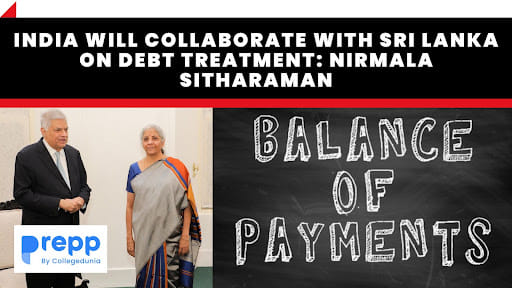
- Recently, the Union Finance Minister of India called on the Sri Lankan President as part of a three-day visit to the island country.
- At the Naam 200 event, Sri Lankan President Ranil Wickremesinghe attributed Sri Lanka’s present stability to India’s assistance.
Table of Contents
What did the Indian Finance Minister and the Sri Lankan President discuss at their recent meeting?
- Debt treatment: India agreed to collaborate with Sri Lanka on debt treatment as the island country was still recovering from its economic crisis.
- Sri Lanka requires India’s support as well as that of its other major creditors - China and Japan - to develop an agreeable debt treatment plan for it to unlock the second tranche of the IMF’s Extended Fund Facility (EFF).
- India had provided around $4 billion in aid to Sri Lanka during its economic crisis.
- Industrial cooperation: No new projects were agreed upon during the visit but existing projects were firmed up.
- Discussions were also conducted on India-Sri Lanka cooperation in sectors such as inter-grid connectivity, aviation, power projects, and oil exploration in Mannar.
- Buddhist ties: India and Sri Lanka exchanged a revised MoU on the $15 million grant assistance from India for the promotion of Buddhist ties between the countries.
- $10 million of this amount was earmarked for the solar electrification of religious places.
- The Finance minister also visited senior Buddhist monks in the central Kandy district.
- Naam 200: The Naam 200 event was organized to commemorate the 200th anniversary of the arrival of the Malaiyaha Tamils in Sri Lanka.
- Mr. Wickremesinghe and Ms. Sitharaman virtually launched the foundation stone laying ceremony for 10,000 houses being built with Indian grant assistance.
- Phase III of the scheme announced in 2017 is nearing completion and around 3,700 houses have been handed over to beneficiaries.
- Economic and Technology Cooperation Agreement (ETCA): The 12th round of negotiations on the stalled ETCA was conducted by officials from India and Sri Lanka.
Sri Lanka’s financial crisis
- The Sri Lankan economic crisis which began in 2019 is the country’s worst economic crisis since its Independence.
- Impact:
- Unprecedented levels of inflation
- Near-depletion of foreign exchange reserves
- Shortages of medical supplies
- Price increases for basic commodities.
- The crisis is believed to have been initiated by numerous interconnected factors, including tax cuts, money creation, a nationwide policy shift to organic or biological farming, the 2019 Sri Lanka Easter bombings, and the impact of the COVID-19 pandemic in Sri Lanka.
- The country faced a shortage of foreign currency in early 2021, leading to a balance of payments (BoP) problem, and the depletion of foreign exchange reserves.
- This was accompanied by a food shortage due to the implementation of the organic farming policy and the Sri Lanka Economic Crisis.
- The subsequent economic hardships triggered the 2022 Sri Lankan protests.
To know more, click the link.
What has the IMF done to help Sri Lanka?
- In October, Sri Lanka concluded the first review of the 48-month EFF programme and came to an agreement with the IMF on economic policies.
- This is part of the agreement reached with the IMF in March, in which Sri Lanka qualified for an EFF of $2.9 billion after financial assurances from its creditors - India, China, and Japan.
- The present agreement will ensure access to $330 million for Sri Lanka as part of the first tranche.
- The approval of the IMF Management and Executive Board will however depend on Colombo reaching an agreement with its official creditors.
Extended Fund Facility
- The Extended Fund Facility is a lending facility of the Fund of the IMF that was established in 1974 to help countries address medium- and longer-term balance of payments problems.
- It is prescribed for a country that is suffering from balance of payment problems caused by structural weaknesses and those in need of fundamental economic reforms.
- Assistance under an extended arrangement features longer program engagement to help countries implement medium-term structural reforms with a longer repayment period.
- Typically approved for periods of three years, but may be approved for periods as long as 4 years (repaid over 4.5–10 years in 12 equal semiannual installments.
- Conditions:
- EFF is determined by a country’s financing needs, capacity to repay, and track record with past use of IMF resources:
- Borrowing under an EFF is subject to the normal limit of 145 percent annually of a country’s IMF quota and a cumulative limit over the life of the program of 435 percent of its quota, net of scheduled repayments.
- The Fund may lend amounts exceeding these limits in exceptional circumstances provided that a country satisfies a predetermined set of criteria.
- The IMF’s Executive Board regularly assesses program performance and can adjust the program to adapt to economic developments.
- Lending is tied to the IMF’s market-related interest rate, known as the basic rate of charge, which is linked to the Fund’s Special Drawing Rights (SDR) interest rate.
Malaiyaha Tamils
|
(*Click this link to read prelims specific weekly current affairs articles)
FAQs
Question: What is the balance of payments?
Answer:
The balance of Payment (BoP) of a country is defined as a systematic statement of all economic transactions of a country with the rest of the world in a specific period. It indicates whether the country has a surplus or a deficit in trade.
The country is in a surplus if exports exceed imports and in a deficit if imports exceed exports.
Question: What are some reports prepared by the IMF?
Answer:
The International Monetary Fund publishes the
- Global Financial Stability Report: A semi-annual report to assess the stability of global financial markets and emerging-market financing.
- World Economic Outlook: It is a semi-annual survey that analyzes and predicts global economic developments
UPSC Mains Practice Question:
|
MCQs
Question: Consider the following statements: (UPSC 2020)
- The value of Indo-Sri Lanka trade has consistently increased in the last decade.
- “Textile and textile articles” constitute an important item of the trade between India and Bangladesh.
- In the last five years, Nepal has been the largest trading partner of India in South Asia.
Which of the statements given above is/are correct?
(a) 1 and 2 only
(b) 2 only
(c) 3 only
(d) 1, 2 and 3
Answer: (b) See the Explanation
- India’s export to Sri Lanka was >34000 crore in 2015, and >26000 crore in 2016, and >28000 crore in 2017. This represents a zigzag increase. Hence statement one is incorrect.
- Textiles contributed 31.3% of Indian exports to Bangladesh in 2016-17. The other prominent products of export were engineering products (around 25% of exports), Chemical products (9% of exports), and vegetable products such as fresh vegetables (8% of exports). Hence statement 2 is correct.
- India’s trade relations with South Asian countries account for less than 4% of its global trade since the 1980s. Hence statement 3 is incorrect.
Therefore, option (b) is the correct answer.
Question: “Gold Tranche” (Reserve Tranche) refers to (UPSC 2020)
(a) a loan system of the World Bank
(b) one of the operations of a Central Bank
(c) a credit system granted by WTOs to its members
(d) a credit system granted by IMF to its members
Answer: (d) See the Explanation
- The reserve tranche is a credit facility granted by the IMF to its members.
- It is the component of a member country's quota with the IMF that is in the form of gold or foreign currency.
- For any member country, 25% out of the total quota should be paid in the form of foreign currency or gold. Hence it is called reserve tranche or gold tranche.
Therefore, option (d) is the correct answer.
Download the PREPP App and attempt FREE IAS Exam Mock Tests and get complete study material!

Full Test - 04: UPSC CSE Prelims CSAT (Paper-II)
Full Test - 03: UPSC CSE Prelims CSAT (Paper-II)
UPSC CSE Prelims 2026 GS Paper 1 Question Paper (24-May-2026)
UPSC CSE Prelims 2026 CSAT Paper 2 Question Paper (24-May-2026)

17 February 2025 | The Hindu Must Read Articles | Current Affairs

16 February 2026 | The Hindu Must Read Articles | Current Affairs

13 February 2026 | The Hindu Must Read Articles | Current Affairs









Comments