India To Produce Its Own Reference Fuels
Relevance: Prelims
(Source: The Hindu, 10/30/2023)
Click here for Daily Current Affairs
Why in the news?
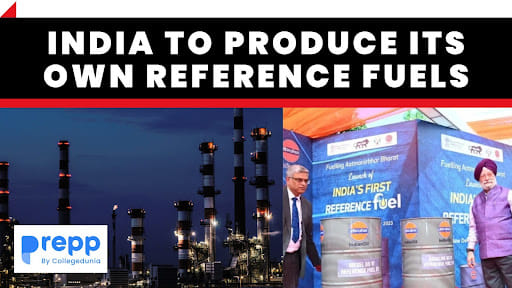
Recently, Indian Oil Corporation Limited (IOCL) launched India’s first gasoline and diesel reference fuel, used by automobile manufacturers for testing vehicles.
Table of Contents
What are Reference Fuels
- Reference fuels, which encompass gasoline (petrol) and diesel, are esteemed and high-quality products essential for the calibration and assessment of vehicles by automotive original equipment manufacturers (OEMs) and organizations involved in automotive testing and certification.
- These fuels play a critical role in facilitating the development of engines and evaluating vehicle performance to ensure their suitability for operation in diverse global climatic conditions.
- The key difference between regular fuel and standard or premium fuel is primarily centered on the octane number.
- The regular fuel has an octane number of 87, but premium fuel has an octane number of 91. Reference grade fuel comes with a 97 octane number.
Why do we need reference fuels?
- Reference fuels are essential due to the inherent variability in the properties of commercial fuels such as regular petrol and diesel. These variations can arise from different suppliers, batches, seasonal changes, and geographical locations.
- Presently, India relies on imports from select European and American companies to fulfill its need for these reference fuels.
- As per estimates from Society of Indian Automobile Manufacturers, the country's current annual demand stands at approximately 120 kiloliters for gasoline reference fuel and around 15 kilometers for diesel reference fuel.
What is the significance for India?
- Reduces Import Dependence: The introduction of specialized fuels by Indian Oil diminishes India's reliance on imports. It also elevates the country's energy sector to an exclusive league of global players equipped with unique capabilities.
- Enhances India's Technical Expertise: It marks a groundbreaking moment as India ventures into the domestic production of Reference Gasoline and Diesel Fuels, a departure from the previous practice of depending on imports to fulfill the demand for these specialized fuels.
- Cost-Effective Supply: It will not only supplant imports but also ensure a consistent and cost-effective supply for vehicle manufacturers and testing organizations.
- Promotes Auto Manufacturing: The availability of locally produced reference fuels will aid automobile manufacturers based in India for engine testing and vehicle development activities. This endeavor aligns with India's vision of "AtmaNirbhar Bharat," bringing the nation closer to self-sufficiency in this crucial sector.
India’s Oil Import Dependence
|
Conclusion
The production of reference gasoline and diesel fuels in India highlights the nation's technical capabilities, essential for the automotive industry. These fuels, with stricter specifications, reduce India's import dependence, enhancing energy self-sufficiency and supporting the domestic automotive sector.
(*Click this link to read prelims specific weekly current affairs articles)
FAQs
Question: What are Reference Fuels?
Answer:
Reference fuels, which encompass gasoline (petrol) and diesel, are esteemed and high-quality products essential for the calibration and assessment of vehicles by automotive original equipment manufacturers (OEMs) and organizations involved in automotive testing and certification.
Question: What is an Octane number?
Answer:
Octane number, also called octane value or octane rating, is one of the critical measures of a gasoline's performance. It is a measure of a fuel's resistance to knock or to ignite prematurely.
Question: What is IOCL?
Answer:
Indian Oil Corporation Limited (IOCL) is an Indian multinational oil and gas company under the ownership of the Ministry of Petroleum and Natural Gas.
MCQ
Question: The term ‘West Texas Intermediate’, sometimes found in news, refers to a grade of (UPSC 2020)
(a) Crude oil
(b) Bullion
(c) Rare earth elements
(d) Uranium
Answer: (a) See the Explanation
West Texas intermediate (WTI), also known as Texas light sweet, is a grade of crude oil used as a benchmark in oil pricing. It is described as light crude oil because of its relatively low density, and sweet because of its low sulfur content.
It is sourced from US oil fields, primarily in Texas, Louisiana, and North Dakota.
Therefore, option (a) is the correct answer.
Download the PREPP App and attempt FREE IAS Exam Mock Tests and get complete study material!

Full Test - 04: UPSC CSE Prelims CSAT (Paper-II)
Full Test - 03: UPSC CSE Prelims CSAT (Paper-II)
UPSC CSE Prelims 2026 GS Paper 1 Question Paper (24-May-2026)
UPSC CSE Prelims 2026 CSAT Paper 2 Question Paper (24-May-2026)

17 February 2025 | The Hindu Must Read Articles | Current Affairs

16 February 2026 | The Hindu Must Read Articles | Current Affairs

13 February 2026 | The Hindu Must Read Articles | Current Affairs









Comments