India Said To Plan $2 Bn Incentive For Green Hydrogen Industry (UPSC Current Affairs)
Relevance: GS2 - Government policies and interventions for development in various sectors and issues arising out of their design and implementation; GS 3 - Changes in industrial policy and their effects on industrial growth
(Source: The Hindu,12/28/22)
Click here for Daily Current Affairs
Why in the news?
- India is planning a $2 billion incentive program for the green hydrogen industry, in a bid to cut emissions and become a significant export player in the field.
- The ₹180-billion ($2.2 billion) incentive aims to reduce the production cost of green hydrogen by a fifth over the next five years.
- The Indian aid could be announced in the February 1 Budget for the fiscal year beginning April 1.
India's plans for green fuel
- The Indian government anticipates industry to invest ₹8 trillion in green hydrogen and its derivative green ammonia by 2030.
- Green Hydrogen can be used by the fertilizer industry or as a fuel or convenient means of transporting hydrogen.
- The green hydrogen proposal is likely to be called "Strategic Intervention for Green Hydrogen Transition (SIGHT)" and will be split into ₹45 billion for electrolyser manufacturing for five years and the ₹135 billion for green hydrogen and green ammonia production for three years.
- The incentive for making green hydrogen is likely to be ₹50 per kg for three years.
- India wants to sell 70% of its production to the European Union, South Korea, and Japan.
- According to various industry sources, the government forecasts that the need for green hydrogen would increase from slightly under 75 million tonnes in the present to more than 100 million tonnes by the year 2030.
- By 2030, India is expected to produce 5 million tonnes of green hydrogen annually, a goal that might double depending on global demand, according to plans released by the government in February.
- The country's manufacturing capacity for electrolysers is expected to reach 15 gigawatts by 2030, according to the government's projections. That would be roughly ten times the capacity of the entire world today.
Significance of the incentive
- Lower production cost: The current price of Hydrogen in India is ₹300 to ₹400 per kg. The incentive aims to lessen green hydrogen's production cost by a fifth in the next five years and it would do this in part by increasing the scale of the industry.
- Exporter: Additionally, India has the potential to become a major source of green ammonia exports.
- Between 2020 and 2050, hydrogen demand has the potential to increase by more than four times, reaching almost 29 million tonnes, according to NITI Aayog's "Harnessing Green Hydrogen Report."
- According to the analysis, green hydrogen will eventually rule the hydrogen industry entirely on the basis of cost-competitiveness.
- Green hydrogen can be an important component of both new greenfield investments and existing brownfield usage even in the year 2030.
- Green hydrogen can supply about 94 percent of the world's hydrogen needs in 2050, up from only 16 percent in 2030.
- In India, the market for green hydrogen could be worth and $8 billion by 2030 and $340 billion by 2050
Plans by Companies
- The first green hydrogen factory in India opened in Bengaluru by US-based Ohmium International.
- Reliance Industries, Greenko, H2e Power, Larsen & Toubro, and others announced intentions to build gigawatt-scale facilities last year.
- In June, Adani Enterprises announced that the company with Total Energies for France would create the largest green hydrogen ecosystem in the world.
- The Greenko company and Singapore's Keppel Infrastructure inked an MoU in October to collaborate on a 250,000-tonne contract per year to supply green energy to Keppel's new 600Mw power plant in Singapore. This agreement will take effect in 2025.
What is Green Hydrogen?
- Hydrogen can be used as fuel.
- It is made by splitting water with an electrical process, electrolysis.
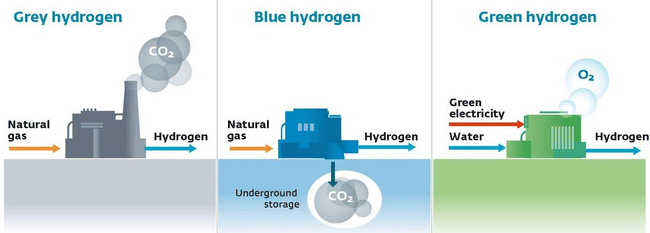
- If the electrolyzers are powered by renewable energy, the product is called green hydrogen, a fuel free of greenhouse emissions.
Other types
- Grey hydrogen is created by using steam to split methane (CH4) into carbon dioxide (CO2) and hydrogen (H2).
- Blue hydrogen: Grey and blue hydrogen are made using the same process, however blue hydrogen requires extra technology in order to capture and store the carbon dioxide created when the hydrogen separates from the methane.
- However, not all of the carbon dioxide can be caught, and not all methods work well for long-term storage.
- However, the effect of hydrogen production on the environment can be greatly diminished by absorbing a large portion of the carbon dioxide.
- Pink Hydrogen : It uses nuclear power to electrolyse water, thereby splitting hydrogen from oxygen for use as a fuel.
- Black and brown hydrogen: Black (bituminous) or brown (lignite) coal is used in the production of black or brown hydrogen. Black and brown hydrogen, however, are hazardous to the environment because carbon dioxide (CO2) and carbon monoxide formed during the process are not collected.
- White hydrogen: The naturally occurring form of white hydrogen is occasionally found underground, but there are few practical means to extract it, so experts instead try to artificially produce it.
(*Click this link to read prelims specific weekly current affairs articles)
Some Important FAQs
Question: What is Green hydrogen?
Answer:
Green hydrogen is defined as hydrogen produced by splitting water into hydrogen and oxygen using renewable electricity
Question: What is Green Ammonia?
Answer:
Green ammonia is made by combining nitrogen with hydrogen using renewable energy sources
Question: What is Electrolysis?
Answer:
In 1800, a British chemist, William Nicholson (1753–1815), had shown that if electrodes were immersed in water, and a current was passed, bubbles of oxygen and hydrogen were produced when an electric current is passed through water, it splits up into hydrogen & oxygen. This is called the electrolysis of water.
MCQs
Question: Consider the following statements:
- White Hydrogen refers to naturally occurring H2 in underground deposits.
- Pink hydrogen is generated through electrolysis powered by nuclear energy.
Which of the above statements is/are correct?
(a) 1 only
(b) 2 only
(c) Both 1 and 2
(d) Neither 1 nor 2
Answer: (c) See the Explanation
- White Hydrogen refers to naturally occurring H2 in underground deposits.Hence, statement 1 is correct.
- Pink hydrogen is generated through electrolysis powered by nuclear energy.Hence, statement 2 is correct.
- Therefore, option (c) is the correct answer.
Download the PREPP App and attempt FREE IAS Exam Mock Tests and get complete study material!

Full Test - 04: UPSC CSE Prelims CSAT (Paper-II)
Full Test - 03: UPSC CSE Prelims CSAT (Paper-II)
UPSC CSE Prelims 2026 GS Paper 1 Question Paper (24-May-2026)
UPSC CSE Prelims 2026 CSAT Paper 2 Question Paper (24-May-2026)

17 February 2025 | The Hindu Must Read Articles | Current Affairs

16 February 2026 | The Hindu Must Read Articles | Current Affairs

13 February 2026 | The Hindu Must Read Articles | Current Affairs









Comments