India Ranks 107th Out Of 121 Countries On Global Hunger Index (GHI) (UPSC Current Affairs)
Relevance: GS2 - Issues relating to development and management of Social Sector/Services relating to Health, Education, Human Resources. Issues relating to poverty and hunger; Important International institutions, agencies and fora- their structure, mandate.
(Source: The Hindu)
Why in the news?
Recently, GHI for the year 2022 has been released.In the 2022 Global Hunger Index, India ranks 107th out of 121 countries. With a score of 29.1, India has a level of hunger that is serious.
Highlights
- India is classified as "serious" with a score of 29.1.
- India falls behind Sri Lanka (64), Nepal (81), Bangladesh (84), and Pakistan (99). The only South Asian nation that ranks lower than India on the index is Afghanistan (109).
- China is among the countries collectively ranked between 1 and 17 having a score of less than five.
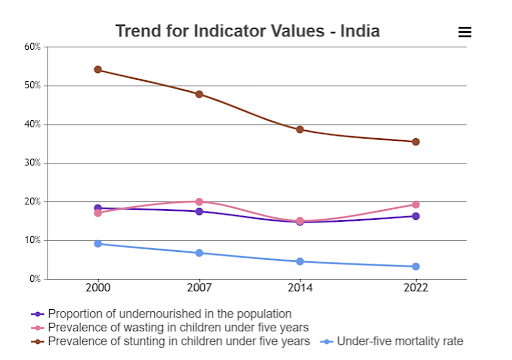
- India has the highest child wasting rate (low weight for height), at 19.3%, which is worse than the levels seen in 2014 (15.1%) and even 2000 (17.15%) and is the highest for any country in the world.
- Because of India's enormous population, this rate raises the average for the region.
What is Global Hunger Index (GHI)?
- The Global Hunger Index is a peer-reviewed annual report, jointly published by Concern Worldwide and Welthungerhilfe.
- The Global Hunger Index (GHI) is a tool for comprehensively measuring and tracking hunger at global, regional, and national levels.
- GHI scores are based on the values of four component indicators:
- Undernourishment
- Child Stunting
- Child Wasting
- Child Mortality
- Undernourishment: the share of the population with insufficient caloric intake.
- Child stunting: the share of children under age five who have low height for their age, reflecting chronic undernutrition.
- Child wasting: the share of children under age five who have low weight for their height, reflecting acute undernutrition.
- Child mortality: the share of children who die before their fifth birthday, partly reflecting the fatal mix of inadequate nutrition and unhealthy environments.
- Based on the values of the four indicators, a GHI score is calculated on a 100-point scale reflecting the severity of hunger, where 0 is the best possible score (no hunger) and 100 is the worst. Each country’s GHI score is classified by severity, from low to extremely alarming.
- The aim of the GHI is to trigger action to reduce hunger around the world.
What is the significance of GHI?
- The GHI is a metric for measuring the effects of development in the area of hunger.
- In order to assess how well government initiatives and other interventions perform in enhancing outcomes, it is critical to distinguish between policy actions and their results.
Issues
- The prevalence of undernourishment, which is an indicator of the population's proportion that experiences chronic dietary energy intake insufficiency, increased in the nation from 14.6% in 2018-2020 to 16.3% in 2019-2021.
- Out of the 828 million undernourished individuals worldwide, 224.3 million people live in India.
- India's GHI score dropped from 38.8 points in 2000, regarded as alarming, to 29.1 points in 2022, considered serious.
Status of Hunger globally
- According to the research, there is "severe" or "alarming" hunger in 44 nations, and neither the globe as a whole nor about 46 countries are expected to achieve even low hunger as determined by the GHI by 2030.
- The fight against hunger has mostly stagnated on a global scale in recent years. The global GHI score in 2022 is rated as "moderate," yet the difference between 19.1 in 2014 and 18.2 in 2022 is merely marginal.
- This is because of converging issues like war, climate change, COVID-19's economic effects, and the Ukraine War, which has driven up the cost of food, gasoline, and fertilizer around the world and is predicted to "worsen hunger in 2023 and beyond."
What progress has India made according to the GHI?
- India has advanced significantly since 2000, although there are still certain issues, particularly with regard to child nutrition.
- India's population undernutrition rate is at a medium level, and the country's under-five death rate is thought to be low.
- The two measures, child stunting, and child mortality have both improved in India.
- Between 2014 and 2022, child stunting decreased from 38.7% to 35.5%, while child death decreased from 4.6% to 3.3%.
- India has overall seen a small deterioration as evidenced by its GHI score, which rose from 28.2 in 2014 to 29.1 in 2022.
Steps were taken by the government to address Malnutrition
- Umbrella Integrated Child Development Services Scheme: To address the issue of malnutrition in the nation, the government is implementing a number of schemes and initiatives under the Umbrella Integrated Child Development Services Scheme.
- Mission Poshan 2.0:The government has announced Mission Poshan 2.0 to improve nutritional delivery, outcomes, outreach, and practices with an emphasis on fostering health, well-being, and resistance to disease and malnutrition.
- There have been efforts made to raise the standard of nutrition, boost delivery, and use technology to enhance governance.
- National Food Security Act (NFSA) 2013:The National Food Security Act (NFSA) 2013, which was put into effect by the government to achieve the goal of ending hunger, allows up to 75% of the rural population and up to 50% of the urban population to receive highly subsidized foodgrains through the Targeted Public Distribution System (TPDS), which as of the 2011 Census amounts to a maximum of 81.35 crore people.
- States and UTs have been urged to encourage the use of AYUSH systems for the prevention of diseases connected to malnutrition.
- A program to assist the creation of Poshan Vatikas at Anganwadi centers has also been launched in an effort to close the dietary diversity gap by utilizing traditional nutritional practices.
Some Important FAQs
Question: What is Global Hunger Index?
Answer:
The Global Hunger Index (GHI) is a tool for comprehensively measuring and tracking hunger at global, regional, and national levels.
- Undernourishment, child stunting, child wasting, and child mortality are the four indicators on which the Global Health Index (GHI) scores are based.
- The GHI score is determined on a scale of zero to one hundred, with zero representing the best score (no hunger) and one 100 representing the worst.
Question: What is Malnutrition?
Answer:
Malnutrition, in all its forms, includes undernutrition (wasting, stunting, underweight), inadequate vitamins or minerals, overweight, obesity, and resulting in diet-related noncommunicable diseases.
Question: Who publishes Global Hunger Index?
Answer:
The Global Hunger Index is a peer-reviewed annual report, jointly published by Concern Worldwide and Welthungerhilfe.
MCQs
Question: Which of the following Indicators are used to calculate Global Hunger Index.
- Undernourishment
- Child stunting
- Child wasting
- Child mortality
Which of the above statements is/are correct?
(a) 1, 2 and 3 only
(b) 2, 3 and 4 only
(c) 1, 3 and 4 only
(d) 1, 2, 3 and 4
Answer: (d) See the Explanation
- The Global Hunger Index (GHI) is a tool for comprehensively measuring and tracking hunger at global, regional, and national levels.
- Undernourishment, child stunting, child wasting, and child mortality are the four indicators on which the Global Health Index (GHI) scores are based.
- The GHI score is determined on a scale of zero to one hundred, with zero representing the best score (no hunger) and one 100 representing the worst.
- Therefore, option (d) is the correct answer.
Download the PREPP App and attempt FREE IAS Exam Mock Tests and get complete study material!

Full Test - 04: UPSC CSE Prelims CSAT (Paper-II)
Full Test - 03: UPSC CSE Prelims CSAT (Paper-II)
UPSC CSE Prelims 2026 GS Paper 1 Question Paper (24-May-2026)
UPSC CSE Prelims 2026 CSAT Paper 2 Question Paper (24-May-2026)

17 February 2025 | The Hindu Must Read Articles | Current Affairs

16 February 2026 | The Hindu Must Read Articles | Current Affairs

13 February 2026 | The Hindu Must Read Articles | Current Affairs









Comments