India Climbs To The 40th Rank In The Global Innovation Index of WIPO (UPSC Current Affairs)
Relevance: GS2 - Important International institutions, agencies, and for a- their structure, and mandate.
(Source: PIB)
Click here for Daily Current Affairs
Why in the news?
- Recently, the World Intellectual Property Organization (WIPO) released the Global Innovation Index (GII) 2022. Switzerland has emerged as the world's most innovative economy for the 12th consecutive year.
- India surpassed Vietnam to become the world's most innovative lower middle-income economy, according to the World Intellectual Property Organization (WIPO), after moving up six spots to the 40th position in 2022 from the 46th position in 2021.
- The GII reveals the most innovative economies in the world, ranking the innovation performance of 132 economies.
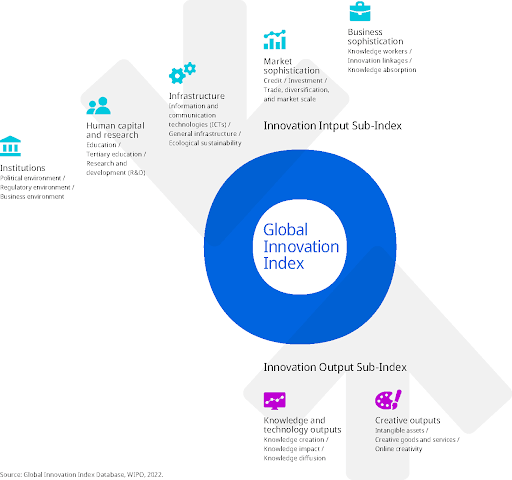
About Global Innovation Index 2022
- The Global Innovation Index 2022 (GII), in its 15th edition this year, is published by WIPO, in partnership with the Portulans Institute and with the support of various Corporate Network partners like the Confederation of Indian Industry (CII), the Brazilian National Confederation of Industry (CNI), Ecopetrol (Colombia), and the Turkish Exporters Assembly (TİM).
- UN Economic and Social Council in its 2019 resolution on Science, Technology and Innovation for Development has recognized GII as an authoritative benchmark for measuring innovation in relation to the Sustainable Development Goals (SDGs).
- This index is published annually.
- The core of the GII provides performance measures and ranks 132 economies on their innovation ecosystems.
- The Index is built on a rich dataset the collection of 81 indicators from international public and private sources.
- The GII 2022 is calculated as the average of two sub-indices. The Innovation Input Sub-Index gauges elements of the economy that enable and facilitate innovative activities and is grouped in five pillars:
- Institutions,
- Human capital and research,
- Infrastructure,
- Market sophistication, and
- Business sophistication.
The Innovation Output Sub-Index captures the actual result of innovative activities within the economy and is divided in two pillars:
- Knowledge and technology outputs and
- Creative outputs.
Highlights of report
- The report demonstrates that despite the COVID-19 epidemic, research and development (R&D) and other investments that fuel global inventive activity continued to expand in 2021.
- However, obstacles are emerging in translating innovation investments into impact.
- The GII discovers that productivity growth, the specific subject for GII in 2022, which is often sparked by greater innovation, has actually slowed down.
- Despite the recent boom in R&D spending and venture capital investments, it also indicates that current technology advancement and acceptance show signals of slowing growth.
- However, a new era of innovation-driven growth powered by Deep Science and Digital Age innovation waves may begin if innovation ecosystems are nurtured with greater care and attention.
GII’s key findings
- R&D Expenditure:Prior to the pandemic in 2019, the top global corporate R&D spenders boosted their R&D spending by approximately 10% to over USD 900 billion in 2021.
- Four industries, including ICT hardware and electrical equipment, software and ICT services, pharmaceuticals and biotechnology, and construction and industrial metals, were principally responsible for this increase.
- Despite slowing from the historically high 6.1 percent R&D growth rate seen in 2019, global R&D investments expanded at a rate of 3.3 percent in 2020.
- Government expenditure on R&D: For the top R&D expenditure economies, government budget allocations showed a significant rise in 2020.
- Budgets for government R&D in 2021 showed a more mixed picture, with rising spending in Germany and the Republic of Korea and declining investment in the US and Japan.
- Venture capital: In 2021, venture capital (VC) agreements increased by 46 percent, reaching heights comparable of the late 1990s internet boom.
- The fastest-growing VC markets are in Latin America, the Caribbean, and Africa. However, the VC outlook for 2022 is less optimistic; tighter monetary policies and their impact on risk capital would cause VC to slow down.
- Annual ranking of the world’s economies on innovation capacity and output: In its annual ranking of the world’s economies on innovation capacity and output, the GII shows some key changes in the top 15 of the ranking, with the United States climbing to the 2nd position, the Netherlands reaching the 5th position, Singapore reaching 7th, Germany reaching 8th and China up one place to 11th and on the doorstep of the top 10.
- Canada is back among the top 15 global innovators (15th). India (40th) and Turkey (37th) make their maiden appearances in the top 40.
- Beyond these, the middle-income economies with the fastest current growth in innovation performance are Viet Nam (48), the Islamic Republic of Iran (53), and the Philippines (59).
India
- India is the innovation leader in the lower middle-income group.
- It continues to lead the world in ICT services exports and holds top rankings in other indicators, including venture capital receipt value, finance for startups and scaleups, graduates in science and engineering, labor productivity growth and domestic industry diversification.
- With the exception of Infrastructure, where it performs below average for the upper-middle-income group, India's innovation performance is above average overall.
- In Central and Southern Asia, India ranked highest among three the “most innovation economies” followed by Iran and Uzbekistan.
(*Click this link to read prelims specific weekly current affairs articles)
Some Important FAQs
Question: What is the World Intellectual Property Organization (WIPO)?
Answer:
WIPO (World Intellectual Property Organization) is one of the United Nations' 15 specialized bodies (UN). WIPO was established in 1967 by the World Intellectual Property Organization (WIPO) Convention to promote and preserve intellectual property (IP) across the world via collaboration with governments and international organizations.
Question: What is the India Innovation Index?
Answer:
On the model of the GII, the NITI (National Institution for Transforming India) Aayog has created the India Innovation Index.
- The index goes beyond traditional techniques by taking into account the most effective metrics for assessing innovation, such as patents per million of population, scientific journal publishing, and research investment as a proportion of GDP.
- It also includes factors particular to the Indian economy (such as the Demographic Dividend) to provide a more comprehensive picture.
Question: Which are the most innovative economies in 2022?
Answer:
For the 12th year in a row, Switzerland has the most innovative economy in the world in 2022, followed by the US, Sweden, the UK, and the Netherlands. According to the GII 2022, China is closing in on the top 10, while India and Turkey both make their maiden appearances in the top 40.
MCQs
Question: Global Innovation Index was in news recently, it is published by:
(a) World Bank
(b) World Economic Forum
(c) World Intellectual Property Organisation
(d) UN Economic and Social Council
Answer: (c) See the Explanation
- Recently, the World Intellectual Property Organization (WIPO) released the Global Innovation Index (GII) 2022. Switzerland has emerged as the world's most innovative economy for the 12th consecutive year.
- India surpassed Vietnam to become the world's most innovative lower middle-income economy, according to the World Intellectual Property Organization (WIPO), after moving up six spots to the 40th position in 2022 from the 46th position in 2021.
- The GII reveals the most innovative economies in the world, ranking the innovation performance of 132 economies.
- Therefore, option (c) is the correct answer.
Download the PREPP App and attempt FREE IAS Exam Mock Tests and get complete study material!

Full Test - 04: UPSC CSE Prelims CSAT (Paper-II)
Full Test - 03: UPSC CSE Prelims CSAT (Paper-II)
UPSC CSE Prelims 2026 GS Paper 1 Question Paper (24-May-2026)
UPSC CSE Prelims 2026 CSAT Paper 2 Question Paper (24-May-2026)

17 February 2025 | The Hindu Must Read Articles | Current Affairs

16 February 2026 | The Hindu Must Read Articles | Current Affairs

13 February 2026 | The Hindu Must Read Articles | Current Affairs









Comments