India, Bhutan To Discuss New Routes Of Regional Connectivity
Relevance: GS2 - India and its neighborhood- relations. Bilateral, regional and global groupings and agreements involving India and/or affecting India’s interests.
(Source: The Hindu, 11/07/2023)
Click here for Daily Current Affairs
Why in the news?
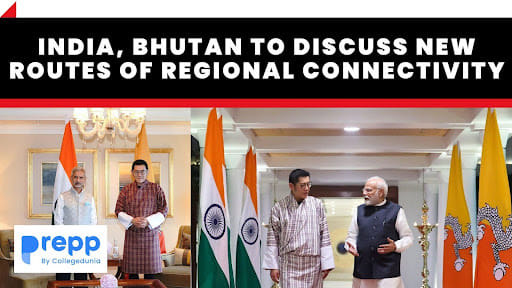
- Recently, the King of Bhutan, Jigme Khesar Namgyel Wangchuck, and Indian PM Narendra Modi held discussions on bilateral cooperation and regional and global issues of mutual interest.
- The two countries agreed to discuss new routes of regional connectivity and upgrade border and immigration posts between the two countries.
Table of Contents
What was discussed in the meeting between the leaders of India and Bhutan?
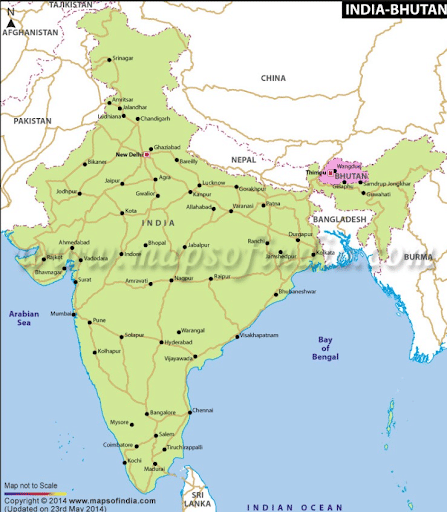
- Rail connectivity: The two countries agreed to proceed with the final survey for the 58 km cross-border rail link between Gelephu in Bhutan and Kokrajhar in Assam to be built by India.
- India and Bhutan also committed to exploring a second rail link of around 18 km length between Samtse in Bhutan and Banarhat in West Bengal.
- Air connectivity: The proposed rail connectivity projects could aid in the implementation of air connectivity in the northeast region as well.
- Bhutan has planned to build an international airport at Gelephu as part of the larger Sarpang district Special Economic Zone.
- Trade: India also agreed to allow Bhutanese trade items to be carried further on from Haldibari in West Bengal to Chilahati in Bangladesh.
- Both countries also agreed on the need to strengthen trade infrastructure and upgrade the existing land customs station at Dadgiri (Assam) to a modernized “Integrated Check Post” (ICP).
- India will also support the Bhutanese SEZ project and aid in the development of facilities at Gelephu.
- Immigration and border control: The Darranga-Samdrup Jongkhar border crossing between Assam and Bhutan’s SouthEastern district will be designated as an immigration checkpost.
- This will enhance connectivity and tourism while also permitting third-country nationals to enter and exit efficiently and safely.
- Tourism: Ease of travel between the two countries and further exchanges to Bangladesh will generate opportunities for trade and travel in Bhutan.
- This will provide a significant boost for the pandemic-hit Bhutanese economy in the form of tourism revenues.
- Socio Economic Development: Bhutan informed India of the ongoing reforms within the country while India reiterated its commitment to supporting socio-economic development in Bhutan.
- Bhutan expressed its gratitude for India’s development assistance for Bhutan’s 12th Five-Year Plan and India’s continued support of the new 13th Five-Year Plan.
- Bilateral relations: India has committed to maintaining its close friendship and cooperation with Bhutan.
What are the problems faced by the Bhutanese economy?
- Bhutan’s economy was significantly affected by the COVID pandemic and the after-effects of a stringent lockdown.
- The country’s economy is expected to grow 4.3%, which is lower than the sub-regional average.
- Bhutan is expected to face long-term impacts due to a net-out migration by its youth in pursuit of education and employment.
- Other concerns faced by Bhutan include:
- Low forex reserves
- Major public debt with an estimated 125% Government Debt to GDP ratio in 2022,
- The majority of this public debt consists of debt to India.
- The proposed SEZ in Bhutan is aimed at tackling these challenges by generating employment in the country and improving forex reserves.
India-Bhutan relations
- Historical ties: India-Bhutan ties can be traced back to 747 AD when the Buddhist monk Padmasambhava travelled to Bhutan from India.
- During the colonial era, Bhutan became a part of British Empire.
- Post independence, Bhutan was given an option to remain independent or join the Indian Union but Bhutan chose to remain independent.
- Diplomatic relations:
- In 1949, India and Bhutan signed the Indo-Bhutan Treaty also known as the Treaty of Peace and Friendship, which formed the bedrock of ties between the two countries.
- It called for peace between the two nations and non-interference in each other’s internal affairs.
- It was revised in 2007 to replace the provisions requiring Bhutan to take India’s guidance on foreign policy matters and permission for arms imports.
- Bilateral diplomatic relations were established in 1968 through the establishment of a special office in Thimphu.
- Borders: There is a 699 km long border between India and Bhutan spanning the states of Assam, Arunachal Pradesh, West Bengal and Sikkim.
- The Indo-Bhutan border also acts as a buffer between India and China.
- Economic: India is Bhutan’s largest trading partner with imports from India accounting for more than 77.1% of Bhutan’s total imports and exports from Bhutan constituting 90.2 % of its total exports.
- The trade between the two countries is governed by the India-Bhutan Trade and Transit Agreement 1972 which established a free trade regime.
- Increased trade and commerce ties with Bhutan will assist with trade and development in landlocked Arunachal Pradesh and Assam.
- India has been a key development partner for Bhutan and has contributed to Bhutan’s Five Year Plans.
- India has contributed to the development of transport and communication networks in Bhutan.
- The Bilateral Agreement on Trade, Commerce and Transit between India and Bhutan came into effect in 2017, and will be valid for ten years.
- Energy and hydrology: The core of bilateral economic cooperation between India and Bhutan is hydro-power cooperation.
- Bhutan is the source of the Brahmaputra, the Sankosh, and the Manas which are crucial for irrigation, hydroelectric power generation, and other purposes for India.
- Projects totalling 2136 MW are already operational in Bhutan and are supplying electricity to India.
- Security: Bhutan serves as a vital buffer between India and China.
- India and Bhutan have established the Border District Coordination Meeting (BDCM) Mechanism for border management and security cooperation.
- India provides security assistance to Bhutan and has helped Bhutan build its border infrastructure, and develop the Bhutanese army.
- Educational and cultural exchange: Bhutanese students pursue their education in India, supported by Indian scholarships.
- The two countries have also promoted people-people connections among them.
- The Indian diaspora of around 60,000 Indians residing in Bhutan.
- Bhutan is a Buddhist theocracy, and monarchy, which also shares a historical and cultural link with India.
- Multilateral partnerships: India and Bhutan are founding members of the South Asian Association for Regional Cooperation (SAARC) and also participate in other regional multilateral bodies like the BBIN, BIMSTEC, etc.
- Challenges in ties
- India has been criticized for its meddling in Bhutan’s internal affairs which has led to a negative perception of Indians among the Bhutanese.
- This has developed resentment against what is seen as a big brothel attitude by India.
- There is a growing feeling in Bhutan that India’s support for the development of Bhutan’s hydropower production is driven by self-interest as it is getting Bhutan’s surplus power at relatively cheap rates.
- Both India and Bhutan face a common threat in the form of militancy in the border regions which could affect its internal security.
- China’s claims to strategic border regions like the Chumbi valley and Doklam are a concern for both India and Bhutan.
- The recent boundary talks between China and Bhutan is a matter of concern for India due to its potential impact on India’s interests in the Chicken’s neck corridor.
Conclusion
- Strong India-Bhutan ties signify the continued strength of bilateral relations and cooperation in various sectors such as connectivity, trade, and socio-economic development. Although challenges exist, the partnership holds strategic importance and is pivotal in maintaining regional stability and economic progress.
(*Click this link to read prelims specific weekly current affairs articles)
FAQs
Question: What is the Chicken’s neck?
Answer:
The Siliguri Corridor, or Chicken’s Neck, is a narrow stretch of land in West Bengal which connects northeast India with the rest of India via Darjeeling, Jalpaiguri, and Terai areas of West Bengal. It is bordered by Nepal, Bangladesh, and the Kingdom of Bhutan.
Question: What is a SEZ?
Answer:
An SEZ or Special Economic Zone is a territory within a country that is generally duty-free and has different business and commercial laws to encourage investment and generate employment. In India, the Special Economic Zones Act, 2005 provides for the establishment, development and management of the Special Economic Zones.
UPSC Mains Practice Question:
|
MCQs
Question: With reference to India’s projects on connectivity, consider the following statements:
- East-West Corridor under Golden Quadrilateral Project connects Dibrugarh and Surat.
- Trilateral Highway connects Moreh in Manipur and Chiang Mai in Thailand via Myanmar.
- Bangladesh – China -India – Myanmar Economic Corridor connects Varanasi in Uttar Pradesh with Kunming in China.
How many of the above statements are correct? (UPSC CSE 2023)
(a) Only one
(b) Only two
(c) All three
(d) None
Answer: (d) See the Explanation
- East-West Corridors runs through Porbandar–Rajkot-Samakhiali–Radhanpur(in Gujarat)–to Bongaigaon - NalbariBijni–Guwahati–Nagaon–Dabaka–Silchar) in Assam). Hence statement 1 is incorrect.
- India–Myanmar–Thailand Trilateral Highway (IMT Highway, is a highway under upgrade under India's Look East policy that will connect Moreh (Manipur), India with Mae Sot, Thailand via Myanmar. Hence statement 2 is incorrect.
- BCIM corridor proposes to link Kunming in China’s Yunnan province with Kolkata, passing through nodes such as Mandalay in Myanmar and Dhaka in Bangladesh before heading to Kolkata. Hence statement 3 is incorrect.
Therefore, option (d) is the correct answer.
Download the PREPP App and attempt FREE IAS Exam Mock Tests and get complete study material!

Full Test - 04: UPSC CSE Prelims CSAT (Paper-II)
Full Test - 03: UPSC CSE Prelims CSAT (Paper-II)
UPSC CSE Prelims 2026 GS Paper 1 Question Paper (24-May-2026)
UPSC CSE Prelims 2026 CSAT Paper 2 Question Paper (24-May-2026)

17 February 2025 | The Hindu Must Read Articles | Current Affairs

16 February 2026 | The Hindu Must Read Articles | Current Affairs

13 February 2026 | The Hindu Must Read Articles | Current Affairs









Comments