India Becomes Chair of International Sugar Organisation (ISO) for 2024 to Lead Global Sugar Sector
(*Click this link to read prelims specific weekly current affairs articles)
Why in the news?
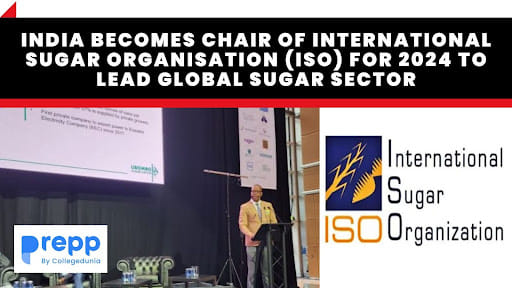
- India has been chosen as the Chair of the International Sugar Organisation (ISO) for 2024. This appointment reflects India's growing stature in the global sugar sector.
- The announcement was made during the 63rd council meeting of the ISO, headquartered in London.
Table of Contents
What is International Sugar Organisation (ISO)?
- The International Sugar Organisation (ISO) is an international organization that was established in 1968 as a part of the United Nations International Sugar Agreement.
- The ISO consists of member countries that are involved in sugar production, consumption, and trade.
- The primary objectives of the ISO are to ensure the stabilization of the global sugar market, facilitate trade among member countries, and promote sustainable and efficient sugar production and consumption practices.
- It aims to improve the global sugar economy through various means, including policy recommendations, market analysis, and research.
- In recent years, the ISO has increasingly focused on promoting sustainable practices in the sugar industry, including environmentally friendly cultivation techniques, energy efficiency, and the use of sugar by-products.
India's Position in the Global Sugar Sector
- Leadership in Global Sugar Consumption and Production: India is the largest consumer and the second-largest producer of sugar globally. With approximately 15% of global sugar consumption and about 20% production, India's sugar trends have a profound impact on the global market.
- Influence in the Eastern Hemisphere: India, along with Brazil in the Western Hemisphere, is a market leader in the sugar sector in the Eastern Hemisphere.
- Commitment to Green Energy and Ethanol Production: India is the third-largest country in ethanol production after the USA and Brazil. The significant increase in ethanol blending and production in recent years demonstrates India's commitment to green energy and its ability to utilize surplus sugar for sustainable purposes.
- Modernization and Diversification of the Sugar Industry: The Indian sugar industry has undergone modernization and expansion, focusing on sustainable and profitable business models. The industry has also capitalized on the potential of by-products, creating additional revenue streams.
- Response during the COVID-19 Pandemic: The resilience of the Indian sugar industry was evident during the COVID-19 pandemic. Despite lockdowns, the mills continued operations and contributed significantly by producing hand sanitizers to meet domestic demand.
- Fair Practices in Cane Pricing: India is unique in paying the highest cane price to farmers while maintaining profitability and operating self-sufficiently without government financial assistance.
- Managing Domestic Sugar Prices: Despite global sugar price hikes, India has managed to maintain stable and consistent domestic sugar retail prices, with only a minimal increase, thereby protecting consumers without burdening the industry.
- International Collaborations and Knowledge Sharing: Through institutions like the National Sugar Institute in Kanpur, India is extending its expertise globally. It collaborates with countries such as Indonesia, Nigeria, Egypt, and Fiji to share the latest technologies and best practices in the sugar sector.
Sugar Industry in India
- India ranks as the world's largest consumer (holding a 15% share) and the second-largest producer of sugar (with a 20% share).
- The sugar industry in India is mainly spread across two key regions:
- In the north, it is prevalent in Uttar Pradesh, Bihar, Haryana, and Punjab, while in the south, it is concentrated in Maharashtra, Karnataka, Tamil Nadu, and Andhra Pradesh.
- The tropical climate of South India is conducive to higher sucrose content, leading to greater yields per unit area compared to the northern region.
Contribution of Sugar Industry in India's Economy
|
Challenges in the Indian Sugar Sector
- Reliance on Monsoon: In central and southern India, where sugarcane cultivation largely depends on rainfall, a good monsoon season is crucial, unlike the northern states where irrigation is more prevalent.
- Low Crop Yields: Despite having the world's largest sugarcane cultivation area, India's yield per hectare is notably low, especially in the northern regions compared to the south.
- Subpar Sugar Extraction: The average sugar extraction rate from sugarcane in India is below 10%, whereas in other sugar-producing regions like Java, Hawaii, and Australia, it reaches around 14%.
- Pricing Policies by the Government: The dual price system set by the government hinders investment in the industry’s growth and improvement.
- Limited Crushing Season: The sugar industry operates seasonally, with a crushing season that typically ranges from 4 to 7 months annually.
Government Initiatives
- Fair and Remunerative Price (FRP) for Sugarcane: This pricing system ensures profit margins and risk coverage for farmers regardless of individual sugar mills' profitability.
- The FRP is set following the Commission for Agricultural Costs and Prices (CACP) recommendations, in consultation with State Governments and other relevant parties.
- To mitigate excess sugarcane production, the government incentivizes sugar companies to produce ethanol for fuel blending with petrol.
- Consequently, India has ascended to become the third-largest ethanol producer globally, following the USA and Brazil.
- Farmers' Welfare: India pays the highest cane price to farmers and maintains profitability without government financial assistance.
- Cane Dues: Significant reduction in pending cane dues, with over 98% of the last season's dues cleared.
- Price Stability: Domestic sugar retail prices in India are stable, with only a 5% increase compared to the global hike of 40%.
Conclusion
India's chairmanship of ISO is not just a recognition of its market position but also its efforts in sustainable practices, farmer welfare, and consumer price stability. India's leadership in ISO is expected to bring positive changes in global sugar sector practices and collaborations.
(*Click this link to read prelims specific weekly current affairs articles)
FAQs
Question: What is International Sugar Organisation (ISO)?
Answer:
The International Sugar Organisation (ISO) is an international organization that was established in 1968 as a part of the United Nations International Sugar Agreement. The primary objectives of the ISO are to ensure the stabilization of the global sugar market, facilitate trade among member countries, and promote sustainable and efficient sugar production and consumption practices. It aims to improve the global sugar economy through various means, including policy recommendations, market analysis, and research.
Question: What is Fair and Remunerative Price (FRP) for Sugarcane?
Answer:
This pricing system ensures profit margins and risk coverage for farmers regardless of individual sugar mills' profitability. The FRP is set following the Commission for Agricultural Costs and Prices (CACP) recommendations, in consultation with State Governments and other relevant parties.
MCQs
Question: The Fair and Remunerative Price (FRP) of sugarcane is approved by the (UPSC 2015)
(a) Cabinet Committee on Economic Affairs
(b) Commission for Agricultural Costs and Prices
(c) Directorate of Marketing and Inspection, Ministry of Agriculture
(d) Agricultural Produce Market Committee
Answer: (a) See the Explanation
The Cabinet Committee on Economic Affairs (CCEA), chaired by the Prime Minister, has approved the proposal for determining the 'Fair and Remunerative Price' (FRP) of sugarcane payable by sugar mills for a sugar season.
The FRP is based on the Commission of Agricultural Costs and Prices' (CACP) recommendation in its report on sugarcane price policy for a season.
Sugarcane's 'FRP' is determined by the Sugarcane (Control) Order, 1966, which is consistently applicable throughout the country.
The FRP determination is in the best interests of sugarcane growers since it recognizes their right to a fair and remunerative price for their produce and ensures a fixed price for cane growers.
Therefore, option (a) is the correct answer.
With reference to the usefulness of the by-products of sugar industry which of the following statements is/are correct? (UPSC 2013)
- Bagasse can be used as biomass fuel for the generation of energy.
- Molasses can be used as one of the feedstocks for the production of synthetic chemical fertilizers.
- Molasses can be used for the production of ethanol.
Select the correct answer using the codes given below:
(a) 1 only
(b) 2 and 3 only
(c) 1 and 3 only
(d) 1, 2 and 3
Answer: (c) See the Explanation
Bagasse is the residue remaining after extracting the juice from sugarcane or sorghum. It is a fibrous dry pulpy substance. Bagasse is used for a variety of purposes, including the generation of heat energy and electricity.
- Sugar mills use it as their principal fuel source since it produces enough energy to fully operate a sugar mill. Its ethanol is also employed as a popular fuel in various places.
- In the production of Pulp, Paper, and Board - In many nations such as India, China, Thailand, and others, wood is substituted in the manufacturing of pulp, paper, and board.
- When blended with molasses and enzymes and fermented, it can be used as cattle feed.
Molasses is the thick syrup produced by the processing of sugarcane or sugar beets into sugar. It is high in vitamin B6 and minerals like as calcium, magnesium, iron, and manganese.
Molasses Applications include:
- Food sweetening and flavoring
- In the manufacture of high-quality commercial brown sugar
- When baking or cooking
- It is the primary ingredient in the distillation of rum and the brewing of beer.
- As a livestock feed
Therefore, option (c) is the correct answer.
Question: Which of the following statements about India's sugar industry is true?
(a) India is the largest producer of sugar in the world.
(b) India's ethanol blending percentage has increased significantly in recent years.
(c) The Indian sugar industry operates with substantial government financial assistance.
(d) India imports a major portion of its sugar requirements.
Answer: (b) See the Explanation
India has increased its ethanol blending percentage from 5% in 2019-20 to 12% in 2022-23, reflecting its commitment to green energy and efficient utilization of surplus sugar for ethanol production.
Therefore, option (b) is the correct answer.
Question: What unique distinction does India hold in the sugar industry?
(a) It is the only country that exports sugar to all ISO member countries.
(b) It is known for paying the highest cane price to its farmers while operating efficiently.
(c) India is the sole consumer of more than 50% of the world's sugar production.
(d) It is the only country with a completely privatized sugar industry.
Answer: (b) See the Explanation
India holds the unique distinction of paying the highest cane price to its farmers, maintaining profitability and operating self-sufficiently without government financial assistance. This reflects a successful synergy between the government and the sugar industry.
Therefore, option (b) is the correct answer.
Download the PREPP App and attempt FREE IAS Exam Mock Tests and get complete study material!

Full Test - 04: UPSC CSE Prelims CSAT (Paper-II)
Full Test - 03: UPSC CSE Prelims CSAT (Paper-II)
UPSC CSE Prelims 2026 GS Paper 1 Question Paper (24-May-2026)
UPSC CSE Prelims 2026 CSAT Paper 2 Question Paper (24-May-2026)

17 February 2025 | The Hindu Must Read Articles | Current Affairs

16 February 2026 | The Hindu Must Read Articles | Current Affairs

13 February 2026 | The Hindu Must Read Articles | Current Affairs









Comments