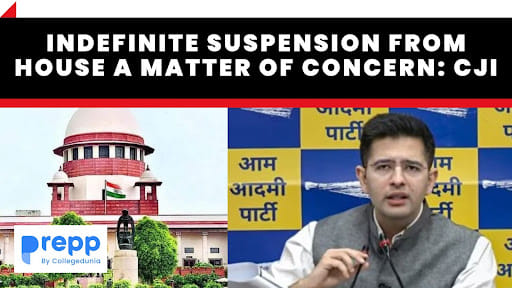
Indefinite Suspension from House a Matter of Concern: CJI
Primary Source: The Hindu
Click here for Daily Current Affairs
Prepp Prelims Booster: Parliamentary Procedures, Freedom of Speech
Prepp Mains Booster: Parliament and State Legislatures—Structure, Functioning, Conduct of Business, Powers & Privileges and Issues Arising out of these
Why in the news?
- The article discusses comments made by the Chief Justice of India (CJI), D.Y. Chandrachud, concerning the indefinite suspension of a Rajya Sabha member.
- He expressed concerns over the loss of humor in public life and the implications of indefinite suspension from the House.
Table of Contents
Background of the Case
- Raghav Chadha was suspended from the Rajya Sabha due to a remark he made at a press conference.
- He joked about sending "birthday invitation cards" to other members to join a select committee for the GNCTD (Amendment) Bill 2023, implying that the members had a choice to attend or not.
- This was construed as inviting members without their consent, leading to his suspension for breach of privilege.
Concerns Voiced by CJI
- CJI Chandrachud remarked on the declining sense of humour in public life.
- He questioned if the statement genuinely demeaned the House's dignity or caused a breach of privilege.
- Attorney-General R. Venkataramani believes such remarks do undermine the House's process.
- He expressed that the exclusion of opposition members from the House is concerning.
- He was of the opinion that the suspended member represents a different viewpoint, which might not align with the government's.
- He emphasized the importance of having diverse voices in Parliament.
- He called indefinite suspension a serious concern for the constitutional court.
Legal Arguments and Provisions
- Article 105: It provides MPs with certain privileges to ensure that they can perform their duties without undue interference. However, these privileges are subject to the provisions of the Constitution and to the rules and standing orders regulating the procedure of Parliament.
- Article 122: It stipulates that the validity of any proceedings in Parliament cannot be called into question on the ground of any alleged irregularity of procedure.
- Rules of Procedure and Conduct of Business in the Rajya Sabha:
-
- Rule 256: Allows the Chairman to name a member who is disregarding the authority of the Chair or abusing the rules of the Council by persistently and willfully obstructing the business thereof. If a motion is adopted by the House, the member can be suspended from the service of the House for a period not exceeding the remainder of the session.
- Rule 266: Typically, it does not allow for an indefinite suspension but may be cited in relation to other disciplinary mechanisms within the rules.
Privileges of Members of Parliament (MPs)
Individual Privileges of MPs
- Freedom of Speech: According to Article 105 of the Constitution, MPs have the freedom to say anything in either House of Parliament without the risk of a defamation suit or any other legal proceeding in any court. However, this is subject to the rules and procedures of the House and does not permit the expression of slanderous or incendiary statements.
- Immunity from Proceedings: An MP is not liable to any proceedings in any court for anything said or any vote given in Parliament or any committee thereof.
- Exemption from Jury Service: MPs are exempted from jury service in a court of law so that their legislative functions are not interrupted.
- Freedom from Arrest: MPs are also protected from arrest in civil cases during the session of Parliament and 40 days before and after such a session. This privilege does not extend to criminal cases, preventive detention, or cases under the anti-defamation law.
Collective Privileges of Parliament and its Committees:
- Exclusive Jurisdiction: Each House of Parliament has exclusive jurisdiction over its internal proceedings, and the courts are barred from inquiring into these proceedings as per Article 122 of the Constitution.
- Right to Publish Debates and Proceedings: While an ordinary citizen may be prosecuted for publishing libelous material, Parliament can publish its debates and proceedings, and such publication is protected by parliamentary privilege.
- Right to Regulate Internal Affairs: Each House has the authority to regulate its own internal affairs, like the power to decide its own agenda, to discipline its members, and to adjudicate in cases of breach of privilege.
- Right to Exclude Others: Each House has the right to exclude strangers from its proceedings and hold sessions in camera if necessary.
- Right to Punish Members and Outsiders for Breach of its Privileges: Both Houses have the power to punish members and outsiders for breach of privilege or contempt of the House.
- Right to Prohibit the Publication of Proceedings: Although Parliamentary proceedings are usually open to the public and the press, there is a right to prohibit the publication of particular debates or proceedings if deemed necessary.
What is the Privileges Committee?
|
Dignity of the House vs Ensuring Diverse voices are Heard –Maintaining A Balance
- Adherence to Parliamentary Rules and Procedures: The rules and procedures are designed to maintain order and decorum while allowing for the expression of different opinions. MPs should adhere to these rules while the presiding officer enforces them impartially.
- Constructive Debates: Encourage constructive and respectful debates. While disagreements are natural, they should be expressed in a manner that contributes to the discussion and respects the opinions of others.
- Effective Time Management: Allocating time judiciously between different parties and independent members can ensure that all get a chance to present their views without monopolizing the proceedings.
- Regular Training and Orientation: MPs, especially newly elected ones, should receive regular training on parliamentary conduct, ethics, and rules to ensure they understand how to effectively engage in debates without breaching the decorum.
- Use of Parliamentary Committees: Parliamentary committees, where representation can be proportional to the composition of the House, are an excellent platform for detailed scrutiny of matters and for diverse voices to be heard in a less adversarial setting than full plenary sessions.
- Transparent and Fair Disciplinary Mechanisms: When disciplinary action is needed, it should be applied transparently and fairly, without bias or targeting specific individuals or groups.
- Promoting a Culture of Tolerance and Mutual Respect: Political leaders and senior parliamentarians should promote a culture of tolerance and respect for diverse opinions, which can set the tone for the conduct of all members.
- Redressal Mechanism for Grievances: Establish a clear, fair, and accessible mechanism for MPs to raise grievances regarding parliamentary proceedings, including any alleged suppression of their rights.
- Review and Reform of Rules: Regularly review parliamentary rules and procedures to ensure they reflect contemporary democratic standards and allow for all voices to be adequately represented and heard.
- Judicious Use of Privileges and Immunities: While privileges and immunities are necessary for MPs to perform their functions without fear or favor, these should be invoked judiciously and not used as instruments to suppress dissent or evade accountability.
Conclusion
The Chief Justice marked the indefinite suspension of a parliamentary member as a significant constitutional concern. The judiciary's involvement underscores the importance of checks and balances and the potential implications of indefinite suspensions in the democratic process.
(*Click this link to read prelims specific weekly current affairs articles)
FAQs
Question: What is Parliamentary Privilege and which article of the Constitution of India provides for it?
Answer:
Parliamentary Privileges are special rights, immunities, and exemptions enjoyed by the two Houses of Parliament, their committees, and their members. They are provided so that Members of Parliament can perform their duties without any hindrances. Article 105 of the Constitution of India deals with the powers, privileges, and immunities of the Houses of Parliament and their members.
Question: Under which rules can a Member of Parliament be suspended from the House, and what are the limitations of such a suspension?
Answer:
A Member of Parliament can be suspended under Rule 374A of the Rules of Procedure and Conduct of Business in the Lok Sabha and corresponding rules in the Rajya Sabha, for causing grave disorder or committing a contempt of the House. The suspension is limited to the remainder of the session unless the House decides otherwise. However, the rules do not provide for indefinite suspension, and such a measure could be seen as a violation of the principles of parliamentary democracy.
Question: What is Privileges Committee?
Answer:
The Privileges Committee is a key committee in the legislative bodies of India, both in the Lok Sabha (House of the People) and the Rajya Sabha (Council of States). Its primary role is to examine any case of breach of privilege or contempt of the House referred to it by the respective House. In the Lok Sabha, the Committee on Privileges consists of 15 members, whereas, in the Rajya Sabha, it has 10 members.
UPSC Mains Practice Question:
|
MCQs
Question: The Parliament of India acquires the power to legislate on any item in the State List in the national interest if a resolution to that effect is passed by the (UPSC 2016)
(a) Lok Sabha by a simple majority of its total membership
(b) Lok Sabha by a majority of not less than two-thirds of its total membership
(c) Rajya Sabha by a simple majority of its total membership
(d) Rajya Sabha by a majority of not less than two-thirds of its members present and voting
Answer: (d) See the Explanation
If the Rajya Sabha passes a resolution to that effect by not less than two-thirds of the members present and voting, Parliament can legislate on any item on the State List in the national interest.
Article 249 authorizes the parliament to legislate on an issue on the State List that is in the national interest.
A resolution passed shall be in effect for a duration not exceeding one year unless otherwise specified.
Therefore, option (d) is the correct answer.
Question: Consider the following statements: (UPSC 2015)
- The Rajya Sabha has no power either to reject or to amend a Money Bill.
- The Rajya Sabha cannot vote on the Demands for Grants.
- The Rajya Sabha cannot discuss the Annual Financial Statement.
Which of the statements given above is/are correct?
(a) 1 only
(b) 1 and 2 only
(c) 2 and 3 only
(d) 1, 2 and 3
Answer: (b) See the Explanation
A money bill can only be kept by the Rajya Sabha for 14 days before being returned to the Lok Sabha with recommendations or passed by the Rajya Sabha. In the event of a disagreement between the two chambers, the measure is deemed passed in the form in which it was passed by the Lok Sabha. Hence, statement 1 is correct.
Only the Lok Sabha has the authority to vote on grant requests. Hence, statement 2 is correct.
The Rajya Sabha debates the budget (annual financial statement as defined by the constitution). Hence, statement 3 is incorrect.
Therefore, option (b) is the correct answer.
Question: What will follow if a Money Bill is substantially amended by the Rajya Sabha? (UPSC 2013)
(a) The Lok Sabha may still proceed with the Bill, accepting or not accepting the recommendations of the Rajya Sabha
(b) The Lok Sabha cannot consider the Bill further
(c) The Lok Sabha may send the Bill to the Rajya Sabha for reconsideration
(d) The President may call a joint sitting for passing the Bill
Answer: (a) See the Explanation
The Rajya Sabha has limited powers in connection to the Money Bill, according to Article 109 of the Constitution.
After the Lok Sabha passes a Money Bill, it is sent to the Rajya Sabha. It must be returned to the Lok Sabha, either with or without recommendations, within fourteen days of being received by the Rajya Sabha.
The Lok Sabha has the option of accepting or rejecting all or some of the Rajya Sabha's recommendations.
Therefore, option (a) is the correct answer.
Question: Consider the following statements: (UPSC 2013)
- The Chairman and the Deputy Chairman of the Rajya Sabha are not the members of that House.
- While the nominated members of the two Houses of the Parliament have no voting right in the presidential election, they have the right to vote in the election of the Vice-President.
Which of the statements given above is/are correct?
(a) 1 only
(b) 2 only
(c) Both 1 and 2
(d) Neither 1 nor 2
Answer: (b) See the Explanation
The Vice-President of India serves as the Rajya Sabha's ex-officio Chairman. Rajya Sabha also selects a Deputy Chairman from among its members. Hence, statement 1 is incorrect.
In case of presidential elections, elected members of parliament (both Lok Sabha and Rajya Sabha MPs) and elected members of state legislatures, including the National Capital Territory of Delhi and Pondicherry have the voting rights and not the nominated members.
Vice President is elected indirectly by an electoral college comprised of members of both houses of Parliament. Hence, statement 2 is correct.
Therefore, option (b) is the correct answer.
Download the PREPP App and attempt FREE IAS Exam Mock Tests and get complete study material!

Full Test - 04: UPSC CSE Prelims CSAT (Paper-II)
Full Test - 03: UPSC CSE Prelims CSAT (Paper-II)
UPSC CSE Prelims 2026 GS Paper 1 Question Paper (24-May-2026)
UPSC CSE Prelims 2026 CSAT Paper 2 Question Paper (24-May-2026)

17 February 2025 | The Hindu Must Read Articles | Current Affairs

16 February 2026 | The Hindu Must Read Articles | Current Affairs

13 February 2026 | The Hindu Must Read Articles | Current Affairs









Comments