In Gaza, Israel Is Waging An Invisible Environmental War
Relevance: GS2 - Effect of policies and politics of developed and developing countries on India’s interests, GS3 - Environmental pollution and degradation, environmental impact assessment, Disaster and disaster management.
(Source: The Hindu, 11/29/2023)
Click here for Daily Current Affairs
Why in the news?
- This article discusses the environmental aspects of Israel’s actions in the Gaza Strip and its implications.
- Repeated bombardment of the Gaza Strip has led to the degradation of the soil while the use of herbicides by Israel has affected the productivity of Palestinian lands.
Table of Contents
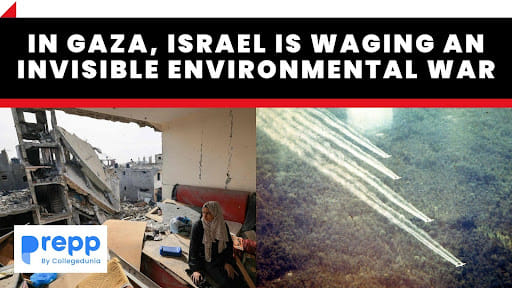
What is the environmental impact of the bombing by Israel in Gaza?
- Since the beginning of the conflict between Israel and Hamas in October 2023, Israel has continuously bombarded the Gaza Strip with bombs, missiles, and white phosphorous.
- According to the New York Times, Israel dropped 2,000-pound bombs on the Jabaliya refugee camp twice in October, killing hundreds and leaving 40-foot-wide craters in the ground.
- These bombs were the second-largest bombs in the Israeli arsenal.
- The Euro-Med Human Rights Monitor has revealed that Israel had dropped more than 25,000 tonnes of explosives at more than 12,000 targets in the Gaza Strip.
- According to the Federation of American Scientists, the 2,000-pound Mk-84 bombs used by Israel are generally filled with tritonal.
- Tritonal is a mixture of one part aluminum and three parts trinitrotoluene (TNT).
- Soil, water, and air in the blast radius are all exposed when a bomb containing tritonal is detonated.
- The chemical components of the bombs detonated have been absorbed into the soil or washed away into the sea.
- The rubble created by the bombings must also be considered pollutants - toxic rubble.
- As a result of the detonation, large quantities of building materials from destroyed buildings consisting of hazardous materials like asbestos, cement, heavy metals, domestic chemicals, and combustion products lie exposed in the streets.
- A study by Pax, a peace organization in the Netherlands revealed that this could lead to health concerns such as lung irritation and disease, chest pain, and chronic nervous and respiratory illnesses.
- According to experts, the destruction caused in Gaza in one month was equivalent to the destruction caused in four years in Syria.
- They have reiterated the need to dispose of the “toxic rubble” in a scientific manner alongside other medical and industrial waste to limit contamination.
- However, the blockade imposed by Israel since 2007 has made it impossible to dispose of the waste appropriately.
Ecological blockade
- Prior to the occupation of Palestine by Israel, the region was rich in a wide variety of crops such as grapefruit, strawberries, Jaffa oranges, almonds, watermelon, eggplants, etc.
- However, the agriculture in the region was mostly dominated by olives with reports indicating that nearly 45% of the arable land in the occupied territories was covered by olive trees.
- The olive is a significant part of the Palestinian lifestyle and identity.
- Following the occupation, Israel seized chunks of the Palestinian farmland which was settled, and infrastructure including barriers, fences, and roads was built.
- Subsequently, Palestinians were denied access to the land.
- During the second Intifada (2000-2005), Israeli forces accused Palestinian farmers of using olive orchards next to Jewish settlements as a “shield and hiding place to attack”.
- In response, they burnt, cut down, or uprooted olive trees with around 3.74 lakh olive trees destroyed by Israeli forces according to the Palestinian Ministry of Agriculture.
Herbicidal warfare
- According to research conducted by agencies associated with the University of London in 2019, Israeli forces have conducted unannounced aerial spraying of crop-killing herbicides in the region.
- This has resulted in the destruction of large areas of arable land and the livelihoods of farmers in Palestine.
- Aim: According to experts, the herbicidal warfare approach adopted by Israel is a reflection of its belief that all residents of Gaza are terrorists.
- Therefore, herbicides are sprayed to ensure that Israeli military personnel can observe and police Gazans effectively.
- The Israeli Ministry of Defence confirmed that it has undertaken the spraying of herbicides during the harvesting period i.e. October-November.
- Herbicides have been sprayed aerially on more than 30 occasions between November 2014 and December 2018.
- The herbicides used are generally a combination of Glyphosate, Oxyfluorfen, and Diuron.
- Glyphosate can cause damage to the eyes and is threatening to aquatic life.
- Contact with Oxyfluorfen causes severe skin and eye irritation
- Diuron adversely impacts photosynthesis.
- Although Israel has claimed that the spraying is conducted only in Israel-controlled areas, the wind often carries the chemicals into Gaza.
- The sectioning off of Palestinian territories has also caused ecological harm by eliminating contiguous spaces.
- Fragmentation has also affected microclimates and micobiomes which are essential to prevent biodiversity loss.
Forestry and species replacement
- Israel has created more than 380 nature reserves and 115 national parks which have been criticized as an attempt to grab Palestinian land including former residential areas of indigenous peoples and arable land.
- Israel has also attempted to reforest the region.
- 90% of Israel’s forests were grown after the formation of the state in 1948, with 89% of the vegetation in these forests being non-indigenous species.
- Experts claim that the Israeli forces replaced indigenous species like olive and citrus trees in the Palestine region with European pines because
- Mono-crop nature: Pine needles are acidic and create inhospitable conditions for other vegetation where they fall.
- Cultural affinity of Palestinians: the replacement of the olive, a cultural link for Palestinians, with other species has been described as an attempt to treat Palestinians as outsiders on their land.
Sewage and WASH
- Israel controls the supply of water to Palestinian territories, which allows it to cut off access to clean water to the region for drinking, sanitation, and agriculture.
- According to UNICEF, only one in 10 people in the Gaza Strip have direct access to safe drinking water.
- Israel has also been accused of deliberately targeting WASH – i.e. Water, Sanitation, and Hygiene – infrastructure in the region which is forbidden by the Geneva Conventions.
- According to reports, 84 of the 849 structures destroyed in 2020 in the West Bank were WASH structures while the desalination plant in Gaza was destroyed in 2021.
- In October, Israel announced cuts in the supply of water and electricity to Gaza which has made daily life harder for the local residents.
- The cut in electricity supplies had enabled the spread of contaminants like Escherichia coli bacteria which causes gastric distress to spread.
- The destruction of the wastewater plants and the inability of the region to import necessary materials for repairs, has resulted in raw untreated sewage being dumped into the sea.
- The mixture of sewage with seawater has led to the contamination of the fishery resources of the region.
- This has had a severe economic impact on Gazans because of its effect on a major source of income - fishing.
- Additionally waters off Gaza are at risk of overfishing as a result of Israel’s blockade on fishing by Gazans beyond six nautical miles in the north and 15 in the east.
Impact of these actions
- Israel’s actions have been compared to a colonial occupation in which the hunger of the occupied people and their need for water and security has been weaponized and ecological infrastructure has been used to deprive the population.
- Siphoning off the resources of a territory and ensuring that they cannot be used by “others” is an integral strategy in the colonization of territories.
- However, these ecological strategies of warfare affect not just the local population but the ecosystem and the planet as a whole.
- The consequences of the ecological violence are not restricted to the Palestinian people alone.
- For example, the contaminated coastal aquifer in Gaza and the air polluted with white phosphorus are both shared with Israel.
Other examples
- In the aftermath of the US withdrawal from Afghanistan, local residents were found to be exposed to the effects of repeated bombing, burn pits, unscientific disposal of military waste, and other military activity.
- Doctors found residents suffering from a variety of diseases like skin rashes, kidney stones, cancer, etc.
- Similarly, studies in the occupied Palestinian territories have revealed the presence of high concentrations of heavy metals in the environment and in wounds.
- The accumulation of heavy metals, which are both carcinogenic and teratogens, has been associated with negative birth outcomes such as a higher rate of premature births and congenital birth defects in the region.
(*Click this link to read prelims specific weekly current affairs articles)
FAQs
Question: What are the Geneva Conventions?
Answer:
The Geneva Conventions (1949) and their Additional Protocols are international treaties that aim to limit the barbarity of and protect people who do not take part in the fighting or are injured such as civilians, medics, and aid workers.
- The First Geneva Convention protects wounded and sick soldiers on land during war.
- The Second Geneva Convention protects wounded, sick, and shipwrecked military personnel at sea during war.
- The Third Geneva Convention applies to prisoners of war.
- The Fourth Geneva Convention affords protection to civilians, including in occupied territory.
Question: What are teratogens?
Answer:
A teratogen is any agent that causes an abnormality or interferes with fetal development. The study of teratogens is known as teratology.
UPSC Mains Practice Question:
|
MCQs
Question: With reference to the ‘Organization for the Prohibition of Chemical Weapons (OPCW)’, consider the following statements: (2016)
- It is an organization of the European Union in working relation with NATO and WHO.
- It monitors the chemical industry to prevent new weapons from emerging.
- It provides assistance and protection to States (Parties) against chemical weapons threats.
Which of the statements given above is/are correct?
(a) 1 only
(b) 2 and 3 only
(c) 1 and 3 only
(d) 1, 2 and 3
Answer: (b) See the Explanation
- The OPCW is the Hague-based autonomous body, which works within the framework of the United Nations. Hence statement 1 is incorrect.
- It was established in 1997 by the Chemical Weapons Convention to carry out its mandate.
- Collective goal of preventing chemistry from ever again being used for warfare, thereby strengthening international security.
Key provisions
- Destroying all existing chemical weapons under international verification by the OPCW monitoring the chemical industry to prevent new weapons from re-emerging. Hence statement 2 is correct.
- Providing assistance and protection to States Parties against chemical threats. Hence statement 3 is correct.
- Fostering international cooperation to strengthen the implementation of the Convention and promote the peaceful use of chemistry.
Therefore, option (b) is the correct answer.
Download the PREPP App and attempt FREE IAS Exam Mock Tests and get complete study material!

Full Test - 04: UPSC CSE Prelims CSAT (Paper-II)
Full Test - 03: UPSC CSE Prelims CSAT (Paper-II)
UPSC CSE Prelims 2026 GS Paper 1 Question Paper (24-May-2026)
UPSC CSE Prelims 2026 CSAT Paper 2 Question Paper (24-May-2026)

17 February 2025 | The Hindu Must Read Articles | Current Affairs

16 February 2026 | The Hindu Must Read Articles | Current Affairs

13 February 2026 | The Hindu Must Read Articles | Current Affairs









Comments