In 4 Years, India Lost Over 30 Million Hectares Of Healthy Land To Degradation: UN Data
Relevance: GS3 - Conservation, environmental pollution and degradation, environmental impact assessment.
(Source: Down to Earth, 10/30/2023)
Click here for Daily Current Affairs
Why in the news?
- Recently, the United Nations Convention to Combat Desertification (UNCCD) released its data on land degradation and desertification.
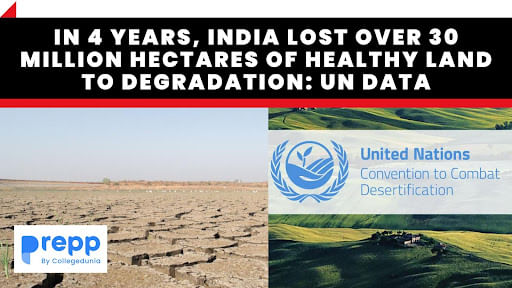
- According to data from UNCCD, India has experienced a substantial loss of over 30 million hectares of healthy land to degradation from 2015 to 2019.
Table of Contents
- What is the United Nations Convention to Combat Desertification (UNCCD)?
- Key Findings
- What is Land Degradation?
- Causes of Land Degradation and Desertification
- Impacts of Land Degradation and Desertification
- India's Efforts to Combat Land Degradation and Desertification
- What are the Global Efforts?
- Conclusion
- FAQs
- MCQs
What is the United Nations Convention to Combat Desertification (UNCCD)?
- The United Nations Convention to Combat Desertification (UNCCD) is an international agreement focusing on addressing the challenges posed by desertification, land degradation, and drought.
- It is one of the three Rio Conventions adopted at the Earth Summit in 1992, alongside the Convention on Biological Diversity (CBD) and the United Nations Framework Convention on Climate Change (UNFCCC).
- The primary goal of the UNCCD is to combat desertification and mitigate the effects of drought in countries experiencing serious drought and/or desertification, particularly in Africa, through effective action at all levels, supported by international cooperation and partnership arrangements.
- The UNCCD promotes good land management practices, aiming to restore the productivity of degraded land.
- Countries affected by desertification and drought are expected to create National Action Plans to address these issues and implement the convention’s principles.
- The convention encourages international cooperation to combat desertification and land degradation. This includes partnerships between affected countries, donors, international organizations, and the private sector.
- The Global Environment Facility (GEF) is the financial mechanism for the UNCCD.
- The convention emphasizes the importance of community participation in combating desertification, acknowledging that local people are critical to implementing sustainable land management practices.
Key Findings
- Land Degradation: Between 2015 and 2019, 30.51 million hectares of land in India, equivalent to 9.45% of the country's total land area, was degraded. This is a significant increase from 4.42% in 2015.
- Population Affected: During this period, 18.39% of India's population, or 251.71 million people, were exposed to land degradation, and 854.4 million people experienced drought from 2015 to 2018.
- Land Lost: Globally, the world lost at least 100 million hectares of healthy land each year from 2015 to 2019.
- The data also shows that India is working towards land degradation neutrality targets, but the progress is partial and not all countries have reported on the status and trends.
- UNCCD emphasizes the need for concerted action to combat land degradation in India and expresses commitment to work with the country to achieve Land Degradation Neutrality targets and restore one billion hectares of healthy land by 2030.
What is Land Degradation?
- Land degradation refers to the long-term deterioration of the quality and productivity of the land, often as a result of various natural and human-induced factors.
- It involves the decline in the land's capacity to support agriculture, vegetation, and other ecosystems.
- In arid, semi-arid, and dry sub-humid regions, this phenomenon is specifically referred to as 'desertification.'
Causes of Land Degradation and Desertification
Natural Factors
- Climate change: Climate change is leading to more extreme weather events, such as droughts, floods, and storms. These events can damage and erode soil, making it less productive.
- Drought: Drought is a prolonged period of abnormally low rainfall. It can cause soil to dry out and crack, making it more susceptible to erosion.
- Wind erosion: Wind erosion is the process by which wind picks up and transports loose soil particles. It is a major problem in dry and arid regions.
- Water erosion: Water erosion is the process by which water washes away soil particles. It is a major problem on sloping land and in areas with heavy rainfall.
Human Factors
- Overgrazing: It is the practice of allowing livestock to graze on an area of land at a rate that exceeds the land's capacity to support them. It can damage vegetation and soil, and it can lead to desertification.
- Deforestation: It is the clearing of forests for other uses, such as agriculture or development. It can lead to soil erosion and desertification.
- Poor agricultural practices: Agricultural practices, such as over-cultivation, monocropping, and excessive use of fertilizers and pesticides, can damage soil and reduce its fertility.
- Urbanization: It is the process of people moving from rural areas to cities. It can lead to land degradation and desertification through the expansion of urban areas into surrounding rural areas and the increased demand for resources such as water and fuelwood.
Impacts of Land Degradation and Desertification
- Environmental Impacts: Land degradation and desertification can lead to the loss of soil fertility, which can reduce crop yields and make it more difficult to grow food.
- It can also lead to the loss of biodiversity, as plants and animals that rely on healthy land are unable to survive.
- It can also increase the risk of natural disasters, such as floods and droughts. This can damage infrastructure, displace people, and lead to loss of life.
- Economic Impact: In 2014-15, land degradation in India resulted in an economic loss equivalent to more than 2% of the country's GDP, as reported by TERI (The Energy and Resources Institute).
- Human Health Impacts: Land degradation and desertification can lead to a number of health problems, including malnutrition, respiratory diseases, and water-borne diseases.
- Societal Impacts: It can lead to poverty, as people are unable to produce enough food to meet their needs.
- It can also lead to migration, as people are forced to leave their homes in search of better opportunities and can create social unrest and conflict, as people compete for scarce resources.
India's Efforts to Combat Land Degradation and Desertification
- Integrated Watershed Management Programme: With the development of Rural Employment, it strives to restore ecological balance by harnessing, preserving, and developing deteriorated natural resources.
- It is now part of the Pradhan Mantri Krishi Sinchai Yojana, which is being implemented by the National Institution for Transforming India (NITI Ayog).
- Desert Development Programme: It began in 1995 with the goal of reducing the negative effects of drought and revitalising the natural resource base of the selected desert areas.
- It was designed for the scorching deserts of Rajasthan, Gujarat, and Haryana, as well as the frigid deserts of Jammu and Kashmir and Himachal Pradesh.
- United Nations Convention to Combat Desertification (UNCCD): In 1994, India signed the UNCCD, which it ratified in 1996. By 2030, India plans to rehabilitate 26 million hectares of degraded land.
- National Afforestation Programme: It has been implemented since 2000 for the afforestation of degraded forest lands. It is being implemented by the Ministry of Environment, Forest and Climate Change.
- National Action Programme to Combat Desertification: It was prepared in 2001 to address issues of increasing desertification and to take appropriate actions.
- National Mission on Green India: It was approved in 2014 with the objective of protecting, restoring and enhancing India’s diminishing forest cover with a deadline of 10 years.
What are the Global Efforts?
- The Bonn Challenge: It is a global goal to bring 350 million hectares of degraded and deforested landscapes into restoration by 2030.
- Great Green Wall Initiative: It was launched in 2007 by the African Union, being implemented across 22 African countries. Its aim is to restore the continent’s degraded landscapes and transform millions of lives in the Sahel.
- Goal 15 of Sustainable Development Goal, 2030 (SDG 15): The goal states its dedication to protect the earth from destruction, especially through sustainable consumption and production.
- United Nations Convention to Combat Desertification (UNCCD): It is an international treaty that aims to combat desertification. It is the only legally enforceable international agreement combining environment and development with sustainable land management, having been formed in 1994.
- World Day to Combat Desertification and Drought: Every year on June 17th, the World Day to Combat Desertification and Drought is commemorated.
Conclusion
As we confront the pressing issue of land degradation in India, it becomes clear that collaborative efforts are imperative to protect our precious natural resources. The impacts of land degradation extend beyond the environment, impacting the lives and prosperity of millions. The UNCCD is steadfast in its commitment to partnering with India to expedite the achievement of Land Degradation Neutrality objectives and the restoration of one billion hectares of healthy land by 2030.
(*Click this link to read prelims specific weekly current affairs articles)
FAQs
Question: What is Land Degradation?
Answer:
Land degradation refers to the long-term deterioration of the quality and productivity of the land, often as a result of various natural and human-induced factors.
Question: What is UNCCD?
Answer:
The United Nations Convention to Combat Desertification (UNCCD), adopted in 1994, is the sole legally binding international agreement linking environment and development to sustainable land management.
Question: When is World Day to Combat Desertification and Drought celebrated?
Answer:
Every year on June 17th, the World Day to Combat Desertification and Drought is commemorated.
MCQ
Question: The government of India encourages the cultivation of ‘sea buckthorn’. What is the importance of this plant? (UPSC 2012)
- It helps in controlling soil erosion and in preventing desertification.
- It is a rich source of biodiesel.
- It has nutritional value and is well-adapted to live in cold areas of high altitudes.
- Its timber is of great commercial value.
Choose the correct answer using the following codes.
(a) 1 only
(b) 2, 3 and 4 only
(c) 1 and 3 only
(d) 1, 2, 3 and 4
Answer: (c) See the Explanation
- Sea Buckthorn oil is a "Rich" Biodiesel source. It was investigated as a viable option/candidate for biodiesel production.
- Sea Buckthorn oil is mostly used for medical and culinary purposes.
- The plant's large root system can fix atmospheric nitrogen, making it suitable for mitigating desertification and managing soil erosion.
- The Seabuckthorn berry, commonly known as the "Wonderberry," "Leh berry," or "Ladakh gold," is one of the most nutritious fruits available.
Therefore, option (c) is the correct answer.
Download the PREPP App and attempt FREE IAS Exam Mock Tests and get complete study material!

Full Test - 04: UPSC CSE Prelims CSAT (Paper-II)
Full Test - 03: UPSC CSE Prelims CSAT (Paper-II)
UPSC CSE Prelims 2026 GS Paper 1 Question Paper (24-May-2026)
UPSC CSE Prelims 2026 CSAT Paper 2 Question Paper (24-May-2026)

17 February 2025 | The Hindu Must Read Articles | Current Affairs

16 February 2026 | The Hindu Must Read Articles | Current Affairs

13 February 2026 | The Hindu Must Read Articles | Current Affairs









Comments