Importance of 'Loss and Damage' Funds
Primary Source: The Hindu
Click here for Daily Current Affairs
Why in the news?
- The article discusses the importance of the Loss and Damage (L&D) fund, which is a fund to help developing countries recover from the losses and damages caused by climate change.
- It highlights the recent impasse at the Transitional Committee (TC) meetings, which are tasked with operationalizing the L&D fund.
- The disagreements between developed and developing countries on key issues such as host institution, funding mechanism, and eligibility criteria have stalled progress.
Table of Contents
- What is Loss and Damage Fund?
- Establishment of the Loss and Damage Fund
- What is a Transitional Committee (TC)?
- Reasons for Impasse at TC Meetings
- Impromptu TC5 Meeting and its Outcome
- Wider Implications of the Outcome of TC5 Meeting
- Significance of L&D Fund
- India’s Role in Facilitating Loss & Damage Fund
- Conclusion
- FAQs
- MCQs
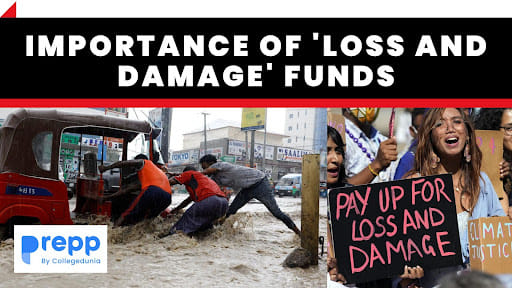
What is Loss and Damage Fund?
- Loss and damage fund (L&D) is a proposed fund to provide financial assistance to developing countries that have been affected by the impacts of climate change.
- The Intergovernmental Panel on Climate Change (IPCC) has stated that some of the impacts of climate change are irreversible and will require adaptation and loss and damage measures to address.
- The IPCC has also emphasized that developed countries have a moral and financial responsibility to support developing countries in addressing climate change impacts, including through the L&D fund.
- The L&D fund is a crucial element of international climate policy because it recognizes the need to address the irreversible and devastating impacts of climate change on vulnerable communities and developing countries.
- The fund also has the potential to strengthen global cooperation on climate change by addressing the concerns of developing countries.
What is Adaptation?
What is Loss and Damage (L&D)?
|
Establishment of the Loss and Damage Fund
| Year | Event |
|---|---|
| Early 1990s | Developing countries begin to call for financial assistance to address the irreversible impacts of climate change. |
| 2007 | The UN Framework Convention on Climate Change (UNFCCC) establishes the Nairobi work programme on loss and damage. |
| 2013 (COP19) | Parties formally agree to establish an L&D fund at the 19th Conference of the Parties (COP19) to the UNFCCC in Warsaw, Poland. |
| 2021 (COP26) | The Glasgow Dialogue on finance for loss and damage was established to continue discussions over the next three years on the fund. |
| 2022 (COP27) | Representatives of the UNFCCC's member states agreed to set up the L&D fund and a Transitional Committee (TC) to figure out how the new funding mechanisms under the fund would operate. |
| 2023 | Four meetings of the TC have concluded with no clear recommendations on operationalizing the L&D fund. |
| 2023 (October) | An impromptu fifth meeting of the TC (TC5) in Abu Dhabi concluded and a set of recommendations have been drafted and forwarded to COP 28. |
| 2023 (November-December) | COP 28 is scheduled to take place in Dubai, United Arab Emirates, where the recommendations from TC5 will be considered and potentially adopted. |
What is a Transitional Committee (TC)?
- A Transitional Committee (TC) is a temporary body established to oversee the development and implementation of a new initiative or program.
- The specific roles and responsibilities of the TC for the L&D fund included:
- Developing recommendations for the operationalization of the fund:This included identifying the fund's objectives, governance structure, funding sources, eligibility criteria, and allocation mechanisms.
- Engaging with stakeholders:The TC consulted with a wide range of stakeholders, including governments, civil society organizations, and experts, to gather input on the design of the fund.
- Preparing a report for consideration by COP:The TC prepared a report that included its recommendations for the operationalization of the fund. This report was submitted to COP for consideration and adoption.
- The work of the TC was a critical step in the development of the L&D fund.
- The TC's recommendations will be considered by COP28, which is scheduled to take place in Dubai, United Arab Emirates, in November-December 2023.
Reasons for Impasse at TC Meetings
- Hosting of the L&D fund: Developing countries advocated for the fund to be housed at the World Bank, while some developed countries preferred an alternative arrangement, citing concerns about the World Bank's track record on climate finance and its potential to impose additional administrative burdens.
- Principle of Common But Differentiated Responsibilities (CBDR): Developed countries resisted explicit references to CBDR in the fund's operational guidelines, which emphasizes the differentiated obligations of countries based on their historical contributions to climate change.
- Climate reparations: Developing countries called for the fund to include an element of climate reparations, acknowledging the historical responsibility of developed nations in causing the climate crisis and the need for compensation for the irreversible damages they have incurred.
- Eligibility of developing nations: There were debates over the eligibility criteria for accessing L&D funds, with some developed countries suggesting stricter criteria to limit the scope of the fund.
- Funding sources: The question of how to secure adequate and predictable funding for the L&D fund remained unresolved, with developed countries not committing to specific levels of contributions.
Impromptu TC5 Meeting and its Outcome
- In an effort to break the deadlock, an impromptu fifth meeting of the TC (TC5) was convened in Abu Dhabi from October 3-4, 2023.
- The meeting was attended by representatives from all 24 TC members.
- The TC drafted and forwarded a set of recommendations to COP 28 for consideration.
- Developing nations conceded to the fund being hosted by the World Bank Financial Intermediary Fund for an interim period of four years.
- Developed nations have remained noncommittal about being primary donors to the fund and have rejected references to the CBDR,equity,and liability in the draft.
- The current draft simply urges and invites developed nations to provide money.
- The fund's size remains unclear, and support is voluntary, watering down the spirit and intent of the fund.
Wider Implications of the Outcome of TC5 Meeting
- The TC5 outcome highlights a lack of trust between developed and developing economies regarding historical responsibilities.
- The unwillingness of wealthy nations to fulfill commitments undermines faith in global climate negotiations and hampers cooperation.
- The discontent among developing nations complicates the path to climate action and global issues.
- The watering down of the L&D fund threatens climate justice, exacerbates suffering in vulnerable communities, and increases the risk of humanitarian crises.
- It also has economic and security implications, as financial crises and environmental degradation can lead to instability and conflict.
Significance of L&D Fund
- It would provide much-needed financial assistance to developing countries that are already struggling to cope with the impacts of climate change.
- It would help to build resilience to climate change in developing countries, which would help them to better adapt to future impacts.
- It would send a signal that the international community is committed to addressing the losses and damages caused by climate change.
- It would help to strengthen the global climate regime by providing a mechanism to address the needs of developing countries.
- It would recognize the historical injustice caused by developed countries and would help to ensure that developed countries take responsibility for the damage they have caused
- It would help to build trust and cooperation between developed and developing countries on climate change.
- The L&D fund is also significant because it would help to address the gaps in existing climate finance mechanisms.
- It has the potential to make a real difference in the lives of people in developing countries who are already suffering from the impacts of climate change.
India’s Role in Facilitating Loss & Damage Fund
- Global Vulnerability Index: CEEW created a Climate Vulnerability Index for India last year. It discovered that more than 80% of Indians are extremely sensitive to harsh weather events.
- Such publicly available data assists in mapping important vulnerabilities and planning plans to enhance resilience by climate-proofing communities, economies, and infrastructure.
- Early Warning Systems Initiative: The Executive Action Plan for the Early Warnings for All Initiative, released at COP27 intends to protect every individual on Earth with early warning systems within five years.
- It has advocated for $3.1 billion in targeted investments between 2023 and 2027, which might save developing countries $3-16 billion in yearly losses due to natural disasters.
- Coalition for Disaster Resilient Infrastructure (CDRI): India established the CDRI in order to "promote the resilience of new and existing infrastructure systems to climate and disaster risks in support of sustainable development."
- CDRI is now conducting a Fiscal Risk Assessment study to help more than 35 countries and multilateral organizations establish a comprehensive disaster-risk funding plan.
- Diplomatic Mediator: India can act as a bridge between developing and developed nations, especially considering the impasse at the Transitional Committee (TC) meetings over the operationalization of the L&D fund.
- By leveraging its position as a major economy with developing country interests, India can help mediate discussions and find a middle ground on contentious issues like the role of the World Bank, the principle of common but differentiated responsibilities (CBDR), and climate reparations.
- Advocacy for Equitable Solutions: India can champion equitable solutions and argue for a fair and just distribution of the L&D funds. It can emphasize the principle of equity, ensuring that the countries most responsible for emissions bear a larger share of the financial burden.
- Promoting Transparency: India can push for greater transparency in how the L&D funds are allocated and used, which would help build trust among the international community and ensure that the funds are directed where they are most needed.
- Showcasing Best Practices: India can demonstrate at COP 28 and other international forums its own efforts to combat climate change and manage L&D, serving as a model for other countries to emulate.
- Strengthening South-South Cooperation: India can use its influence to strengthen South-South cooperation on climate change issues, encouraging joint initiatives and support among developing nations.
- Facilitating Knowledge Exchange: It can facilitate a knowledge exchange platform for best practices in assessing, documenting, and addressing L&D, and in the process, it can help build capacities in vulnerable countries.
Conclusion
L&D funds are crucial for addressing the irreversible consequences of climate change and achieving climate justice. A successful response to climate change requires balancing proactive adaptation with addressing L&D. Failure to do so will derail global climate action and put more pressure on COP 28 talks.
(*Click this link to read prelims specific weekly current affairs articles)
FAQs
Question: What is Adaptation?
Answer:
Adaptation is the proactive reaction to climate change, the survival art in which people and countries make purposeful decisions to prepare for and cope with climate-related issues.
Question: What is Loss and Damage (L&D)?
Answer:
L&D illustrates the irreversible effects of climate change: effects that cannot be prevented or lessened through adaptation efforts. They include actual losses that go beyond monetary value and strike at the heart of human rights and well-being. Economic losses, human deaths, and the deterioration of ecosystems and cultural heritage are all examples of L&D.
Question: What is a Transitional Committee (TC)?
Answer:
A Transitional Committee (TC) is a temporary body established to oversee the development and implementation of a new initiative or program.
UPSC Mains Practice Question:
|
MCQs
Question: “Climate Action Tracker” which monitors the emission reduction pledges of different countries is a: (UPSC 2022)
(a) Database created by coalition of research organisations
(b) Wing of “International Panel of Climate Change”
(c) Committee under “United Nations Framework Convention on Climate Change”
(d) Agency promoted and financed by United Nations Environment Programme and World Bank
Answer: (a) See the Explanation
The Climate Action Tracker (CAT) is an impartial scientific analysis that follows government climate action and compares it to the Paris Agreement's goal of "holding warming well below 2°C and pursuing efforts to limit warming to 1.5°C." Since 2009, the CAT, a collaboration of two organizations, Climate Analytics and NewClimate Institute, has provided this impartial study to policymakers. The Climate Action Tracker (CAT) initiative aims to give policymakers, civil society, and the media with an up-to-date assessment of countries' specific reduction targets as well as an overview of their combined global effects.
Therefore, option (a) is the correct answer.
The ‘Common Carbon Metric’, supported by UNEP, has been developed for: (UPSC 2021)
(a) assessing the carbon footprint of building operations around the world
(b) enabling commercial farming entities around the world to enter carbon emission trading
(c) enabling governments to assess the overall carbon footprint caused by their countries
(d) assessing the overall carbon foot-print caused by the use of fossil fuels by the world in a unit time
Answer: (a) See the Explanation
The Common Carbon Metric is a computation that is used to describe the measurement, reporting, and verification of GHG emissions linked with the operation of specific building types in specific climate areas. It lays the groundwork for realistic performance baselines, national targets, and carbon trading on a fair playing field.
The goal of a Common Carbon Metric for Buildings is to provide information to a sector that accounts for 40% of worldwide energy consumption and a third of global greenhouse gas (GHG) emissions.
Therefore, option (a) is the correct answer.
Question: “Momentum for Change: Climate Neutral Now” is an initiative launched by: (UPSC 2018)
(a) The Intergovernmental Panel on Climate Change
(b) The UNEP Secretariat
(c) The UNFCCC Secretariat
(d) The World Meteorological Organisation
Answer: (c) See the Explanation
In 2015, the UNFCCC secretariat established the Climate Neutral Now project. It is a campaign that encourages individuals, businesses, and governments to assess their carbon footprint and cut their greenhouse gas emissions as much as feasible.
As part of a bigger effort to highlight successful climate action around the world, the secretariat introduced a new pillar within its Momentum for Change campaign centered on Climate Neutral Now in 2016.
Climate neutrality is a three-step procedure that requires individuals, businesses, and governments to: measure their carbon footprint; decrease emissions as much as possible; and offset what they can't lower with UN-certified emission reductions.
Therefore, option (c) is the correct answer.
Question: Which of the following statements are correct about the deposits of ‘methane hydrate’? (UPSC 2019)
- Global warming might trigger the release of methane gas from these deposits.
- Large deposits of ‘methane hydrate’ are found in Arctic Tundra and under the seafloor.
- Methane in atmosphere oxidizes to carbon dioxide after a decade or two.
Select the correct answer using the code given below:
(a) 1 and 2 only
(b) 2 and 3 only
(c) 1 and 3 only
(d) 1, 2 and 3
Answer: (d) See the Explanation
Methane hydrate is a crystalline solid composed of a methane molecule surrounded by an interlocking cage of water molecules. It is a "ice" that can only form spontaneously in subterranean deposits with favorable temperature and pressure conditions.
Regions with favorable temperature and pressure conditions for the development and stabilization of methane hydrate- sediment and sedimentary rock units beneath Arctic permafrost; sedimentary deposits along ontinental edges; deep-water sediments of inland lakes and seas; and Antarctic ice. As a result, assertion 2 is correct.
The sensitive sediments, methane hydrates, can rapidly dissociate with an increase in temperature or a fall in pressure. The dissociation generates free methane and water, which can be caused by global warming. As a result, assertion 1 is correct.
Methane is eliminated from the atmosphere in roughly 9 to 12 years by an oxidation mechanism that converts it to carbon dioxide.
Therefore, option (d) is the correct answer.
Download the PREPP App and attempt FREE IAS Exam Mock Tests and get complete study material!

Full Test - 04: UPSC CSE Prelims CSAT (Paper-II)
Full Test - 03: UPSC CSE Prelims CSAT (Paper-II)
UPSC CSE Prelims 2026 GS Paper 1 Question Paper (24-May-2026)
UPSC CSE Prelims 2026 CSAT Paper 2 Question Paper (24-May-2026)

17 February 2025 | The Hindu Must Read Articles | Current Affairs

16 February 2026 | The Hindu Must Read Articles | Current Affairs

13 February 2026 | The Hindu Must Read Articles | Current Affairs









Comments