Hulivesha - Indian Folk Dance - Art and Culture Notes
Huli Vesha, or Tiger Faced Dance, is a coastal Karnataka dance genre. During the Navratri Festival, local youth perform Huli Vesha. It is a Hindu ritual that honours Goddess Durga, whose official animal is the tiger. Goddess Durga is well-known for her combative demeanour, which she uses to keep evil forces away from her devotees. This article will explain to you the concepts related to Hulivesha which will be helpful in Indian Art and Culture preparation for the UPSC Civil service exam.
|
Table of Contents |
Hulivesha
- Huli vesha, also known as Pili vesha in Tulu, is a folk dance that is unique to the districts of Dakshina Kannada and Udupi.
- It is done to honour the Goddess Durga, whose favourite animal is said to be the tiger.
- Huli Vesha may be found in all of Karnataka's coastal cities, including Mangalore, Udupi, Kundapura, Moodubidiri, Karkala, and others.
- While there is no set time or place to see Huli Vesha, there is a very good chance of seeing it near temples, city centres, and popular public places during the Navratri festival season.
- Huli Vesha can also be performed at other popular festivals such as Ganesh Chaturthi, Sri Krishna Janmashtami, and so on.
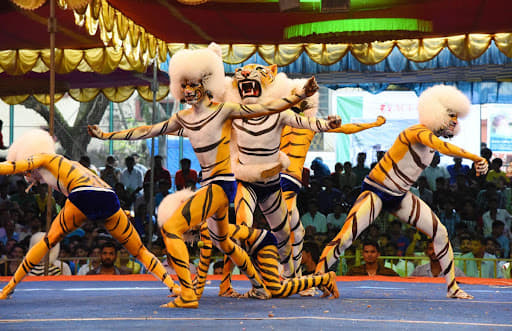
Hulivesha
| Other Relevant Links | |
|---|---|
| Karma Nach | Raut Naach |
| Dumhal | Tippani |
| Fugdi | Garadi |
| Cheraw | Hojagiri |
| Dalkhai | Yakshagana |
Hulivesha - Features
- During a Huli Vesha performance, a group of people will often dress up as tigers, with tiger face masks or paintings, tiger stripes on the body, and yellow or orange coloured shorts.
- The troupe dances along the town's main streets, backed by drums and music, delighting the public while also collecting donations from anyone who offers it.
- Throughout the dance, they come to a halt and do various manoeuvres and formations in order to keep the audience amused.
- The traditional dance moves performed by the artiste are the main attraction of the huli vesha.
- White, orange, yellow, and black are among the colours utilised while performing Huli vesha. Along with the stripes, these colours are painted all over the artist's body.
- The tiger dance is performed as a tribute to Goddess Durga's vehicle.
- During the performance period, the performers must not eat alcohol or non-vegetarian cuisine, according to an unwritten rule.
Conclusion
Culture and tradition are deeply embedded in the people's roots. While time may bring about some changes, the roots of the art form will remain intact and will not lose its charm and beauty as long as there are people who value the art form for what it is. Thus, Huli Vesha will always be an expression of rich culture.
|
|
|
|---|---|
| Indian Art and Culture | Performing Arts |
| Indian Music | Indian Circus |
| Indian Puppetry | Indian Theatre |
| Indian Folk Dances | Indian Classical Dance Forms |
FAQs
Question: What is Hulivesha?
Answer: Hulivesha, also known as Pili Vesha, is a folk dance originating from the coastal regions of Karnataka. During this dance, performers dress up as tigers with face masks, body paintings, and tiger stripes, paying tribute to Goddess Durga. It is traditionally performed during the Navratri festival and other religious celebrations like Ganesh Chaturthi.
Question: Where is Hulivesha primarily performed?
Answer: Hulivesha is predominantly performed in the coastal districts of Karnataka, including Mangalore, Udupi, Kundapura, and Moodubidiri, especially during festivals such as Navratri, Ganesh Chaturthi, and Sri Krishna Janmashtami.
Question: What is the significance of Hulivesha in the Hindu tradition?
Answer: Hulivesha is a devotional dance performed to honor Goddess Durga, whose vehicle is the tiger. The dance is symbolic of Durga's fierce and protective nature, often seen as driving away evil and promoting good. The tiger represents strength and power, which is an integral part of Durga’s iconography.
Question: What are the main features of the Hulivesha performance?
Answer: In a typical Hulivesha performance, dancers dress as tigers, with tiger face masks and painted bodies in yellow, orange, black, and white. The dancers move along the streets or temple areas, performing intricate steps and gestures. The performance is accompanied by traditional drums and music, and donations are often collected from the public during the procession.
Question: Are there any restrictions for performers during Hulivesha?
Answer: Yes, there is an unwritten rule that performers of Hulivesha should refrain from consuming alcohol or non-vegetarian food during the performance period as a sign of respect for the religious and ritualistic nature of the dance.
MCQs
1. Hulivesha is performed in which Indian state?
A) Tamil Nadu
B) Andhra Pradesh
C) Karnataka
D) Kerala
Answer: (C) See the Explanation
Explanation: Hulivesha is a folk dance that originates from Karnataka, particularly in the coastal districts of Dakshina Kannada and Udupi.
2. What is the primary deity honored in the Hulivesha dance?
A) Lord Shiva
B) Goddess Saraswati
C) Goddess Durga
D) Lord Vishnu
Answer: (C) See the Explanation
Explanation: Hulivesha is performed in honor of Goddess Durga, whose vehicle is said to be the tiger, and the dance is symbolic of her power and protection against evil.
3. Which colors are predominantly used in the costumes during Hulivesha?
A) Blue and green
B) Yellow, orange, and black
C) Red and white
D) Purple and pink
Answer: (B) See the Explanation
Explanation: The performers of Hulivesha traditionally paint their bodies in vibrant colors such as yellow, orange, black, and white to resemble a tiger's stripes.
4. During which festival is Hulivesha most commonly performed?
A) Diwali
B) Holi
C) Navratri
D) Pongal
Answer: (C) See the Explanation
Explanation: Hulivesha is most commonly performed during the Navratri festival, which is dedicated to the worship of Goddess Durga.
5. Which of the following is NOT a characteristic of the Hulivesha dance?
A) Performers dress as tigers
B) Performed to honor Goddess Durga
C) Performed only indoors
D) Accompanied by traditional drums
Answer: (C) See the Explanation
Explanation: Hulivesha is a street performance, not confined to indoor spaces. It is accompanied by drums and music as the dancers move through public spaces.
GS Mains Questions and Model Answers
Q1: Discuss the cultural significance of Hulivesha in Karnataka's coastal regions. How does it reflect the state's traditional values?
Answer: Hulivesha is a traditional folk dance deeply rooted in the coastal regions of Karnataka. The dance, performed to honor Goddess Durga, reflects the state's religious devotion, its cultural expressions, and the influence of Hindu rituals in local festivities. The portrayal of the tiger, Durga's vehicle, symbolizes strength, protection, and the triumph of good over evil. This folk dance, often performed during festivals like Navratri, not only entertains but also educates the public about the spiritual and cultural values of the region, emphasizing community involvement and religious observance. The use of bright colors and traditional music adds to the festive atmosphere and showcases the vibrancy of Karnataka's folk culture.
Q2: Explain the role of dance in expressing religious devotion in Indian culture, with reference to Hulivesha.
Answer: In Indian culture, dance has long been a medium for expressing religious devotion, serving as a visual and physical offering to deities. In the case of Hulivesha, the dance honors Goddess Durga, symbolizing her fierce power and protection. By donning the tiger mask and performing intricate dance steps, the participants embody the qualities of the goddess and her vehicle. The dance integrates elements of storytelling, ritualistic practice, and communal participation, creating a spiritual experience for both the performers and the audience. Such folk dances play an important role in keeping traditional practices alive, allowing communities to pass down their beliefs and values through generations.
Q3: Analyze the influence of folk dances like Hulivesha in promoting local cultural identity and tourism.
Answer: Folk dances like Hulivesha contribute significantly to the promotion of local cultural identity by preserving traditional forms of expression that reflect the region's customs, religious beliefs, and historical narratives. These dances serve as a means of cultural education, uniting communities around shared rituals and values. Furthermore, the performance of Hulivesha during popular festivals attracts tourists, thereby promoting cultural tourism in Karnataka. By highlighting the uniqueness of regional dance forms, it encourages the preservation of these art forms and fosters greater awareness and appreciation of local traditions, making them an integral part of the state's cultural heritage and tourism industry.
Previous Year Questions on Indian Folk Dances
1. UPSC CSE Prelims 2021:
Question: Which of the following folk dances is performed in the coastal regions of Karnataka?
A) Garba
B) Kuchipudi
C) Hulivesha
D) Bharatnatyam
Answer: (C)
Explanation: Hulivesha is a folk dance performed in the coastal regions of Karnataka, particularly during festivals like Navratri.
2. UPSC CSE Mains 2019 (GS Paper 1):
Question: "Folk dances like Hulivesha play a key role in preserving regional cultural identities." Discuss the cultural, religious, and social significance of such folk dances in India.
Answer: Folk dances like Hulivesha are integral to preserving regional cultural identities in India. They express religious devotion, pass down traditions, and foster community cohesion. These dances reflect the socio-religious fabric of the region, contributing to the continuity of cultural practices and beliefs. For example, Hulivesha celebrates Goddess Durga and symbolizes the strength and protection associated with her. Beyond their religious significance, such dances also promote social interaction and tourism, further embedding the local culture into the national consciousness.
Download the PREPP App and attempt FREE IAS Exam Mock Tests and get complete study material!

Full Test - 04: UPSC CSE Prelims CSAT (Paper-II)
Full Test - 03: UPSC CSE Prelims CSAT (Paper-II)
UPSC CSE Prelims 2026 GS Paper 1 Question Paper (24-May-2026)
UPSC CSE Prelims 2026 CSAT Paper 2 Question Paper (24-May-2026)

17 February 2025 | The Hindu Must Read Articles | Current Affairs

16 February 2026 | The Hindu Must Read Articles | Current Affairs

13 February 2026 | The Hindu Must Read Articles | Current Affairs









Comments