How To Solve The Problem Of Stubble Burning
Relevance: GS3 - Environmental Pollution and Degradation,
(Source: Indian Express, 11/20/2023)
Click here for Daily Current Affairs
Why in the news?
- This article discusses the problem of stubble burning, and the factors associated with it and suggests some potential solutions to tackle the crisis.
- According to the Commission for Air Quality Management (CAQM), the cumulative number of farm fires in Delhi, Punjab, Haryana, and NCR areas of Rajasthan and Uttar Pradesh in 2023 was 6,391, down from 13,964 in 2022.
What is stubble burning?
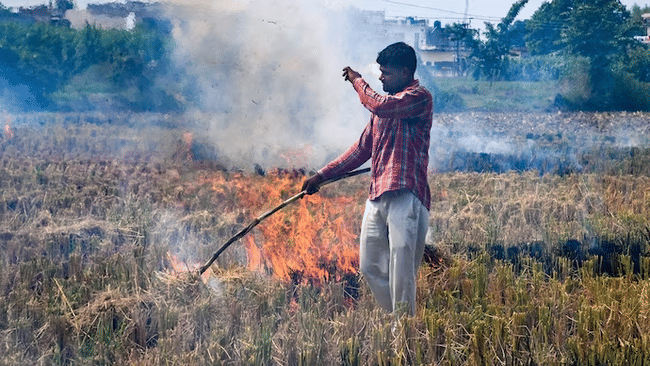
- Stubble (parali) burning refers to the act of setting fire to crop residue in order to clear the field to sow the next crop.
- It has been generally observed to begin in October and peak in November along with the withdrawal of the southwest monsoon.
Advantages
- It destroys weeds, particularly those that are resistant to herbicides.
- It acts as a method to kill pests like slugs.
- It can decrease nitrogen tie-up by microorganisms.
Impact
- Pollution: Stubble burning has led to the emission of large volumes of pollutants, like methane, carbon monoxide, volatile organic compounds (VOC), and carcinogenic polycyclic aromatic hydrocarbons into the atmosphere.
- The presence of these chemicals leads to the formation of thick layers of smog.
- Soil fertility and productivity: Burning of the stubble in the field can also destroy the nutrients in the soil and lead to the loss of moisture and beneficial bacteria.
- This in turn makes the soil less fertile and could affect future crop outputs.
- Increase in pests: Stubble burning can lead to the death of many microorganisms in the atmosphere
- The loss of these organisms leads to an increase in pests and diseases in crops.
- Human health: Stubble burning has a significantly adverse effect on human health.
- It can cause eye irritation, skin infections, chronic cases of asthma, Chronic Obstructive Pulmonary Disease (COPD), bronchitis, lung capacity loss, emphysema, cancer, etc.
- Loss of quality fertilizers: Stubble can be mixed with cow dung and natural enzymes to produce high-quality organic fertilizers.
- The government of Chhattisgarh has established gauthans in many villages where stubble is used to create organic fertilizers.
Why is stubble burning practiced?
- It is the cheapest and quickest method available to farmers, especially those in Haryana and Punjab to dispose of the crop residue as the window between paddy harvesting and sowing the wheat crop is very short (three weeks).
- Since paddy straw has a high silica content, it is not preferred as animal feed and also interferes with subsequent crop operations if plowed back into the field.
What are the two major factors behind the rise in stubble burning in the NCR?
- There are two major factors behind the increase in instances of stubble burning.
- Subsidized power supply: Punjab has provided free power supply to the farming sector since 1997 while Haryana has subsidized electricity supply to the sector.
- This ensured an uninterrupted supply of water to farmers in the two states leading to an increase in the net-sown areas in Punjab (from 50% to 75%) and Haryana (from 30% to 40%) in the 1990s.
- This has increased the quantity of stubble left on the fields, making it difficult for farmers to dispose of it.
- Demand for labor: The harvesting and threshing of paddy is a labor-intensive process.
- However, the shortage in availability of labor led to farmers adopting new technologies such as Combined Harvesters.
- Such machines only pick the panicle (the top part of the plant), thereby leaving the remaining stalk of about 2-3 feet standing in the field.
- This remaining stalk is also known as stubble, which has to be harvested, cleared, and burnt separately.
- In the manual method, the stalks were cut lower to the ground and the stubble was left to decompose at a corner of the field.
- Since the area occupied by the stubble in the field was very little, it was not a major concern for the farmers.
- However, since machines left more quantities of stubble in the fields, farmers have had to resort to burning the stubble in the fields.
What are the solutions proposed to tackle the crisis?
Revision of free power supply:
- Farmers can be given direct benefit transfers (DBT) instead of a power subsidy.
- The DBT amount can be linked to inflation in power tariffs and adjusted regularly to remain relevant for farmers.
- Farmers will have to be compensated for the cost of power when shifting from the subsidized power system to a metered supply.
- Benefits:
- Encourage farmers to diversify their crops away from paddy which leads to stubble burning.
- It will also help counter the over-exploitation of groundwater by farmers in cultivating water-intensive crops like wheat and paddy.
Markets for paddy:
- The government should take steps to make stubble valuable for farmers.
- This can be done by creating a market for paddy straw or stubble which will compensate the farmers for their efforts (labor and economic) in harvesting, collecting, and disposing of the stubble.
- E.g.: Baling machines (balers) which enable paddy and other crop straws to be entered in the value chain.
- On average, an acre of land generates about 2.5 tonnes of paddy straw which would involve costs of around ₹1,000 to ₹1,100 for baling per acre.
- Therefore, a value of ₹1,000-1,200 per tonne of bale of parali will help cover the costs and generate a small profit for the farmer.
- Punjab and Haryana generate about 20 million metric tonnes (MMT) and 10 MMT of parali respectively, of which 85% is burnt in the field.
- Therefore, the total stubble burnt in the field can be acquired at an estimated cost of ₹2000 crores (Punjab) and ₹1000 crore (Haryana).
- The baled paddy straw can then be used in the production of biofuels such as BioCNG and ethanol and as a direct fuel in brick kilns, furnaces, and thermal plants.
- Therefore the use of stubble as a biofuel must be encouraged through financial incentives and through technical and infrastructural support.
- Machinery can be supplied on a subsidized basis.
- The production of compressed biogas from straw can be economically and environmentally beneficial.
- It produces bio-slurry which can be used to replenish soil fertility.
- However, it will take time to establish these supply chains and thus promote a circular economy in the country’s agricultural economy.
- This can then be followed by an effective law to ban stubble burning which must be strictly enforced throughout the country.
Other steps taken to prevent stubble burning
- Experts have suggested finding an alternative to paddy or reducing the duration of the rice crop.
- However, alternatives like maize also produce large amounts of stubble.
- Even in areas with early maturing paddy, farmers have been observed to prefer stubble burning.
- In 2019, the Supreme Court directed the governments of Haryana, Punjab, and Uttar Pradesh to financially incentivize farmers to end stubble farming.
- In 2020, Punjab appointed 8000 nodal officers to check stubble burning in villages growing paddy.
- Penalties have been imposed on farmers who burn the crop residue in the field.
- More than 23,000 crop residue management machines have been provided to farmers for in-situ management of straw.
- Under a 100% centrally-funded scheme, in-situ residue management machines are provided to individual farmers at a 50% subsidy and to CHCs (custom hiring centers) at an 80% subsidy.
Commission on Air Quality Management
|
Conclusion
A system that provides financial incentives for crop residue backed by legal guarantees and administrative support will help prevent stubble burning in the country, contribute to the economy, and enhance public health.
(*Click this link to read prelims specific weekly current affairs articles)
FAQs
Question: What are Direct Benefit Transfers?
Answer:
The Direct Benefit Transfer (DBT) Program was launched by the Government of India in 2013. It aims to make payments directly into the Aadhaar-linked bank accounts of beneficiaries. This has helped make the process transparent and remove duplications and diversions in fund distribution.
Question: What is a happy seeder?
Answer:
The Happy Seeder(HS) is a tractor-operated machine developed by the Punjab Agricultural University(PAU) in collaboration with the Australian Centre for International Agricultural Research(ACIAR). It is used for in-situ management of paddy stubble and can cut and lift the previous crop and sow a new crop in its place.
|
UPSC Mains Practice Questions Q.1) What are the major factors responsible for making the rice-wheat system a success? In spite of this success, how has this system become a bane in India? (UPSC GS3 2020) Q.2) What are the direct and indirect subsidies provided to the farm sector in India? Discuss the issues raised by the World Trade Organization (WTO) in relation to agricultural subsidies. (UPSC GS3 2023) Q.3) How does -Technology help farmers in the production and marketing of agricultural produce? Explain.(UPSC GS3 2023) |
MCQs
Question: What is/are the advantage/advantages of zero tillage in agriculture?
- Sowing of wheat is possible without burning the residue of the previous crop.
- Without the need for a nursery of rice saplings, direct planting of paddy seeds in the wet soil is possible.
- Carbon sequestration in the soil is possible.
Select the correct answer using the code given below: (UPSC CSE 2020)
(a) 1 and 2 only
(b) 2 and 3 only
(c) 3 only
(d) 1, 2 and 3
Answer: (d) See the Explanation
- Zero tillage allows farmers to sow crops without the need to burn the residue of the previous crop, which can improve soil fertility and reduce greenhouse gas emissions. Hence statement 1 is correct.
- Zero tillage eliminates the need for nursery-grown rice saplings, allowing farmers to directly plant paddy seeds in wet soil. This can save time and labor. Hence statement 2 is correct.
- Zero tillage can help to sequester carbon in the soil, which can help to mitigate climate change. When farmers do not disturb the soil, the organic matter in the soil is not oxidized and is instead stored in the soil. Hence statement 3 is correct.
Therefore, option (d) is the correct answer.
Question: “System of Rice Intensification” of cultivation, in which alternate wetting and drying of rice fields is practiced, results in
- Reduced seed requirement
- Reduced methane production
- Reduced electricity consumption
Select the correct answer using the code given below: (UPSC CSE 2022)
(a) 1 and 2 only
(b) 2 and 3 only
(c) 1 and 3 only
(d) 1, 2 and 3
Answer: (d) See the Explanation
- The System of Rice Intensification involves cultivating rice with as much organic manure as possible.
- It employs young seedlings planted singly at a wider spacing in a square pattern; with intermittent irrigation that keeps the soil moist but not inundated, and frequent inter-cultivation with a weeder that actively aerates the soil.
- The System of Rice Intensification (SRI) includes a method called Alternate Wetting and Drying (AWD) which is a form of controlled or intermittent irrigation of the rice crops.
- SRI methods have the following benefits and impacts, in general, compared to conventional methods of paddy cultivation:
- To increase paddy yields usually by 20-50% and sometimes up to 100%
- It reduces the required seeds for transplanting by 60-80%. Hence statement 1 is correct.
- The electricity consumption will be less as it enables reduced use of chemical fertilizers and agrichemicals and reduced use of irrigation water by 25-50%. Hence statement 3 is correct.
- It helps stop flooding and mostly relies on organic fertilization which helps reduce methane emissions without offsetting increases in nitrous oxide.
- Oxford researchers in India found a 30% reduction in net greenhouse gas emissions with SRI, compared with current practice, and more than 50% reduction in greenhouse gas emissions per kilogram of rice produced. Hence statement 2 is correct.
Therefore, option (d) is the correct answer.
Download the PREPP App and attempt FREE IAS Exam Mock Tests and get complete study material!

Full Test - 04: UPSC CSE Prelims CSAT (Paper-II)
Full Test - 03: UPSC CSE Prelims CSAT (Paper-II)
UPSC CSE Prelims 2026 GS Paper 1 Question Paper (24-May-2026)
UPSC CSE Prelims 2026 CSAT Paper 2 Question Paper (24-May-2026)

17 February 2025 | The Hindu Must Read Articles | Current Affairs

16 February 2026 | The Hindu Must Read Articles | Current Affairs

13 February 2026 | The Hindu Must Read Articles | Current Affairs









Comments