How India Can Become The Bank For The Global South
Relevance: GS3 - Indian Economy and issues relating to planning, mobilization, of resources, growth, development and employment GS2 - Effect of policies and politics of developed and developing countries on India’s interests
(Source: Indian Express, 12/13/2023)
Click here for Daily Current Affairs
Why in the news?
- This article discusses India’s role as a bank for the global south amid an opportunity for India to take advantage of stagnation in Europe and the internal problems faced by the USA and China.
- India can take advantage of the lessons from 2023, where it served as host of the G20, and use its GDP of $3.7 trillion, supported by its people, companies, and state apparatus to reshape the global order.
Table of Contents
- What is the opportunity before India?
- Case study: China
- Similarities and Differences - India and China (2007)
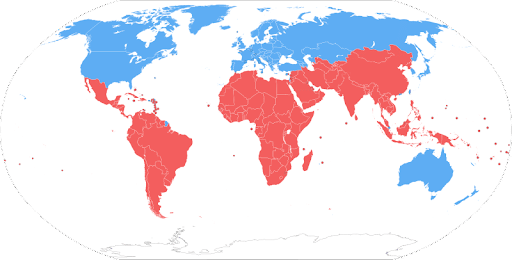
- Global South
- India’s association with the Global South
- How can India become the Bank of the Global South?
- Steps taken by India to become the Voice of the Global South
- Challenges faced
- Gati Shakti
- Key features
- The way forward
- FAQs
- MCQs
What is the opportunity before India?
- India’s economy which has neared $4 trillion in size has the potential to exert a large influence on the world.
- India can establish a position for itself alongside larger economies like the USA, EU, and China.
- According to experts, India is faced with an opportunity for growth as external conditions are conducive to growth.
- Europe has stagnated while the USA and China have turned inward to deal with their economic crises.
- Similarly, China has been faced with a shrinking of its share in the global economy in nominal terms
- India must use this opportunity to demonstrate its potential and the additionality that it could provide for global growth, institutions, and security.
Case study: China
- Fifteen years ago, China was in a similar position to what India is presently in.
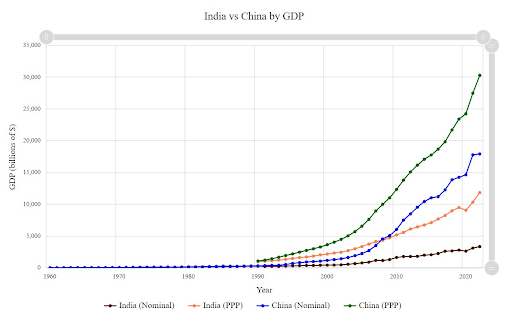
- In 2007, China was not the economic powerhouse it is today with a GDP of $3.6 trillion.
- In comparison, India’s present GDP is around $3.7 trillion.
- China offered its partners a full-fledged framework for growth that attracted global partners to participate in its system, allowing it to establish itself as a major global financial power.
- China established a future-focused architecture system that proved to its partners that its $4 trillion economy could compete with other economies as large as $15 trillion.
- Despite having a GDP lower than India’s present GDP, China emerged as the go-to nation during the global financial crisis of 2008.
- Countries adopted a special diplomatic approach towards China and deepened bilateral relations.
- China provided institutional and geoeconomic responses to the major crises faced by countries during the crisis.
- A development bank
- A cross-continental lending programme
- This helped China galvanize the growth of infrastructure projects without the constraints of Western agencies.
- This series of economic projects eventually evolved into the present Belt and Road Initiative.
- China leveraged its economic promise in 2008 to establish an oversized economic and political influence, from which it continues to benefit.
- It offered a vital additionality to the global order in the form of guaranteed stability and economic dynamism.
- It was aided by global conditions in which the US was struggling to recover from the crisis and the Eurozone was impacted by demands for withdrawal.
- As a result, China was welcomed by the world as an additional centre of geopolitical power and source of investment that helped fulfill its need for an additional engine of growth.
Similarities and Differences - India and China (2007)
| Similarities | Differences |
|---|---|
Labour Force:
|
Growth
|
Global South
India’s association with the Global South
|
How can India become the Bank of the Global South?
- China’s growth has proved that India will not have to demonstrate extraordinariness.
- India’s trajectory and motives are well suited to the green and digital future with its platform economy offering it a foundation to establish itself as a world leader.
- The additionality that India offers must have attributes that attract its potential partners.
- India will have to establish a new cooperation architecture that will accommodate the country’s increased spending.
- The Indian private sector has been mobilizing to support connectivity, supply chains, and resource resilience across the world.
- This will be accompanied by the growth of public development finance, at a faster rate than the Indian economy.
- India will emerge as a new source of development finance even if it grows at just 10% per annum (in current dollars), which was below its recent benchmarks.
- If India’s development cooperation budget was raised to less than 0.5% of its GDP by 2030, around $70 billion of funds would have to be put into the global system.
- India would need to provide a unique roadmap that can support its finance offerings. This requires
- An outward-focused development finance corporation that can catalyze global projects.
- A bank, similar to the China Development Bank, to focus on global corporate requirements outside of trade finance.
- This would transform India, which was already the voice of the Global South, into the bank of the Global South.
Steps taken by India to become the Voice of the Global South
- New Delhi Declaration: India hosted the G-20 meeting in 2023 where it reiterated its position as the voice of the Global South.
- India helped achieve a consensus on major concerns of the South such as debt financing, gender equality, and climate justice, leading to the development of the New Delhi Declaration.
- India also hosted Voice of the Global South Summits to foster solidarity among the countries.
- Multilateral inclusivity: India has highlighted the need for greater recognition of the Global South by driving the expansion of the G-20 under its presidency.
- The African Union was included as a member of the G-20 in the 2023 Session.
- India has also worked towards expanding membership of the Global South in other multilateral fora like BRICS, where 6 new countries were included to form BRICS PLUS.
- Vaccine diplomacy: India displayed its commitment to the Global South through its Vaccine Maitri scheme which supplied free vaccines, drugs, and medical supplies during the Covid-19 pandemic.
- Climate change: India has regularly called on the Global North to undertake reductions in emissions to achieve net zero before set deadlines.
- India has also highlighted their historical contributions and the the significant developmental advantages gained by them and stated that the Global South can not be forced to pay for this at the cost of their development.
- India also played a key role in the establishment of the Loss and Damage Fund at COP28, UAE.
Challenges faced
- Discord within the Global South: India’s ambitions of acquiring a permanent seat at the UNSC have been opposed by the Coffee Club, which includes countries from the Global South.
- India has been accused of prioritizing its ties with the Global North and not engaging regularly with the South which has led to a disruption in communication and cooperation between the Global South.
- Inefficiencies: Global South countries have highlighted India’s incapacity to deliver on development projects within agreed time frames as a challenge.
- For example, the Kaladan Project with Myanmar which has been delayed multiple times and is now expected to be completed by 2024.
- Competition with China: China, with its greater economic strength, has been providing financial and developmental assistance to the Global South to emerge as its leader.
- Big Brother Attitude: One of the major criticisms leveled against India by its partners in the Global South has been its “Big Brotherly attitude” and alleged interference in domestic affairs.
- This has resulted in public protests against India in countries like Maldives (India Out Campaign).
Gati Shakti
- The government of India has demonstrated a similar initiative at the domestic level.
- The Gati Shakti initiative aims to link disparate infrastructure projects through a common vision.
- It was launched in October 2021 to coordinate infrastructure project planning and execution while reducing logistics costs.
- Aim: It aims to improve economic growth and sustainable development by focusing on infrastructure such as roads, railways, airports, ports, mass transport, waterways, and logistics.
- In the Union Budget 2023, the budget for the PM Gati Shakti National Master Plan was increased by the Union government.
- Six pillars
- Comprehensiveness
- Prioritization
- Optimization
- Synchronization
- Analytical
- Dynamic Approach
Key features
- Integrated Planning: It is a digital platform that connects development projects across 16 ministries, including railways and roads, enabling integrated planning and implementation.
- This allows for swift, efficient, and coordinated decision-making.
- Cross-sectoral Interactions: The collaboration between the various ministries involved in the project helps optimize resource allocation by prioritizing necessary projects and avoiding overlapping.
- Infrastructure Integration: It integrates infrastructure schemes from various ministries and state governments to promote last-mile connectivity and reduce logistics costs.
- For example, the Bharatmala, Sagarmala, inland waterways connectivity projects.
- Enhanced Visibility: PM Gati Shakti utilizes a repository of geospatial data for better planning and decision-making.
- Project Monitoring: A specialized group under the Department of Promotion of Industry and Internal Trade (DPIIT) has been empowered to oversee the progress of key projects in real time.
- They will solve any issues such as inter-ministerial differences and ensure smooth implementation of projects.
The way forward
- India would need to adopt an approach to external engagement with like-minded partners that allows it to develop priority infrastructure, connectivity routes, business and trading hubs, and developmental projects.
- To do so India will have to identify the critical sectors and domains where it can establish its vision for its role in the world.
- Moreover, India must shed its big brotherly attitude and revive its interaction with the countries of the Global South through bilateral and multilateral fora.
(*Click this link to read prelims specific weekly current affairs articles)
FAQs
Question: What is the twin deficit?
Answer:
A twin deficit refers to a simultaneous current account deficit and fiscal deficit in a country. A fiscal deficit means the country has to borrow for its expenditure while a current account deficit means it is importing more than it is exporting.
Question: What is a platform economy?
Answer:
A platform economy is a business model in which a digital platform acts as an intermediary between buyers and sellers. The platform facilitates the exchange of goods, services, or information and collects fees or commissions on these transactions.
Examples: Uber, Amazon, etc.
UPSC Mains Practice Question:
|
MCQs
Question: Consider the following statement:
Statement – I: India accounts for 3.2% of global export of goods.
Statement-II: Many local companies and some foreign companies operating in India have taken advantage of India’s ‘Production-linked Incentive’ scheme.
Which one of the following is correct in respect of the above statements? [2023]
(a) Both statement-I and Statement II are correct and Statement II is the correct explanation for Statement-I
(b) Both Statement-I and Statement-II are correct and Statement-II is not the correct explanation for Statement-I
(c) Statement-I is correct but Statement-II is incorrect.
(d) Statement--I- is incorrect but Statement-II is correct.
Answer: (d) See the Explanation
- As per the Economic Survey 2022-23, India’s accounts for 1.8% of Global export of goods and 4% of global export of services. Hence statement 1 is incorrect.
- Production Linked Incentive (PLI) scheme is a form of Performance-linked incentive given to companies based on their incremental sales from products manufactured in domestic units.
- It is aimed at boosting the manufacturing sector and to reduce imports of India. Hence statement 2 is correct.
Therefore, option (d) is the correct answer.
Question: If another global financial crisis happens in the near future, which of the following actions/policies are most likely to give some immunity to India?
- Not depending on short-term foreign borrowings
- Opening up to more foreign banks
- Maintaining full capital account convertibility
Select the correct answer using the code given below : (2020)
(a) 1 only
(b) 1 and 2 only
(c) 3 only
(d) 1, 2 and 3
Answer: (a) See the Explanation
- If another global financial crisis were to happen, depending on short-term foreign borrowings would make India more vulnerable to external shocks. Hence statement 1 is correct.
- Opening up to more foreign banks and maintaining full capital account convertibility may increase capital inflows, but it would also increase the risk of capital outflows during times of crisis. Hence statements 2 and 3 are incorrect.
Therefore, option (a) is the correct answer.
Download the PREPP App and attempt FREE IAS Exam Mock Tests and get complete study material!

Full Test - 04: UPSC CSE Prelims CSAT (Paper-II)
Full Test - 03: UPSC CSE Prelims CSAT (Paper-II)
UPSC CSE Prelims 2026 GS Paper 1 Question Paper (24-May-2026)
UPSC CSE Prelims 2026 CSAT Paper 2 Question Paper (24-May-2026)

17 February 2025 | The Hindu Must Read Articles | Current Affairs

16 February 2026 | The Hindu Must Read Articles | Current Affairs

13 February 2026 | The Hindu Must Read Articles | Current Affairs









Comments