How DAOs Are Shaping The Future Of The Digital World
Relevance: GS3 - Science and Technology- developments and their applications and effects in everyday life.
(Source: The Hindu, 11/28/2023)
Click here for Daily Current Affairs
Why in the news?
- This article discusses Decentralized Autonomous Organizations (DAOs) which are an intersection of governance and blockchain technology.
- DAOs aim to develop transparent, democratic, and self-executing systems that can reshape traditional business structures and the digital world.
Table of Contents
What are DAOs?
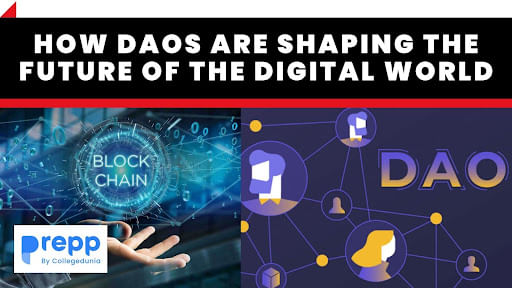
- Decentralized Autonomous Organizations (DAOs) is a term used to describe organizations that are represented by the rules encoded as a computer program that is transparent, controlled by the members, and not influenced by a government.
- DAOs aim to create self-sustaining, community-driven entities that are governed by smart contracts on blockchain networks.
- One of the most important aspects of DAOs is their potential to change the idea of collaboration.
What are the various use cases of DAOs?
- DAOs are versatile and are capable of reshaping industries across various sectors.
- Finance: DAOs have been used in the decentralized finance sector through platforms like Compound and MakerDAO.
- These platforms have introduced lending and borrowing services that allow users to participate in the global financial ecosystem without relying on traditional banks.
- Art: DAOs help artists tokenize their work, manage royalties, and maintain control over their intellectual property.
- Supply chain management: DAOs offer transparency and traceability in global supply chains which helps ensure the quality and authenticity of products.
- Governance: DAOs are useful tools for decision-making as platforms like DAOstack facilitate decentralized governance structures for internet communities.
What are the implications of DAOs for the digital world?
- Decentralization: DAOs act as decentralizing entities by helping shift power from centralized authorities to the collective.
- They enable democratic decision-making through an equitable distribution of influence within the DAO with all token holders able to propose and vote on decisions related to the organisation’s goals and resources.
- This ensures that no single entity holds undue influence within the organization.
- For example, contributors across the world can participate in shaping the direction of a DAO-governed community-driven project while also reducing the dominance of a single central entity.
- Transparency: The smart contracts on which DAO operations are based are generally transparent and immutable.
- They eliminate the need for intermediaries as the smart contracts automatically execute predefined rules.
- The rules are predefined and require consensus for alteration.
- This helps ensure trust through code rather than traditional authorities.
- Transparency can disrupt traditional industries by eliminating the opacity associated with centralized organizations.
- Inclusivity: DAOs enable democratized and inclusive access to resources and opportunities.
- DAOs enable global participation regardless of geographical and socio-economic barriers, thereby encouraging diversity, innovation and creativity.
- Cooperation and collaboration: DAOs enable new forms of collaboration by allowing participants with shared goals to cooperate without requiring intermediaries.
- It helps create a dynamic environment where innovation and cooperation are not affected by hierarchical structures.
- In this way, DAOs have a transformative impact and can help lead to a decentralised, equitable, and collaborative digital future.
What are the challenges and controversies associated with DAOs?
- Vulnerabilities: The DAO hack in 2016 revealed the vulnerabilities in the code that lead to a contentious hard fork in the Ethereum block chain.
- A hard fork refers to a change in a network’s protocol that makes previously invalid blocks and transactions valid, or vice-versa)
- This has raised concerns about the immutability of the blockchain network.
- Insufficient legal and regulatory framework: There are numerous uncertainties in the traditional legal systems with regards to the DAOs.
- Authorities have faced problems in classifying and regulating decentralized entities.
- DAO tokens that can be considered securities and represent ownership or participation are subjected to complex regulatory requirements and compliance challenges( KYC, Anti-Money Laundering etc).
- The decentralized nature of decision making and automated smart contracts in DAOs make it difficult for responsibilities to be assigned to actions.
- The absence of traditional legal mechanisms makes dispute resolution a challenge as they must rely on code-based solutions.
Way forward
- Stakeholders are actively working to establish legal frameworks that balance innovation with compliance.
- DAO creators, participants, and regulators must collaborate to develop guidelines that can accommodate the unique nature of DAOs within existing regulatory structures.
- This includes concerns such as governance, intellectual property, and cross-border operations, and transparency in token-based decision-making.
- A legal framework that allows DAOs to harness their transformative potential while adhering to the complexities of the law must be developed through extensive discussions with stakeholders from law, blockchain technology, and policy making.
Conclusion
- DAOs can have a transformative effect on organozation and collaboration in the digital world.
- DAOs can drive positive change in various sectors and shape the digital future despite the challenges if stakeholders collaborate to address evolving challenges.
(*Click this link to read prelims specific weekly current affairs articles)
FAQs
Question: What is blockchain technology?
Answer:
Blockchain technology is a technology that leads to a chain of blocks containing digital information stored in a public database. It is a distributed database existing on multiple computers at the same time, and is secure and cryptography-based.
Question: What is tokenisation?
Answer:
Tokenization refers to the process of issuing a digital representation of an asset on a blockchain. These assets include physical assets like real estate or art, financial assets like equities or bonds, nontangible assets like intellectual property, identity and data.
MCQs
Question: With reference to Web 3.0, consider the following statements:
- Web 3.0 technology enables people to control their own data.
- In Web 3.0 world, there can be blockchain based social networks.
- Web 3.0 is operated by users collectively rather than a corporation.
Which of the statements given above are correct? (UPSC CSE 2022)
(a) 1 and 2 only
(b) 2 and 3 only
(c) 1 and 3 only
(d) 1, 2 and 3
Answer: (d) See the Explanation
- Web 3.0 is a decentralised internet that runs on a public blockchain, which is also used for cryptocurrency transactions.
- At present, only centralized repositories own user data and profit from it. In Web 3.0, users can control, own and be properly compensated for their time and data. Hence statement 1 is correct.
- People can maintain blockchain based social networks in Web 3.0 which are democratic. Hence statement 2 is correct.
- In Web3.0, all the value that’s created can be shared amongst more people, rather than just the owners, investors and employees. Thus it is operated by users collectively rather than corporation. Hence statement 3 is correct.
Therefore, option (d) is the correct answer.
Question: With reference to Non-Fungible Tokens (NFTs), consider the following statements:
- They enable the digital representation of physical assets.
- They are unique cryptographic tokens that exist on a blockchain.
- They can be traded or exchanged at equivalency and therefore can be used as a medium of commercial transactions.
Which of the statements given above are correct? (UPSC CSE 2022)
(a) 1 and 2 only
(b) 2 and 3 only
(c) 1 and 3 only 1
(d) 1, 2 and 3
Answer: (a) See the Explanation
- Non–fungible tokens (NFTs) are cryptographic assets on a blockchain that have unique identification codes and metadata which distinguishes them from each other. Hence statement 2 is correct.
- NFTs can be anything that can be converted to digital form such as art, pictures, music, tweets, videos, etc. Hence statement 1 is correct.
- Unlike fungible tokens like cryptocurrencies which are identical and can serve as a medium for commercial transactions, NFTs cannot be traded or exchanged at equivalency. Hence statement 3 is incorrect.
Therefore, option (a) is the correct answer.
Download the PREPP App and attempt FREE IAS Exam Mock Tests and get complete study material!

Full Test - 04: UPSC CSE Prelims CSAT (Paper-II)
Full Test - 03: UPSC CSE Prelims CSAT (Paper-II)
UPSC CSE Prelims 2026 GS Paper 1 Question Paper (24-May-2026)
UPSC CSE Prelims 2026 CSAT Paper 2 Question Paper (24-May-2026)

17 February 2025 | The Hindu Must Read Articles | Current Affairs

16 February 2026 | The Hindu Must Read Articles | Current Affairs

13 February 2026 | The Hindu Must Read Articles | Current Affairs









Comments