How Big is the Gender Gap in Earnings?
Primary Source: The Hindu
Click here for Daily Current Affairs
Prepp Prelims Booster: Gender Equality, Government Interventions
Prepp Mains Booster: Indian Economy and issues relating to Planning, Mobilization of Resources, Growth, DevelopmentandEmployment, Government Policies and Interventions for Development
Why in the news?
- The Periodic Labour Force Surveys (PLFS) examines the gender earnings gap across various employment types from April-June 2019 to 2023.
- A new aspect of Periodic Labour Force Surveys (PLFS) emphasizes on weekly hours worked, suggesting that just looking at total earnings may not provide a complete understanding of the gender gap.
Table of Contents
Difference in Gender Earnings Gap
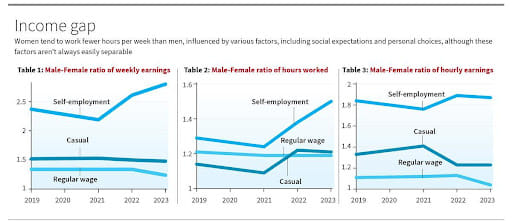
- Table 1 shows the ratio of weekly earnings for men and women. A figure above 1 indicates men earn more than women.
- Across all job types, men earn more than women, with the most significant gap being among the self-employed.
- In 2023, self-employed men earned 2.8 times more than women. Regular wage men earned 24% more, and casual male workers earned 48% more.
- There's been a gender gap increase for self-employed but a decrease for regular wage workers.
Differences in Average Weekly Work Hours
- Women work fewer hours per week across all job types, as shown in Table 2.
- In 2023, self-employed men worked 50% more hours than women, while regular wage men worked 19% more hours.
- Regular wage workers (both men and women) have the longest work weeks.
- The rise in the gender hours gap for self-employed women is because more rural women are working part-time compared to men’s full-time work.
- Average work hours for rural self-employed women decreased from 37.1 in 2019 to 30.1 in 2023.
Decrease in the Gap in Hourly Earnings
- Table 3 displays the ratio between men and women's hourly earnings.
- For regular wage workers in 2023, the hourly earnings gap was only around 4%, down from 11% in 2019.
- Despite working less, women in regular jobs earn almost the same hourly rate as men.
- In other job types, hourly earning inequality remains, though not as high as total earnings.
- For casual male workers, the gap in 2023 was 23%, down from 33% in 2019.
- For the self-employed, it rose slightly from 84% in 2019 to 87% in 2023.
Factors Influencing Hours of Work
- Choice vs. Constraint: Working hours aren't always determined by individual choice. For many, especially women, the option of working longer hours might not be available due to various external constraints.
- Societal Norms: Social norms that expect women to shoulder the primary responsibility for domestic tasks and child-rearing can restrict their available hours for paid work.
- Availability of Part-Time Work: The influx of women into part-time roles, especially in the self-employed sector, indicates that full-time opportunities might be limited, or part-time roles might be more compatible with other responsibilities.
- Workplace Infrastructure: The absence of facilities like creches (child care centers) in workplaces can limit the hours women can work, especially if they have young children and lack alternative childcare options.
- Maternity and Paternity Leave Policies: Generous maternity leaves, while essential, can influence the number of hours women work in a year. Moreover, the absence of or limited paternity leaves can put the onus of child-rearing primarily on mothers.
- Comprehensive Transformations: Broader societal changes are needed that don't place the entire burden of child care and domestic work on women. If responsibilities at home are equally shared among partners, it can lead to more equitable work hours in the professional sphere.
- Job Availability: The type and nature of jobs available in a region or sector can dictate the hours of work. For instance, certain industries might predominantly offer part-time roles or seasonal work.
Conclusion
The gender earnings gap in India is not just a result of wage differences but also differences in work hours, influenced by both societal norms and workplace policies. There's a need to focus on both aspects to ensure a more equal work environment for men and women.
(*Click this link to read prelims specific weekly current affairs articles)
FAQs
Question: What is the Periodic Labour Force Surveys (PLFS)?
Answer:
The Periodic Labour Force Survey (PLFS) is a significant survey initiated by the National Sample Survey Office (NSSO), Ministry of Statistics and Programme Implementation, Government of India. The PLFS was introduced with the aim of measuring employment and unemployment metrics on a quarterly basis for urban areas and on an annual basis for both rural and urban areas.
Question: What are the factors which influence hours of work?
Answer:
Following are some of the factors influencing hours of work:
- Choice vs. Constraint
- Societal Norms
- Availability of Part-Time Work
- Workplace Infrastructure
- Maternity and Paternity Leave Policies
- Comprehensive Transformations
- Job Availability
UPSC Mains Practice Question:
|
MCQs
Question: Which principle among the ‘following' was added to the Directive Principles of State Policy by the 42nd Amendment to the Constitution? (UPSC 2018)
(a) Equal pay for equal work for both men and women
(b) Participation of workers in the management of industries
(c) Right to work, education and public assistance
(d) Securing living wage and human conditions of work to workers
Answer: (b) See the Explanation
Directive Principles of State Policy (DPSP) are the ideals that the state should keep in mind when passing policies/laws. It is found in Part IV of the Indian Constitution, which covers articles 36 to 51.
The 42nd Amendment to the State Policy Directive Principles introduced four new Directive Principles of State Policy to the current list, which are as follows:
- Article 39 aims to provide possibilities for children's healthy growth.
- Article 39 (A) promotes fair justice and free legal help for the underprivileged.
- Article 43 (A) requires employers to take actions to ensure worker participation in industry management.
- The purpose of Article 48 (a) is to maintain and improve the environment, as well as to protect forests and wildlife.
Therefore, option (b) is the correct answer.
Download the PREPP App and attempt FREE IAS Exam Mock Tests and get complete study material!

Full Test - 04: UPSC CSE Prelims CSAT (Paper-II)
Full Test - 03: UPSC CSE Prelims CSAT (Paper-II)
UPSC CSE Prelims 2026 GS Paper 1 Question Paper (24-May-2026)
UPSC CSE Prelims 2026 CSAT Paper 2 Question Paper (24-May-2026)

17 February 2025 | The Hindu Must Read Articles | Current Affairs

16 February 2026 | The Hindu Must Read Articles | Current Affairs

13 February 2026 | The Hindu Must Read Articles | Current Affairs









Comments