How Are The MiG-21 Fighter Jets Being Phased Out?
Relevance: GS3 - Defense Technology
(Source: The Hindu, 11/08/2023)
Click here for Daily Current Affairs
Why in the news?
- Recently, the Indian Air Force has been phasing out the MiG-21 fighter jet squadron with the phase-out expected to be completed by 2025.
- The legacy jets will be replaced by the LCA Mark-1A manufactured by Hindustan Aeronautics Ltd (HAL).
Table of Contents
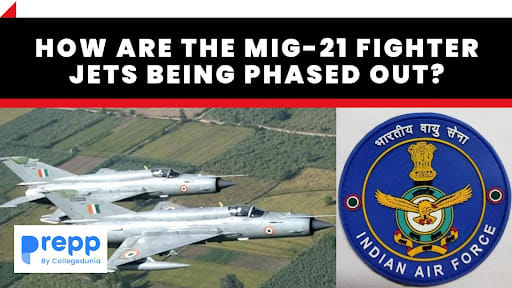
What is the MiG-21?
- The Mikoyan-Gurevich MiG 21 is a supersonic jet fighter and interceptor aircraft that was designed by the Mikoyan-Gurevich Design Bureau in the Soviet Union.
- It is a single-engine, single-seater multi-role fighter/ground attack aircraft.
- The MiG-21 has been used by around 60 countries on four continents.
- Russia stopped producing the aircraft in 1985, while India continued operating the upgraded variants as it possessed full technology transfer and rights to license-build the aircraft in the country.
What role did the MiG-21 play?
- India has procured over 700 MiG-21 aircraft of different variants such as the Type-77, Type-96 and the BIS.
- The MiG-21 was inducted into the Indian Air Force in 1963 and became the frontline fighter jet of the IAF.
- It was the first supersonic fighter introduced in the IAF’s service.
- The No.4 squadron has served the country for around six decades and has significantly contributed to the Indo-Pak wars.
- Since then, more than 800 variants of the supersonic fighter jet have been inducted into service and used in major conflicts.
- For instance, the No.4 squadron has served the country for approximately six decades and has significantly contributed to the war effort during Indo-Pak conflicts.
- The IAF has operated 24 fighter squadrons and four training units equipped with the MiG-21 with an average tenure of 33 years.
- Six squadrons of MiG-21FLs participated in operations in both the Eastern and Western Sectors during the 1971 War of Bangladesh.
- In the 1999 Kargil conflict, the MiG-21 was used in night operations.
Phasing out of the MiG-21
- According to Air Chief Marshal, Vivek Ram Chaudhary, India will stop flying the MiG-21 fighter aircraft by 2025 and replace it with the MiG-21 squadron with the indigenous Light Combat Aircraft (LCA)-Mk1A.
- In 2022, the No. 51 squadron ‘Swordarms’ based in Srinagar which participated in the aftermath of the Balakot air strike was phased out.
- It was raised in 1985 and initially equipped with MiG-21 Type 75 aircraft before being upgraded to the MiG-21 Bison in 2004.
Reasons for the replacement
- Fleet modernization: The IAF aims to phase out the MiG-21 as part of its modernization drive.
- In 2022, the Union Ministry of Defence sealed a ₹48,000 crore deal with Hindustan Aeronautics Ltd (HAL) for the procurement of 83 Tejas fighter aircraft.
- The IAF is also aiming to procure 114 Multi-Role Fighter Aircraft (MRFA).
- India is also working on an ambitious $5 billion project to develop a fifth-generation medium-weight deep penetration fighter jet to significantly bolster its air power capability.
- Accidents: Since 1963, the MiG-21 fleet experienced more than 400 accidents which led to the deaths of around 200 pilots.
- The high rate of accidents resulted in it being nicknamed the ‘Flying Coffin”.
What is the replacement?
- The IAF has inducted two squadrons of the LCA Tejas and two squadrons of Rafale fighter jets to increase the IAF’s squadron strength to more than 30.
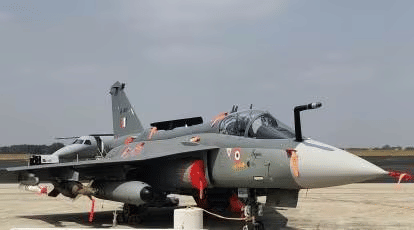
- The LCA-Mk1A will form the bulk of the force as the other jets will take time to be inducted.
- India is looking to procure an additional 97 LCA-Mk1A at an estimated cost of ₹67,000 lakh crore, making a total of 180 Mk1A variants.
LCA-Mk1A
Variants of Tejas
|
(*Click this link to read prelims specific weekly current affairs articles)
FAQs
Question: What is a Light Combat Aircraft?
Answer:
A light combat aircraft (LCA) is a light, multirole jet/turboprop military aircraft, that is designed for use in light combat missions, reconnaissance, interdiction roles or trainer roles.
Question: What is the Aeronautical Development Agency?
Answer:
Aeronautical Development Agency (ADA) was established under the DRDO to lead development and design of UAV and aeronautical systems for the defense services.
MCQs
Question: Which one of the following pairs is not correctly matched? (UPSC 2005)
(a) Arjun : Indigenously produced Main Battle Tank (MBT)
(b) Phalcon : Cruise missile supplied by Russia to India
(c) Saras : Indigenously developed civilian passenger aircraft.
(d) Operation Seabird: New Indian naval base at Karwar.
Answer: (b) See the Explanation
- Phalcon is not a cruise missile but rather an airborne early warning and control (AEW&C) system.
- It is a radar system mounted on an aircraft to detect and track aircraft, missiles, and other aerial threats.
- It was supplied to India by Israel, not Russia.
Therefore, option (b) is the correct answer.
Download the PREPP App and attempt FREE IAS Exam Mock Tests and get complete study material!
Live Test : UPSC IAS : GS - Modern History - Subject Knowledge Test

Live Test : UPSC CSE Prelims CSAT (Paper-II) (Oct 14 - 17)
Full Test - 04: UPSC CSE Prelims CSAT (Paper-II)
Full Test - 03: UPSC CSE Prelims CSAT (Paper-II)
UPSC CSE Prelims 2026 GS Paper 1 Question Paper (24-May-2026)
UPSC CSE Prelims 2026 CSAT Paper 2 Question Paper (24-May-2026)

17 February 2025 | The Hindu Must Read Articles | Current Affairs

16 February 2026 | The Hindu Must Read Articles | Current Affairs

13 February 2026 | The Hindu Must Read Articles | Current Affairs









Comments