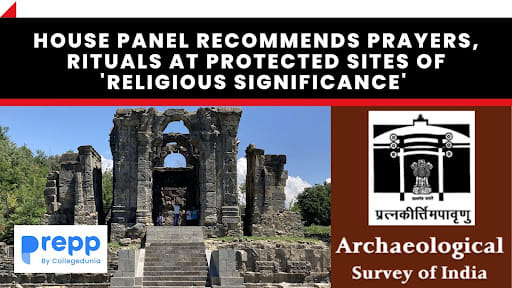
House Panel Recommends Prayers, Rituals at Protected Sites of 'Religious Significance'
Primary Source: The Indian Express
Click here for Daily Current Affairs
Why in the news?
- Recently, a parliamentary panel has recommended allowing puja and worship at Archaeological Survey of India (ASI)-protected monuments of religious significance.
- The panel suggests that permitting religious activities at such sites could fulfill the aspirations of many people.
Table of Contents
- What is the Archaeological Survey of India (ASI)?
- What is the Current Policy of Archaeological Survey of India (ASI)?
- What are the Parliamentary Committee's Recommendations?
- Response of Ministry of Culture
- Concerns of Archaeological Survey of India (ASI)
- Parliamentary Panel's Critique of Ministry
- Conclusion
- FAQs
- MCQs
What is the Archaeological Survey of India (ASI)?
- The Archaeological Survey of India (ASI) is the premier organization in India for the archaeological research and protection of the cultural heritage of the nation.
- Established in 1861, it functions under the Ministry of Culture, Government of India.
- The ASI is responsible for the archaeological studies and the preservation of the cultural heritage of the country in accordance with various acts and rules that are centered on archaeological research and the protection of cultural heritage.
- The ASI regulates all archaeological activities in the country as per the provisions of the Ancient Monuments and Archaeological Sites and Remains Act (AMASR Act) of 1958 and its Rules (1959).
What is the Current Policy of Archaeological Survey of India (ASI)?
- As per the policy, ASI permits worship and rituals only at monuments where such traditions were ongoing at the time the monument came under the agency's custody.
- This means that prayers are allowed at protected sites only if they were "functioning places of worship" when ASI took charge of them.
- For instance, the Taj Mahal is a well-known example of a living ASI monument where namaz is held every Friday.
- Other such living monuments include three mosques in Kannauj, the Roman Catholic Church in Meerut, the Nila Mosque in Delhi's Hauz Khas Village, and several Buddhist monasteries in Ladakh.
- However, according to ASI rules, no religious rituals are permitted at non-living monuments – those places where there has been no continuity of worship since they became ASI-protected sites.
- This distinction is important because, of the 3,693 centrally protected monuments and archaeological sites maintained by the ASI, less than a quarter (820) have places of worship, and the rest are considered non-living monuments where new religious rituals are not allowed.
- The Ministry of Culture has noted that, as per policy, revival of worship is not allowed where it was not in vogue at the time of protection by the ASI or has been abandoned since long.
Living Monuments
Non-living Monuments
|
What are the Parliamentary Committee's Recommendations?
- Permitting Religious Activities at Monuments: The committee suggested that the Archaeological Survey of India (ASI) should explore the possibility of allowing puja, worship, and certain religious activities at Centrally Protected Monuments of religious significance.
- This recommendation is based on the view that several historical monuments hold immense religious importance for many people, and permitting religious activities could fulfill the legitimate aspirations of these people.
- Conditions for Religious Activities: The committee recommended that any permitted religious activities should not negatively impact the conservation and preservation of the monuments.
- This condition is crucial to ensure that the historical and cultural integrity of these sites is maintained.
Response of Ministry of Culture
- While the ministry has noted the recommendation and is exploring its feasibility, it adheres to the existing policy decision that disallows the revival of worship at sites where it was not in practice at the time of the monument coming under ASI's protection or has been long abandoned.
- The ministry's stance is consistent with the ASI's rules, which permit prayers at protected sites only if they were "functioning places of worship" when ASI took charge.
- The ministry, while open to considering the committee's recommendations, remains committed to the principle that such activities should not negatively impact the conservation and preservation of the monuments.
Concerns of Archaeological Survey of India (ASI)
- Preservation and Conservation Issues: The ASI is cautious about permitting religious activities at these sites due to concerns about the potential impact on their state of conservation and preservation.
- Violation of ASI Norms: There have been instances where prayers or rituals were conducted at sites classified as 'non-living' monuments, such as the Martand Sun Temple. These actions were against ASI rules and raised concerns about setting precedents for similar violations at other sites.
- Managing 'Living' and 'Non-Living' Monuments: The ASI distinguishes between 'living' monuments (where worship was ongoing when they took over) and 'non-living' monuments (where worship was not ongoing or had been abandoned).
- Decisions to permit religious activities at 'non-living' monuments challenge this classification and create complexities in management.
- Concerns about Unauthorized Worship: There are cases of unauthorized worship at some protected monuments. These activities are against ASI rules and raise concerns about the unauthorized use of heritage sites.
Martand Sun Temple
|
Parliamentary Panel's Critique of Ministry
- The panel criticized the Ministry for providing action-taken notes on only 21 out of 35 recommendations regarding "untraceable monuments."
- The committee reiterated the need for the Ministry and ASI to conduct surveys to identify monuments in a time-bound manner.
- It also recommended that the survey results, including data on expenditure and problems surrounding the monuments, should be made public.
Conclusion
There needs to be a balance between religious aspirations and conservation. The recommendation, if implemented, could redefine the management of religiously significant monuments under ASI.
(*Click this link to read prelims specific weekly current affairs articles)
FAQs
Question: What is Archaeological Survey of India(ASI)?
Answer:
The Archaeological Survey of India (ASI) is the premier organization in India for the archaeological researches and protection of the cultural heritage of the nation. Established in 1861, it functions under the Ministry of Culture, Government of India.
Question: What is the current policy of the ASI regarding religious activities at protected monuments?
Answer:
The current policy of the ASI permits worship and religious rituals only at monuments where such traditions were ongoing at the time the monument came under the agency’s custody. This policy is aimed at preserving the historical and cultural integrity of these sites.
Question: What are the criteria for a monument to be considered a 'living monument' by the ASI?
Answer:
A 'living monument' is defined by the ASI as a site where religious practices were continuously performed up to the point when the ASI took charge of the monument. Examples include the Taj Mahal, where namaz is held, and several other religious sites across India.
MCQs
Question: With reference to Indian History, Alexander Rea, A. H. Longhurst, Robert Sewell, James Burgess and Walter Elliot were associated with: (UPSC 2023)
(a) archaeological excavation
(b) establishment of English Press in Colonial India
(c) establishment of churches in Princely States
(d) construction of railways in Colonial India
Answer: (a) See the Explanation
In 1873, James Burgess began his career as an Archaeological Surveyor for West India, having already done comprehensive surveys and compiled inventories of monuments in Bomby, Sindh, Berar, the Central Provinces, and Hyderabad.
In 1874, he first oversaw Belgaum and Kaladgi districts, then Kathiawad and Kachchha, Nizam of Hyderabad's western dominions.
When Burgess' term expired in 1879, he was granted a four-year extension. Burgess was appointed Archaeological Surveyor of South India in 1881.
Meanwhile, Robert Sewell's investigations of the Amaravati stupa, surveys of the Vijayawada area and the stupas at Amaravati and Jaggayyapeta, Chalukyan temples of Dharwar district, Alexander Rea's survey of Madurai district, monuments of Belgaum region, and Mahabalipuram monuments are among the major achievements.
Therefore, option (a) is the correct answer.
With reference to the art and archaeological history of India, which one among the following was made earliest? (UPSC 2015)
(a) Lingaraja Temple at Bhubaneswar
(b) Rock-cut Elephant at Dhauli
(c) Rock-cut Monuments at Mahabalipuram
(d) Varaha Image at Udayagiri
Answer: (b) See the Explanation
- The rock-cut Elephant at Dhauli was built during the era of Ashoka (272-231 BC).
- The Lingaraja Temple in Bhubaneswar was built in the 11th century AD.
- Rock-cut temples of Mahabalipuram date from the 7th century AD.
- The Varaha Image at Udayagiri dates from the 5th century AD.
Rock-cut Elephant
- The rock-cut elephant atop the Edicts is Odisha's first Buddhist sculpture.
- The stone elephant depicts only the animal's foreparts, yet it has an excellent sense of form and movement.
- It is one of the rare surviving examples of Mauryan art.
Lingaraja Temple
- The Lingaraj Temple, dedicated to Lord Shiva and erected in the 11th century AD, is the largest temple in Bhubaneswar.
- It is thought to have been constructed by Somvanshi King Yayati I.
- It is a superb example of Kalinga architecture.
Rock-cut Monuments at Mahabalipuram
- The Pallava ruler Narsimha created the rock-cut monuments at Mahabalipuram in the 7th and 8th century.
- The magnificence of the temple's rock-cut sculpture reflects the artistic sensibilities of the former Pallava monarchs.
Varaha Image at Udayagiri
- The renowned Varaha sculpture, which depicts the story of Bhudevi's (Earth's) salvation.
Therefore, option (b) is the correct answer.
Question: According to ASI rules, which of the following is a prerequisite for allowing prayers at its protected sites?
(a) The site must be of historical significance.
(b) Prayers are allowed if the local community demands it.
(c) The site must have been a functioning place of worship at the time of ASI taking charge.
(d) The site should be at least 1000 years old.
Answer: (c) See the Explanation
ASI's current policy allows prayers at protected sites only if they were functioning places of worship at the time the ASI took charge of them. This rule is to maintain the continuity of religious practices without compromising the historical integrity of the site.
Therefore, option (c) is the correct answer.
Download the PREPP App and attempt FREE IAS Exam Mock Tests and get complete study material!

Full Test - 04: UPSC CSE Prelims CSAT (Paper-II)
Full Test - 03: UPSC CSE Prelims CSAT (Paper-II)
UPSC CSE Prelims 2026 GS Paper 1 Question Paper (24-May-2026)
UPSC CSE Prelims 2026 CSAT Paper 2 Question Paper (24-May-2026)

17 February 2025 | The Hindu Must Read Articles | Current Affairs

16 February 2026 | The Hindu Must Read Articles | Current Affairs

13 February 2026 | The Hindu Must Read Articles | Current Affairs









Comments