Hijab Ban Amounts To Discrimination (UPSC Current Affairs)
Relevance: GS2 - Fundamental Rights
(Source: The Hindu)
Click here for Daily Current Affairs
Why in the news?
Recently, a student from Karnataka who has challenged Karnataka High Court Judgement on the prohibition on wearing a hijab to school argued in the Supreme Court during the hearing that the prohibition imposed on Muslim students from wearing hijab in classrooms is discriminatory on the ground of sex and religion.
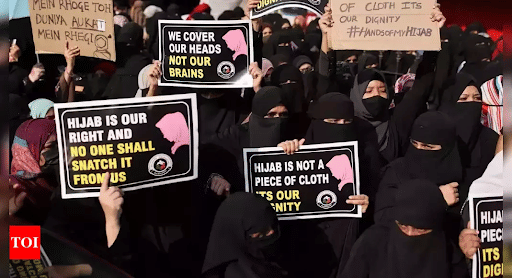
What are the arguments of the petitioner in the Hijab Case in the Supreme Court Hearing
- Violates Right to Equality: The prohibition imposed on Muslim students from wearing hijab in classrooms is discriminatory on the ground of sex and religion, which violates the Fundamental Rights under Article 14-15 and should not be viewed as disciplinary action.
- Imposes Restriction on Articles 19 and 21: The ban on the wearing of hijab in school amounts to a restriction on freedom of expression and the right to live life.
- Positive Secularism in India: India follows Positive Secularism which provides for equal treatment to all religions. Hence, the state may allow the practice of wearing hijab in school.
What is the Hijab Case?
- It is a dispute on school uniforms that erupted in Karnataka in February 2022, when some Muslim girl students of a junior college who wanted to wear hijab to classes were denied entry on the grounds that it was a violation of the college's uniform rules.
- On behalf of the aggrieved students, petitions were filed with the Karnataka High Court.
What is the Judgement of the Karnataka High Court?
- The Karnataka High Court upheld the restriction on Muslim women wearing a hijab in school stating that the right to wear a hijab is not an essential practice of religion and it is not constitutionally protected.
- The High Court held that wearing the hijab is not “religion-specific” and the aggrieved party did not present sufficient evidence to prove that wearing a hijab is an essential religious practice of Islam.
- On the arbitrary nature of the Karnataka Government's Order, the court held that the Government has the power to prescribe uniform rules as per the Karnataka Education Act, 1983 and the Rules under it.
Response to Karnataka High Court Judgement:
- The petitioner has challenged the Karnataka high court judgment in the Supreme Court on the ground of violation of Articles 14 and 15 (Right to Equality) and Article 25.
How does the Constitution protect the freedom of religion?
- The Constitution of India under Article 25 provides for the "freedom of conscience and the right to freely profess, practice, and propagate religion."
- It is a right that guarantees that the state must ensure that there is no interference or obstacle to exercising the freedom of religion.
- However, the Right to Religion under Article 25 is not sacrosanct and like all other fundamental rights, the state has the power to impose reasonable restrictions on the freedom of religion to protect public order, morality, health, and other state interests.
- The Right to Religion includes:
- Freedom of Conscience refers to an individual's inner freedom to mold his relation with God or Creatures in whatever way he desires.
- Right to Profess covers the declaration of one's religious faith and belief openly and freely.
- Right to Practice covers religious worship, rituals, ceremonies, and the exhibition of beliefs and ideas.
- Right to Propagate covers the transmission and dissemination of one's religious beliefs to others, as well as the exposition of one's religion's tenets.
What is the Essential Practice in religion pertains to?
- The question in the Hijab Case of essential practices to the religion relates to the Doctrine/ Test Of Essentiality in the religious case.
- Under the Doctrine of Essentiality, the Supreme Court has evolved a practical test to determine which religious practices are constitutionally protected and which are not, over the years.
- A seven-judge Supreme Court bench invented the notion of "essentiality" in 1954's "Shirur Mutt" case.
- It is a controversial doctrine that the court developed to ensure that only those religious practices were protected that were fundamental and important to the faith.
- The Supreme Court decided that all rituals and acts that are "integral" to a religion fall under the umbrella word "religion," and it assumed the task of identifying which religious practices are important and which are optional.
- The Constitution Bench had decided in 1994, citing the Ayodhya case, that a mosque is not a necessary component of practicing Islam and that Muslims may give namaz (prayer) anywhere, even in public.
How has the doctrine been used in subsequent years?
- Several constitutional experts have criticized the Supreme Court's "doctrine of essentiality".
- Constitutional law experts have contended that the doctrine of essentiality tends to steer the court into a realm outside of its purview and give judges the authority to make decisions that are simply religious.
- As a result, courts have ruled inconsistently on this issue over time; in some instances, they have based their decisions on religious scriptures to establish essentiality.
- Others were based on whether the practice was there at the time the religion formed, while yet others were based on the empirical behavior of adherents.
(*Click this link to read prelims specific weekly current affairs articles)
FAQs
Question: What is secularism in the Constitution?
Answer:
With the Forty-second Amendment of the Constitution of India enacted in 1976, the Preamble to the Constitution asserted that India is a secular nation. The Constitution does not recognize, it does not permit, mixing religion and state power. That is the constitutional injunction.
Question: When was the word "Secular" incorporated in the Preamble?
Answer:
By the 42nd Amendment in 1976, the term "Secular" was also incorporated in the Preamble. There is no difference of religion i.e. Hinduism, Buddhism, Jainism, Sikhism, Christianity and Islam are equally respected and moreover, there is no state religion.
Question: What is Indian secularism?
Answer:
Secularism in India, thus, does not mean the separation of religion from state. Instead, secularism in India means a state that supports or participates in a neutral manner in the affairs of all religious groups.
MCQs
Question: The words "Secular" was added to the Preamble of the Constitution of India by
(a) 38th amendment
(b) 39th amendment
(c) 40th amendment
(d) 42nd amendment
Answer: (d) See the Explanation
The 42nd Constitutional Amendment Act added the words 'Socialist, 'Secular' and 'Integrity'.
Therefore, option (d) is the correct answer.
Question: Secularism means
(a) The State is to give patronage to any one religion.
(b) Respect all religions without favoring any one religion.
(c) Lacking religious emotion, doctrines, and practices.
(d) To impose any particular religion upon the rest of the people.
Answer: (b) See the Explanation
Secularism is the principle of separation of the state from religious institutions.
- It also involves giving respect to all religions without favoring any one religion.
- The preamble of the Constitution of India mentions Secularism as one its Objective.
- The Supreme Court has also termed it as one of the Basic Structures of the Constitution of India.
Therefore, option (b) is the correct answer.
Download the PREPP App and attempt FREE IAS Exam Mock Tests and get complete study material!

Full Test - 04: UPSC CSE Prelims CSAT (Paper-II)
Full Test - 03: UPSC CSE Prelims CSAT (Paper-II)
UPSC CSE Prelims 2026 GS Paper 1 Question Paper (24-May-2026)
UPSC CSE Prelims 2026 CSAT Paper 2 Question Paper (24-May-2026)

17 February 2025 | The Hindu Must Read Articles | Current Affairs

16 February 2026 | The Hindu Must Read Articles | Current Affairs

13 February 2026 | The Hindu Must Read Articles | Current Affairs









Comments