Heterodox Schools of Indian Philosophy - Art and Culture Notes
The Heterodox school of philosophy, often known as the Nastika school, denies the Vedic notion of authority. Charvaka (Brihaspati), Jainism, and Buddhism are regarded as heterodox schools of thought since they do not recognise the authority of the Vedas as the orthodox system of philosophy. Here we will discuss the features of Heterodox schools and their different sub-schools, which will be helpful in UPSC CSE preparation.
|
Table of Contents |
Heterodox School
- Heterodox (nastika) Hindu philosophy schools do not acknowledge the authority of the Vedas.
- They do not believe in the originality of the Vedas and question the existence of God.
- It is also known as Nastika school.
- This orthodox-heterodox distinction is a Western language construct that has no scholarly basis in Sanskrit. (These are orthodox (astika) Hindu philosophy schools that recognise the authority of the Vedas;)
- Heterodox Schools are divided into three major sub-schools:
- Buddhist Philosophy
- Jainism Philosophy
- Charvaka School or Lokayata Philosophy
- The belief in a doctrine that departs from the norm is referred to as heterodoxy.
- In certain cases, the civil power has supported religious authorities, while in others, it has remained neutral or indifferent.
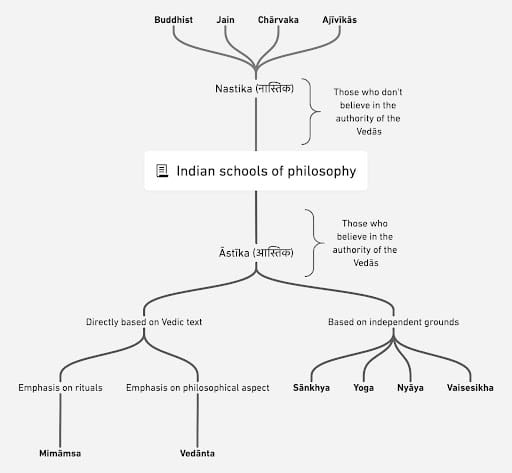
Indian Schools of Philosophy
|
|
|
|---|---|
| Nyaya School | Vaisheshika School |
| Orthodox Schools | Mimamsa School |
| Samkhya School | Vedanta School |
| Yoga School | Charvaka School or Lokayata Philosophy |
Buddhist Philosophy
- The founder of this school is said to be Gautama Buddha, who was born in 563 BCE in Lumbini, Nepal's foothills.
- He had life-changing experiences, and by the age of 29, he had renounced the world to seek the truth of life.
- While meditating under a pipal tree in Bodhgaya, he is said to have found salvation.
- He spent his life traveling and helping people find salvation and freedom from the trappings of this life from then until his death at the age of 80.
- After his death, his disciples convened a council at Rajagriha, where the fundamental teachings of Buddhism were codified. They were as follows:
- Vinaya Pitaka (Rules of order for Buddhists) - Written by Upali
- Sutta Pitaka (Buddha’s sermons and doctrines) - Written by Ananda
- Abhidhamma Pitaka (Buddhist Philosophy) - Written by Mahakashyap
- According to Buddhist philosophy, the traditional teachings instilled in the Vedas may not be useful for humans to achieve salvation, and one should not blindly trust them.
- Following his life experiences, Buddha realized that the world is full of misery and that every human being should strive for liberation by realising the four noble truths.
- First, there is suffering in human life, which manifests itself in the form of sickness, pain, and death. Even the circle of life and death is painful. Separation from one's beloved causes pain in humans as well.
- Second, desire is the root cause of all suffering.
- Third, he advises man to destroy the materialistic passions, desires, and love that govern his life. The annihilation of these passions, attachments, jealousy, sorrow, doubt, and ego would mean the end of sorrow and pain in human life. This will result in complete peace and nirvana.
- Finally, one must move away from the constant suffering and pessimism that dominates an individual's life and toward liberation and optimism.
- According to Buddhist philosophy, the path to liberation (nirvana) is comprised of eight steps. This is the path to take:
- Right Vision: This path ensures that people's visions are free of ignorance.
- One should consider one's relationship with the world to be a transient one, and thus strive for salvation and to break free from the cycle of rebirth.
- Right, Resolve: To walk this path, one must cultivate strong willpower to destroy desires, passions, and ill thoughts that would harm oneself and others.
- Sacrifice, sympathy, and kindness to others should all be practiced.
- Right Speech: This is related to the preceding path of controlling one's speech through right speech cultivation. One should not speak ill of others or criticize them.
- Right Conduct: One should try to avoid all activities that are harmful to one's life. A man should begin to abandon his desire for materialistic things.
- Right Ways of Earning a Living: This path advises men to avoid using unfair means to earn a living. They should not engage in deception, theft, or bribery.
- Right Effort: Man should make an effort to avoid negative feelings and impressions. Anything that diverts a person's attention away from the path to salvation should be avoided.
- Right Mindfulness: It is necessary to maintain one's body, mind, and health in good working order. When the body is out of alignment, one experiences negative thoughts, which lead to erroneous actions and, eventually, pain.
- Right Concentration: If any human being follows the seven paths mentioned above, he will be able to concentrate correctly and achieve salvation or nirvana.
- Right Vision: This path ensures that people's visions are free of ignorance.
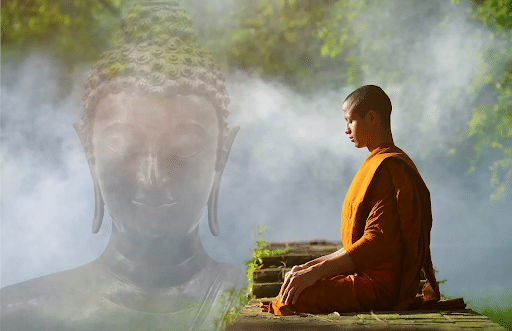
Buddhism: Heterodox School Philosophy
Jain Philosophy
- Rishabha Deva, a Jain tirthankar or wise person, was the first to develop Jain philosophy. He was one of the Jain religion's 24 tirthankaras (rulers).
- The first to realise that the Adinath was the source of all Jain philosophy was one of them. Aristanemi and AjitNath were also important in developing and disseminating Jain philosophy.
- The Jains, like Buddhists, oppose the primacy of Vedas in achieving salvation.
- They also contend that man is surrounded by pain and that controlling one's mind and regulating one's behavior can alleviate human suffering.
- They contended that a man should be able to control his mind by seeking correct perception and knowledge.
- He would be able to continue on the path of salvation if he was accompanied by appropriate behaviour.
- If a man wishes to be liberated from the cycle of birth and death on Earth, he should practise brahamcharya, or celibacy, according to Jain's philosophy.
- They believed that all natural and supernatural things in the universe are made up of seven fundamental elements: jiva, ajivaa, asrava, bandha, samvara, nirjara, and moksha.
There are two kinds of existences:
- One, Astikaya, or something with a physical shape, such as a body. It has the ability to embrace and envelop a person.
- Second, Anastakiya, or that which has no physical form, such as 'time.'
- According to Jain philosophy, everything that has a substance is called dharma. These substances serve as the foundation for the qualities that an object or man possesses.
- Furthermore, while the substance is eternal and unchanging, the qualities or attributes are constantly changing.
- For example, consciousness is the soul's substance, but one can be happy or sad depending on one's mood; this 'mood' is the attribute that changes.
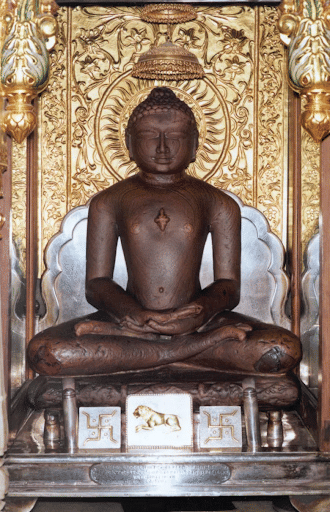
Jainism: Heterodox School Philosophy
Charvaka School or Lokayata Philosophy
- Brihaspati laid the groundwork for this school, which was supposed to be one of the first to develop a philosophical theory.
- The philosophy dates back to the Vedas and the Brihadaranyaka Upanishad.
- The Charvaka School was a major proponent of the materialistic approach to salvation.
- Because it was aimed at the common people, the philosophy was quickly dubbed Lokayata or something derived from the common people.
- Direct perception was accepted as the most reliable technique of proving the truth of anything. Insists on having a happy life.
- Charvaka, the author of the Barhaspatya Sutras in the fourth and fifth century B.C., was its founder.
Charvaka School
*For detailed notes of this topic, check this link Charvaka School or Lokayata Philosophy
Ajivika School
- Ajivika Philosophy is a similar philosophy that is classified as unorthodox by some.
- The ajivikas might have just been a loosely structured band of travelling ascetics (shramanas or sannyasins).
- Makkhali Gosala and Sanjaya Belatthaputta were two of its most notable members.
- This was a Mahajanapada era ascetic movement on the Indian subcontinent.
- Original texts of the Ajivika school of philosophy may have existed in the past, but they are now inaccessible and most likely lost.
- Their beliefs are based on references to Ajivikas in secondary sources of ancient Indian literature, notably those of Jainism and Buddhism, both of which polemically denounced the Ajivikas.
- The Ajivika school is famous for its Niyati philosophy of total determinism (fate), which holds that there is no free choice and that everything that has occurred, is occurring, or will happen is fully predetermined and a result of cosmic laws.
- Ajivika saw the karma idea as a logical error.
- Ajivika were atheists who denied the authority of the Vedas, but they believed in the existence of a tman in all living beings, which is a basic tenet of Hinduism and Jainism.
Ajnana School
- Ajnana was an ancient school of radical Indian scepticism and one of the nastika or "heterodox" schools of ancient Indian philosophy.
- It was a Sramana movement that competed with early Buddhism, Jainism, and the Ajivika school.
- They are documented in Buddhist and Jain scriptures.
- They believed that obtaining knowledge of metaphysical nature or determining the truth value of philosophical statements was impossible, and that even if information could be obtained, it was meaningless and detrimental to eventual salvation.
- They concentrated in rebuttal rather than promoting any positive philosophy.
- Sanjaya Belatthiputta was a significant supporter of this school of thinking.
Conclusion
Unorthodox (nastika) systems or heterodox schools are those that do not acknowledge the authority of the Vedas. These schools are also significant in India's philosophical tradition. The term "Indian Philosophy" refers to the orthodox and heterodox intellectual traditions of the subcontinent. Every school of thought in India believed in karma and reincarnation, and moksha was described as deliverance from the cycle of births and deaths.
FAQs
Question: What are the Heterodox schools of Indian philosophy?
Answer: The Heterodox schools of Indian philosophy refer to those schools that did not accept the authority of the Vedas. These include Buddhism, Jainism, and the Carvaka school. They offered alternative viewpoints on metaphysics, ethics, and epistemology, often diverging from the Vedic traditions.
Question: How do Heterodox schools differ from Orthodox schools?
Answer: Heterodox schools, such as Buddhism and Jainism, do not recognize the authority of the Vedas and often reject the caste system inherent in Vedic traditions. In contrast, Orthodox schools (Astika) like Vedanta, Nyaya, and Mimamsa accept the Vedas as supreme and adhere to the social structures and rituals prescribed by them.
Question: What is the main focus of Buddhist philosophy?
Answer: Buddhist philosophy primarily focuses on the Four Noble Truths and the Eightfold Path, emphasizing the cessation of suffering (Dukkha) through ethical conduct, mental discipline, and wisdom. It promotes the concept of impermanence (Anicca) and the doctrine of no-self (Anatta).
Question: What are the key teachings of Jain philosophy?
Answer: Jain philosophy emphasizes non-violence (Ahimsa), non-possessiveness (Aparigraha), and the principle of multiple perspectives (Anekantavada). It advocates strict asceticism and believes in the cycle of birth, death, and rebirth, with liberation (Moksha) achievable through self-discipline and renunciation.
Question: What is the Carvaka school known for?
Answer: The Carvaka school is known for its materialistic and atheistic beliefs. It rejects the existence of an afterlife, deities, and the spiritual aspects of life, emphasizing that only perception is a valid means of knowledge. Carvaka advocates that pleasure is the only purpose of life.
MCQs
1. Which of the following schools is considered a Heterodox school of Indian philosophy?
A) Vedanta
B) Samkhya
C) Buddhism
D) Nyaya
Answer: (C) See the Explanation
Explanation: Buddhism is classified as a Heterodox school because it does not accept the authority of the Vedas and offers an alternative approach to philosophy and spirituality.
2. Which of these concepts is not associated with Jain philosophy?
A) Ahimsa
B) Anekantavada
C) Nirvana
D) Brahman
Answer: (D) See the Explanation
Explanation: Brahman is a concept associated with Hindu Orthodox schools like Vedanta. Jain philosophy does not discuss Brahman; it focuses instead on principles like Ahimsa, Anekantavada, and achieving Moksha.
3. What is the primary belief of the Carvaka school?
A) The cycle of rebirth
B) Ascetic practices
C) Materialism and perception
D) Vedic rituals
Answer: (C) See the Explanation
Explanation: The Carvaka school is known for its materialistic beliefs and holds that perception is the only valid source of knowledge, rejecting other spiritual or religious practices.
4. Which of the following teachings is central to Buddhism?
A) Caste hierarchy
B) Four Noble Truths
C) Anekantavada
D) Vedic hymns
Answer: (B) See the Explanation
Explanation: The Four Noble Truths are central to Buddhist teachings, outlining the nature of suffering and the path to its cessation through the Eightfold Path.
5. Which of these schools emphasizes non-violence as a core teaching?
A) Nyaya
B) Vedanta
C) Carvaka
D) Jainism
Answer: (D) See the Explanation
Explanation: Jainism strongly emphasizes non-violence (Ahimsa) as one of its central tenets, promoting peaceful and ethical living.
GS Mains Questions and Model Answers
Q1: Compare and contrast the core beliefs of Buddhism and Jainism as Heterodox schools of Indian philosophy.
Answer: Buddhism and Jainism, as Heterodox schools, diverge from Vedic traditions and share some similarities but also significant differences. Both reject the authority of the Vedas, emphasize ethical conduct, and advocate for liberation from the cycle of rebirth. However, while Buddhism promotes the concept of Anicca (impermanence), Anatta (no-self), and the Middle Path, Jainism emphasizes strict asceticism, Ahimsa (non-violence), and Anekantavada (multiple perspectives). The means to attain Moksha in Jainism are through self-mortification and renunciation, whereas Buddhism focuses on meditation, wisdom, and following the Eightfold Path. These differences highlight their distinct approaches to achieving enlightenment and their impacts on Indian society and culture.
Q2: Explain the significance of the Carvaka school in the context of Indian philosophical thought.
Answer: The Carvaka school, known for its materialistic and atheistic perspective, plays a unique role in Indian philosophical thought as a counterpoint to spiritual and religious philosophies. It rejected the metaphysical elements and emphasized direct perception as the only reliable means of knowledge, challenging the dominance of spiritual dogma and the concept of an afterlife. Carvaka’s focus on hedonism and practical enjoyment of life served as a critique of the ascetic and ritualistic practices prevalent in Vedic and post-Vedic traditions. This school highlights the diversity of philosophical thought in ancient India, illustrating the presence of rational and skeptical inquiry alongside spiritual beliefs.
Q3: Discuss how the Heterodox schools of Indian philosophy contributed to the social and ethical discourse in ancient India.
Answer: The Heterodox schools, particularly Buddhism and Jainism, contributed significantly to the social and ethical discourse in ancient India. By rejecting the Vedas and the rigid caste system, they provided alternative paths that emphasized personal ethical conduct, equality, and non-violence. Buddhism’s teachings, centered on the Four Noble Truths and the Eightfold Path, promoted compassion and moral discipline as ways to alleviate human suffering. Jainism’s principles of Ahimsa and Aparigraha influenced societal norms toward non-violence and minimalism. These schools challenged prevailing norms and practices, encouraging a shift towards more inclusive and humane values. Their contributions laid the groundwork for later social reforms and philosophical debates that shaped Indian culture and ethics.
Previous Year Questions on Heterodox Schools
1. UPSC CSE Prelims 2020:
Question: Which of the following Indian philosophical schools is materialistic and does not believe in an afterlife?
A) Vedanta
B) Carvaka
C) Samkhya
D) Nyaya
Answer: (B)
Explanation: The Carvaka school is known for its materialistic philosophy, rejecting spiritual and religious practices, and denying the existence of an afterlife.
2. UPSC CSE Mains 2018 (GS Paper 1):
Question: "Evaluate the impact of the Heterodox schools of Indian philosophy on ancient Indian society and its subsequent philosophical developments."
Answer: The Heterodox schools, including Buddhism, Jainism, and Carvaka, significantly influenced ancient Indian society by challenging the prevailing Vedic orthodoxy. They provided alternatives to the hierarchical caste system, promoting ethical behavior and spiritual equality. Buddhism’s Middle Path inspired a more balanced approach to spirituality, while Jainism’s commitment to non-violence reshaped social norms. The Carvaka school introduced a critical lens to philosophical discourse, emphasizing reason over ritual. These schools laid a foundation for the diverse philosophical traditions of India, influencing subsequent movements like Bhakti and contributing to the pluralistic nature of Indian thought.
Download the PREPP App and attempt FREE IAS Exam Mock Tests and get complete study material!

Live Test : UPSC CSE Prelims CSAT (Paper-II) (Oct 20 - 23)
Full Test - 04: UPSC CSE Prelims CSAT (Paper-II)
Full Test - 03: UPSC CSE Prelims CSAT (Paper-II)
UPSC CSE Prelims 2026 GS Paper 1 Question Paper (24-May-2026)
UPSC CSE Prelims 2026 CSAT Paper 2 Question Paper (24-May-2026)

17 February 2025 | The Hindu Must Read Articles | Current Affairs

16 February 2026 | The Hindu Must Read Articles | Current Affairs

13 February 2026 | The Hindu Must Read Articles | Current Affairs









Comments