Harvest The Odisha Story To Ensure Food Security
(Source: The Hindu, 12/12/2023)
Click here for Daily Current Affairs
Why in the news?
- This article discusses the Odisha model of food security which is based on equity and sustainability.
- From being a major importer of food grains, Odisha is now the fourth most significant contributor to the paddy pool of the Food Corporation of India.
- The Odisha Chief Minister cited Odisha’s commitment to achieving the ‘Zero Hunger’ goal at the United Nations World Food Programme headquarters.
Table of Contents
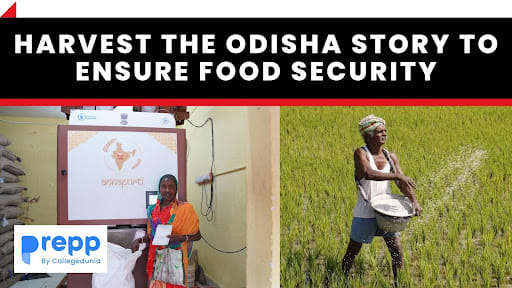
Agricultural transformation in Odisha
- Over the last two decades, Odisha has transitioned from being an intensive importer of rice (pre-2000s) to producing record crop outputs (13.6 million tonnes in 2020).
- The average rice yield in Odisha has nearly tripled between 2000 (10.41 quintals per hectare) and 2020 (27.3 quintals per hectare).
- Kalahandi, which was earlier known as the land of hunger, has transformed into the rice bowl of the state.
- Consistent improvements in the agricultural sector in Odisha have made the state surplus in paddy production.
- Odisha is now the fourth most significant contributor to the paddy pool of the Food Corporation of India.
- In 2020-21, Odisha accounted for 9% of the total rice in India and 4.22% of the total food-grain production in India.
- Highlights:
- Majority of farmers are small or marginal farmers
- Increase in productivity despite stable crop area
- Odisha has focused on small and marginal farmers intending to improve their income.
- As a result of the enhanced income, resilient livelihoods have been created and food security improved in the region.
- The implementation of flagship schemes like KALIA (Krushak Assistance for Livelihood and Income Augmentation) has helped increase the cultivation of non-paddy crops by raising awareness about scientific crop management practices.
- The Odisha Millet Mission has also contributed to improved climate resilience and crop productivity.
- Crop diversification has been accompanied by a reduction in the area under paddy cultivation.
KALIA
Benefits
To learn more, click the link. |

Resilience and sustainability
- Odisha has developed a comprehensive Climate Change Action Plan to address its vulnerability to climate change.
- Odisha is particularly vulnerable to climate change on account of its geographical location and physical conditions.
- Concerns associated with climate change:
- Disruption of presently used strategies
- Exacerbate poverty
- Loss of life and livelihoods
- Destruction of assets and infrastructure
- The Climate Change Action Plan was developed by an expert team from multiple departments with input from civil society.
- The activities identified in the plan are implemented by various departments and agencies and monitored by a committee headed by the Chief Secretary.
- It covers various sectors such as agriculture, coastal zone protection, energy, fisheries and animal resources, forests, health, industries, mining, transport, and urban and water resources.
- Approach towards climate resilience: It has adopted a bottom-up approach towards climate resilience.
- This approach assists the authorities in adopting necessary measures in adverse weather conditions like cyclones, floods, and droughts, which are frequent in the State.
- The Crop Weather Watch Group conducts weekly meetings, oversees field visits by officers, and organizes video conferences to monitor the crop program.
- Crop planning is done at the district level by officials of allied departments based on the agro-climatic zone.
- Climate resilient practices adopted by farmers:
- Integrated farming
- Zero-input-based natural farming
- Adoption of non-paddy crops,
- Improved water management and adoption of water-saving devices,
- E-pest surveillance
- Large-scale farm mechanization including the adoption of farm implements that are women-friendly.
- In addition to these climate-resilient techniques, farmers have been provided training in crop-specific techniques to boost food grain production such as integrated nutrient and pest management.
Social protection
- According to estimates, the frequency of occurrence of disasters could increase to 1.5 per day in 2024, i.e 560 disasters per year.
- Unchecked climate change could drive hunger and malnutrition by 20% while food productivity is predicted to fall by 21% due to global warming,
- The Government of Odisha has partnered with the UN World Food Programme to develop innovative pilot schemes for improving food and nutrition security.
- For example, the application of biometric technology in the Targeted Public Distribution System in the Rayagada district in 2007 and rice fortification in the Gajapati district.
- The WFP and the government of Odisha collaborate on numerous food security, livelihood, and climate resilience initiatives.
- Odisha was ranked the top-performing state in the country on the State Ranking Index for the National Food Security Act in 2022.
World Food Programme (WFP)
|

Conclusion
- Odisha’s transition from foodgrain scarcity to surplus driven by sustained efforts in climate-proofing its agricultural system, crop diversification, protection of smallholders, and food and nutrition security for the vulnerable is a unique and emulatable developmental model amid the complexities presented by climate change.
- The spiraling global food crisis caused by the climate crisis, conflicts, and distress means the Odisha developmental model could be adopted to ensure food security and climate adaptation through equity and sustainability.
(*Click this link to read prelims specific weekly current affairs articles)
FAQs
Question: What are the SDGs?
Answer:
The Sustainable Development Goals (SDGs) are a set of 17 global goals established by the United Nations in 2015 as part of the 2030 Agenda for Sustainable Development. They provide a comprehensive framework for addressing social, economic, and environmental challenges to achieve a sustainable future for all.
Question: What is the UN Development Programme?
Answer:
The UNDP is a UN agency responsible for helping countries eliminate poverty and achieve sustainable growth and development. It was established in 1966 by the General Assembly of the United Nations. It is funded entirely by voluntary contributions from member nations and is headquartered in New York, USA.
UPSC Mains Practice Question:
|
MCQs
Question: “System of Rice Intensification” of cultivation, in which alternate wetting and drying of rice fields is practiced, results in
- Reduced seed requirement
- Reduced methane production
- Reduced electricity consumption
Select the correct answer using the code given below: (UPSC CSE 2023)
(a) 1 and 2 only
(b) 2 and 3 only
(c) 1 and 3 only
(d) 1, 2 and 3
Answer: (d) See the Explanation
- The System of Rice Intensification involves cultivating rice with as much organic manure as possible. It involves the use of young seedlings which are planted singly at a wider spacing in a square pattern; intermittent irrigation that keeps the soil moist but not inundated, and frequent inter-cultivation with a weeder that actively aerates the soil.
- System of Rice Intensification (SRI) includes a method called Alternate Wetting and Drying (AWD) which is a form of controlled or intermittent irrigation of the rice crops.
- The benefits and impacts, of the SRI include:
- To increase paddy yields usually by 20-50% and sometimes up to 100%
- It reduces required seeds for transplanting by 60-80%. Hence, option 1 is correct.
- The electricity consumption will be less as it enables reduced use of chemical fertilizers and agrichemicals and reduced use of irrigation water by 25-50%. Hence Option 3 is correct.
- By stopping flooding and relying mostly on organic fertilization, methane emissions are greatly reduced without offsetting increases in nitrous oxide. Hence, option 2 is correct.
- Oxford researchers in India found a 30% reduction in net greenhouse gas emissions with SRI, compared with current practice, and more than 50% reduction in greenhouse gas emissions per kilogram of rice produced.
Therefore, option (d) is the correct answer.
Question: Consider the following states : (UPSC CSE 2019)
- Chattisgarh
- Madhya Pradesh
- Maharashtra
- Odisha
With reference to the states mentioned above, in terms of the percentage of forest cover to the total area of the State, which one of the following is the correct ascending order?
(a) 2-3-1-4
(b) 2-3-4-1
(c) 3-2-4-1
(d) 3-2-1-4
Answer: (c) See the Explanation
- In terms of percentage of forest cover:
- Madhya Pradesh: (25%), Odisha: (31%), Chattisgarh: (42%), and Maharashtra: (15%).
Therefore, option (c) is the correct answer.
Download the PREPP App and attempt FREE IAS Exam Mock Tests and get complete study material!

Full Test - 04: UPSC CSE Prelims CSAT (Paper-II)
Full Test - 03: UPSC CSE Prelims CSAT (Paper-II)
UPSC CSE Prelims 2026 GS Paper 1 Question Paper (24-May-2026)
UPSC CSE Prelims 2026 CSAT Paper 2 Question Paper (24-May-2026)

17 February 2025 | The Hindu Must Read Articles | Current Affairs

16 February 2026 | The Hindu Must Read Articles | Current Affairs

13 February 2026 | The Hindu Must Read Articles | Current Affairs









Comments