Gupta Administration - Ancient India History Notes
Gupta Empire covered much of the Indian subcontinent between 319 and 467 CE had top to bottom administrative hierarchy. The highest authority in the Gupta dynasty was the king, vested with political, military, and judicial powers. In this article, we will discuss Gupta Administration which will be significant in understanding the administrative structure of Gupta empire which is part of for UPSC Civil services exam syllabus.
|
Table of Contents |
Gupta Empire in brief
- The Gupta Empire, one of the most influential dynasties in ancient Indian history, thrived during the Golden Age of India from the early 4th century CE to the early 6th century CE.
- Founded by Gupta, the empire reached its zenith between 319 and 467 CE, covering a significant portion of the Indian subcontinent. The Gupta rulers, particularly Chandragupta I, Samudragupta, Chandragupta II, and Skandagupta, played pivotal roles in shaping the empire's success.
- This period is often regarded as the Golden Age due to the remarkable advancements in various fields, including art, science, literature, and philosophy.
- The Gupta Empire witnessed a flourishing of Indian culture, marked by significant achievements in literature, particularly evident in the works of the renowned Sanskrit poet Kalidasa.
- However, like many empires, the Gupta Empire eventually declined, with factors such as invasions, internal conflicts, and economic challenges playing a role in its downfall.
- Despite its eventual decline, the legacy of the Gupta Empire left an indelible mark on the cultural and intellectual heritage of ancient India.
- The empire, known by various names such as Rajya, Rashtra, Desha, Mandala, Prithvi, and Avani, exhibited a complex system of provinces and subdivisions.
- It was divided into 26 provinces, which were styled as Bhukti, Pradesha and Bhoga.
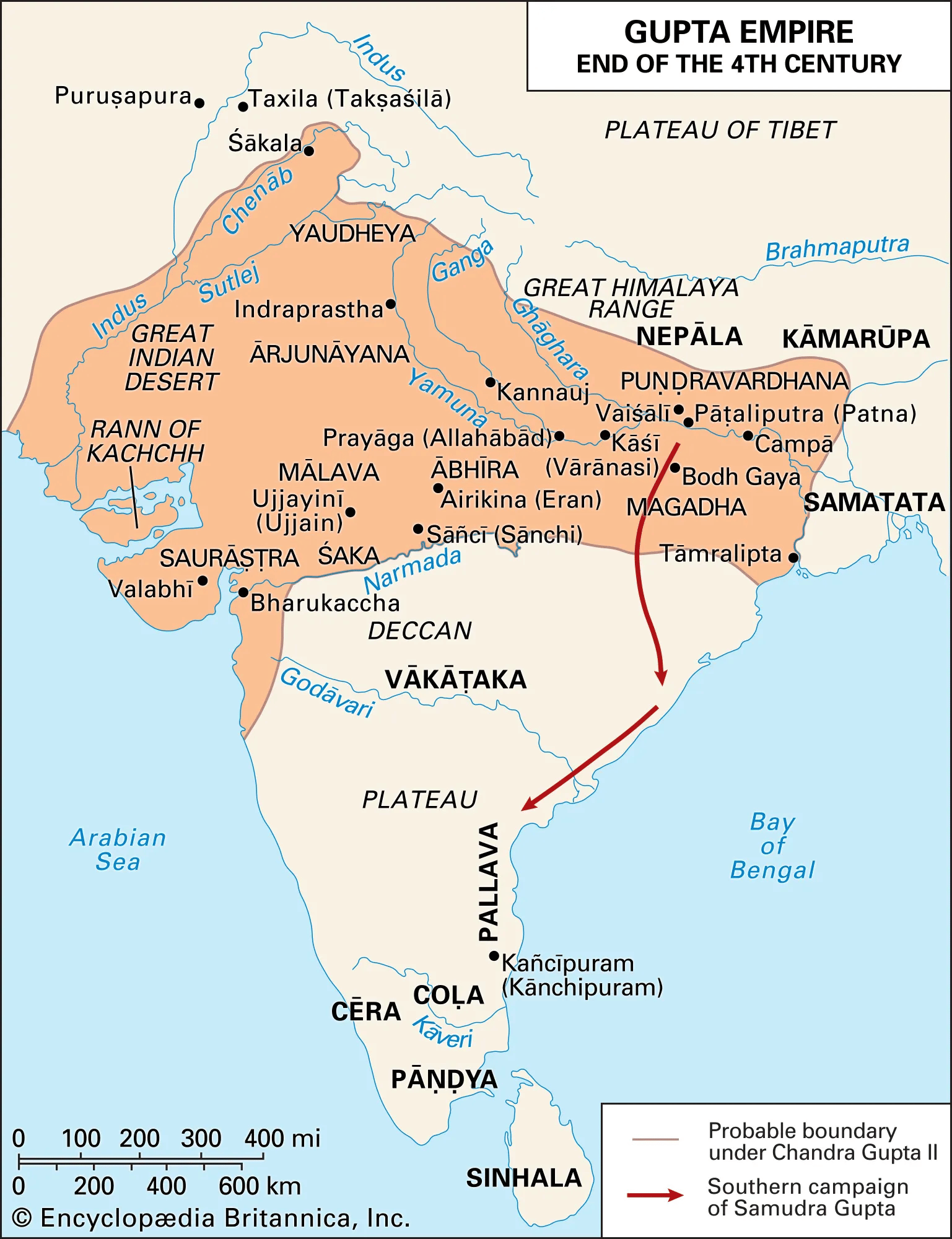

Gupta Administration - Features
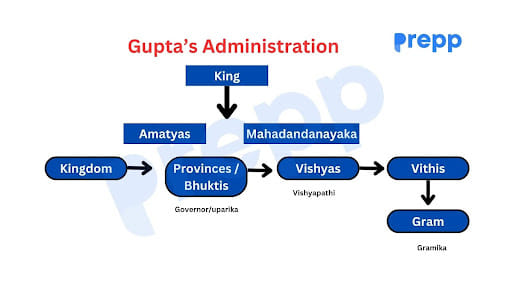
King as highest authority
- The highest authority in the Gupta dynasty was the king, vested with political, military, and judicial powers. (Monarchy was the dominant form).
|
Use of divine titles:
Claims of divine status:
|
- The authority of the king was checked by the council of ministers known as mantri parishad., who advised the king to follow Rajya Dharma.
- Mantri Parishad: Ministerial council was called Mantri Parishad. It was made up of high-ranking officials (Amatyas)such as the kumaramatya and the sandhivigrahika.
- The Gupta Empire was divided into Rajya, Rashtra, Desha, and Mandala. With these decentralized administrative divisions; the Guptas were able to command their domains efficiently. Under them, the northern territories of India were consolidated under one political entity.
Administrative divisions and governing Officers
|
Bhuktis (Governed by Uparika) -> Vishyas (Governed by Ayuktas or Vishyapatis)-> Vithis (Governed by Vithi) ->Gram (Governed by Gramika) |
Provincial administration
- Bhuktis:
- The empire was divided into provinces called 'bhuktis'.
- Each bhukti was administered by a provancial governor 'uparika', who was appointed by the king
- The king directly appointed the uparika, who in turn frequently appointed the district administration and the district board.
- Uparika continued to rule "with the enjoyment of the rule consisting of elephants, horses, and soldiers," implying control over military machinery as well.
- The uparika's use of the title maharaja on three Damodarpur plates indicates his high status and position in the administrative hierarchy.
- The bhuktis were further classified as 'Vishyas'.
District Administration
- Vishayas:
- 'Vishayas', were overseen by a Vishayapati.
- Vishayapatis were appointed by the provincial governor or, in some cases, the king himself to control the vishayas.
- The Vishayapati was responsible for maintaining law and order, collecting taxes, and overseeing local administration.
- The vishyapatis were sometimes directly appointed by the kings. The vishyapati was assisted in administrative duties by prominent members of the town.
- Lokpala:
- The Budhagupta Eran pillar inscription, dated Gupta year 165 CE, refers to Maharaja Surashmichandra as a lokpala, ruling over the land between the Kalinndi and Narmada rivers.
- Lokpala appears to be a provincial governor in this context.
Administrative Unit Below district level
- Clusters of settlements known as vithi, bhumi, pathaka, and peta were the administrative units below the district level.
- Vithis: Multiple villages were grouped into ‘Vithis’,sub-dristricts or modern day blocks.
- Gram: The bhuktis were further classified as villages 'Gram'.The village administration was overseen by the village headman ‘Gramika’. Unlike the Mauryan period, the administration in the Gupta period appears to have been managed from the ground up.
- At the local level, the administration was carried out by village councils or Grama Sabhas. These councils were responsible for managing local affairs, resolving disputes, and ensuring the well-being of the community.
- There are references to officials known as ayuktakas and vithi-mahattaras. Villagers elected functionaries such as gramika and gramadhyaksha.
- The Damodarpur copper plate from the reign of Budhagupta mentions an ashtakula-adhikarana (a board of eight members) headed by the mahattara.
- Mahattara has several meanings, including village elder, village headman, and head of a family community.
- The panchmandali, which may have been a corporate body, is mentioned in a Sanchi inscription from the time of Chandragupta II.
Administration in cities
- The administration of the cities was assigned to a Parishad headed by Nagararakshaka, who was subordinate to Purapala Uparika. The Avasthika was the superintendent of Dharamsalas.
- From the Damodarpur copper plate, we get information about the local administration of the Guptas.
- The district headquarters was Adhisthanas, and the court at this level was Adhikarnas.
- The information on the administration at the Vithi level is provided in the Kalaikuri inscription. Some inscriptions from the time of the Skandagupta also tell us about the administration of that period.
Centralized Administration - Ministers and Other Officials
- The authority of the king was checked by the council of ministers known as mantri parishad., who advised the king to follow Rajya Dharma.
- Mantri Mukhya - Prime Minister
- Sandhivigrahika - Minister in Charge of Peace and War who was in charge of contact and correspondence with other states, including initiating wars and concluding alliances and treaties.
- Akshapataladhikrita - Minister in Charge of Records
- Mahabaladhikrita - Minister in Charge of the Military
- Mahadandanayaka or Dandanayaka - Senior Judicial
- The Allahabad prashasti refers to the Sabha, a ministerial assembly or council.
- High-ranking officials were referred to as dandanayakas, while mahadandanayakas were high-ranking judicial or military officers.
- One of the seals mentions a mahadandanayaka named Agnigupta. The Allahabad prashasti refers to three mahadandanayakas. All of this suggests that these positions were hereditary in nature.
- Another person was given the title mahashvapati (commander of the cavalry), indicating military duties.
- Official ranks and designations are mentioned on seals and inscriptions, but their precise meaning is often unknown.
Kumaramatya
|
Revenue Administration
- The Gupta rulers implemented a sophisticated revenue system to ensure economic stability.
- The land revenue, known as Bhaga, was collected from the peasants and was usually one-sixth or one-fourth of the agricultural produce.
- The revenue administration was overseen by officers known as Samahartas or revenue collectors.
- besides Bhaga other taxes during the period were terms Bhoga, Kara, and Sulka.
- Udranga was a fixed tax (Kathiawad copper plate dated towards the end of the 6th century C.E informs us that the professions related to cloth, armor, dye, weaving, and shoemaking were taxed).
- The taxes paid in cash were known as Hiranya.
- It is generally believed that the common man was overloaded with taxes.
- In the absence of cash salaries, land grants with hereditary rights were given to various administrators in this period.
- Largely, the Brahmins who received lands were exempted from paying their taxes.
- A large number of wastelands were brought under cultivation during this period. The rulers of this period also focused on irrigation methods to increase production.
Judicial Administration
- The judicial system in the Gupta Empire was based on the principles of Dharma, and justice was dispensed through a well-organized legal system.
- The king was the ultimate authority, but local judges known as Dharmadhyakshas presided over legal matters at the district level.
- The legal system aimed to ensure fairness and uphold the principles of righteousness.
- Vaishali seal mentions the dandapashika's adhikarana (office), which could have been a district-level police station.
Military administration
- Military designations like baladhikrita and mahabaladhikrita (commander of infantry and cavalry) are mentioned on seals and inscriptions.
- The term "senapati" does not appear in Gupta inscriptions, but it may appear in some Vakataka epigraphs.
- The ranabhandagar-adhikarana, or military storehouse office, is mentioned on a Vaishali seal.
- The mahapratiara (chief of the palace guards) and the khadyatapakita(superintendent of the royal kitchen) were two officials specifically connected with the royal establishment.
- A Vaishali seal refers to a person as a mahapratihara as well as a taravara. The administrative structure's top layer also included amatyas and sachivas, who were executive officers in charge of various departments.
- Spies known as dutakas were part of the espionage system. Another group of high-ranking officers were the ayuktakas.
Conclusion
Gupta Empire's administrative structure was characterized by a centralized hierarchy, with the king as the highest authority. Provinces, districts, and villages were efficiently governed through appointed officials, ensuring effective control over the vast territories. This administrative model, marked by decentralization and institutionalized practices, left a lasting impact on the subsequent periods of Indian history. The decentralization of power allowed for effective governance at various levels, and the emphasis on justice, economic management, and military strength contributed to the Gupta Empire's success during this period in Indian history.
|
|
|
|---|---|
| Ancient History Notes | Gupta Age |
| Mauryan age | Different Indian Dynasties |
| The Indian Notational System | Science and Technology in Ancient India |
FAQs
Question: How was the Gupta administration organized at the provincial level?
Answer: The Gupta Empire was divided into provinces or Bhuktis, each governed by an Uparika or provincial governor. The provinces were further subdivided into districts known as Vishayas, administered by a Vishayapati.
Question: What role did the king play in the Gupta administration?
Answer: The king was the supreme authority in the Gupta administration. He held control over the military, judicial, and administrative systems and was assisted by a council of ministers in governing the empire.
Question: What was the significance of the Mantriparishad in the Gupta administration?
Answer: The Mantriparishad was a council of ministers that advised the king on important matters related to governance, administration, and military affairs. Key officials in the Mantriparishad included the Mahadandanayaka (chief justice) and Sandhivigrahika (minister of war and peace).
Question: How did the Gupta Empire manage its military?
Answer: The Gupta military was well-structured, comprising infantry, cavalry, and elephants. The king personally led military campaigns, and the empire expanded through conquests, particularly under Samudragupta. Military officers were often rewarded with land grants.
Question: What was the role of the judiciary during the Gupta period?
Answer: The judiciary was a well-organized system with local officials overseeing civil and criminal cases. The king was the highest judicial authority, and punishments during the Gupta period were relatively mild compared to earlier periods.
MCQs
- Who was the supreme authority in the Gupta administration?
A. Uparika
B. Vishayapati
C. King
D. Mantriparishad
Answer: (C) See the Explanation
The king was the supreme authority in the Gupta administration, holding ultimate control over governance, military, and judicial matters. The kings of the Gupta dynasty, such as Chandragupta I, Samudragupta, and Chandragupta II, were regarded as central figures in the administration. They were supported by a council of ministers (Mantriparishad), but the final decision-making power rested with the king.
- What was the main source of revenue for the Gupta Empire?
A. Military conquests
B. Trade taxes
C. Land tax
D. Religious donations
Answer: (C) See the Explanation
The land tax was the primary source of revenue for the Gupta Empire. Villages and towns paid taxes in the form of grains, goods, and money. While trade and crafts were taxed as well, land tax was the major contributor to the empire’s wealth. The Gupta rulers imposed taxes on agriculture and relied heavily on this system to support their administration and military.
- Which term refers to the provinces in the Gupta Empire?
A. Vishayas
B. Janapadas
C. Bhuktis
D. Mandalas
Answer: (C) See the Explanation
The Gupta Empire was divided into Bhuktis, which were provinces governed by officials known as Uparikas. These provinces were further subdivided into districts called Vishayas, administered by Vishayapatis. This decentralized administrative structure helped the Guptas manage their large empire more efficiently.
- What was the role of the Sandhivigrahika in the Gupta administration?
A. Chief of ceremonies
B. Minister of war and peace
C. Provincial governor
D. Chief judicial officer
Answer: (B) See the Explanation
The Sandhivigrahika was the minister of war and peace in the Gupta administration. This official played a crucial role in negotiating treaties, managing diplomatic relations, and overseeing military campaigns. The Sandhivigrahika was part of the king’s Mantriparishad and advised the king on matters of war and foreign policy.
- What system did the Guptas introduce that gave land to officials in return for services?
A. Zamindari system
B. Feudalism
C. Panchayati system
D. Devadasi system
Answer: (B) See the Explanation
The Guptas introduced elements of feudalism by granting land to officials, military officers, and Brahmins in return for administrative or military services. These landholders, in turn, managed local governance and collected taxes from the land they controlled. This system contributed to the decentralization of power and laid the foundation for the feudal system that became more prominent in later Indian history.
GS Mains Questions and Model Answers
Q1: Discuss the significance of the provincial administration under the Gupta Empire and how it contributed to the stability of the empire.
Answer: The provincial administration of the Gupta Empire played a key role in maintaining the stability and unity of the empire. The empire was divided into provinces called Bhuktis, governed by Uparikas appointed by the central authority. These provinces were further subdivided into Vishayas, overseen by Vishayapatis, who managed local administrative tasks, including revenue collection and judicial matters. The delegation of authority to regional and local levels allowed for efficient governance and helped maintain law and order throughout the vast empire. The provincial governors acted as intermediaries between the central government and local populations, ensuring the smooth functioning of administrative machinery. This decentralized system also enabled the empire to manage its vast territories without losing control.
Q2: Analyze the role of land grants in the Gupta administration and their impact on the empire's governance structure.
Answer: The Gupta administration extensively used land grants to reward officials, military officers, and Brahmins for their services. This practice laid the foundation for the feudal system in India, where landholders were given rights to collect revenue in exchange for providing administrative or military support. These grants, known as agraharas or bhoga, were often tax-free and transferred significant power to local elites, reducing the direct control of the central government. While the system allowed the Guptas to efficiently govern their vast empire by decentralizing authority, it also led to the rise of powerful regional elites. Over time, this contributed to the weakening of the central administration and the eventual decline of the Gupta Empire.
Q3: Evaluate the judicial system of the Gupta Empire and its approach to law and order.
Answer: The judicial system during the Gupta period was well-organized and aimed at maintaining law and order across the empire. Local officials handled civil and criminal cases at the village and district levels, while the king served as the supreme judicial authority. The Mantriparishad also played a role in administering justice, with officials like the Mahadandanayaka overseeing judicial affairs. Punishments during the Gupta period were generally more lenient compared to earlier periods, reflecting a shift toward a more compassionate legal system. The Gupta rulers were also known to follow Dharmashastra, which provided guidelines for justice based on religious and ethical codes. The decentralized judicial system allowed for swift resolution of disputes at the local level while maintaining the king’s authority as the final arbiter.
Previous Year Questions on Gupta Administration
1. UPSC CSE Prelims 2019
Question: Which of the following officials was responsible for administering the provinces in the Gupta Empire?
A. Vishayapati
B. Mahadandanayaka
C. Uparika
D. Sandhivigrahika
Answer: C
Explanation: The Uparika was the provincial governor responsible for administering the Bhuktis (provinces) in the Gupta Empire. These officials were appointed by the central authority and played a key role in managing the provincial administration.
2. UPSC CSE Mains 2018 (GS Paper 1)
Question: "The Gupta period is often referred to as the golden age of ancient India." Analyze the contributions of the Gupta administration in achieving this status.
Answer:
- Stable Governance: The Gupta administration established a well-structured, efficient governance system with clear divisions of power at the provincial and local levels.
- Military and Expansion: The Guptas expanded their territory through military conquests, particularly under Samudragupta.
- Cultural Flourishing: The period saw advancements in art, science, and literature, with scholars like Kalidasa and Aryabhata contributing to India’s intellectual heritage.
- Economic Prosperity: The Gupta period witnessed economic prosperity through a well-organized taxation system and flourishing trade networks.
Download the PREPP App and attempt FREE IAS Exam Mock Tests and get complete study material!

Full Test - 04: UPSC CSE Prelims CSAT (Paper-II)
Full Test - 03: UPSC CSE Prelims CSAT (Paper-II)
UPSC CSE Prelims 2026 GS Paper 1 Question Paper (24-May-2026)
UPSC CSE Prelims 2026 CSAT Paper 2 Question Paper (24-May-2026)

17 February 2025 | The Hindu Must Read Articles | Current Affairs

16 February 2026 | The Hindu Must Read Articles | Current Affairs

13 February 2026 | The Hindu Must Read Articles | Current Affairs









Comments